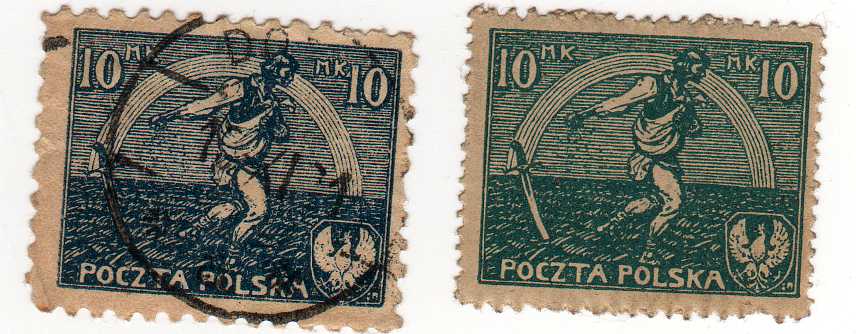
Ooh boy -"Perhaps the most complicated stamp issue of all time" is how James Mackay introduced an article on this little set of stamps.
First, a bit of history. The Poles stopped the Bolshevik westward advance at Warsaw on Aug. 14 1920 by decisively defeating the Red Army, & a peace treaty was signed between the two at Riga, Latvia, on Mar 18 1921
The Poles decided to commemorate this with a set of 3 stamps all having a common design of a peasant sowing a ploughed field. On the left, a sword stuck into the earth symbolising the relinquishment of warfare. A rainbow behind portending better times, & the Polish eagle on a shield completing the design. The 3 values of 10, 15 & 20 Marks were issued sometime around May 1921, although the exact dates are unknown. The 10 & 20 Mark values were reprinted from smaller dies in 1922. For some reason Scott does not list the smaller dies.
Sower "Peace With Russia" Fischer 125-127, Scott 154-155A
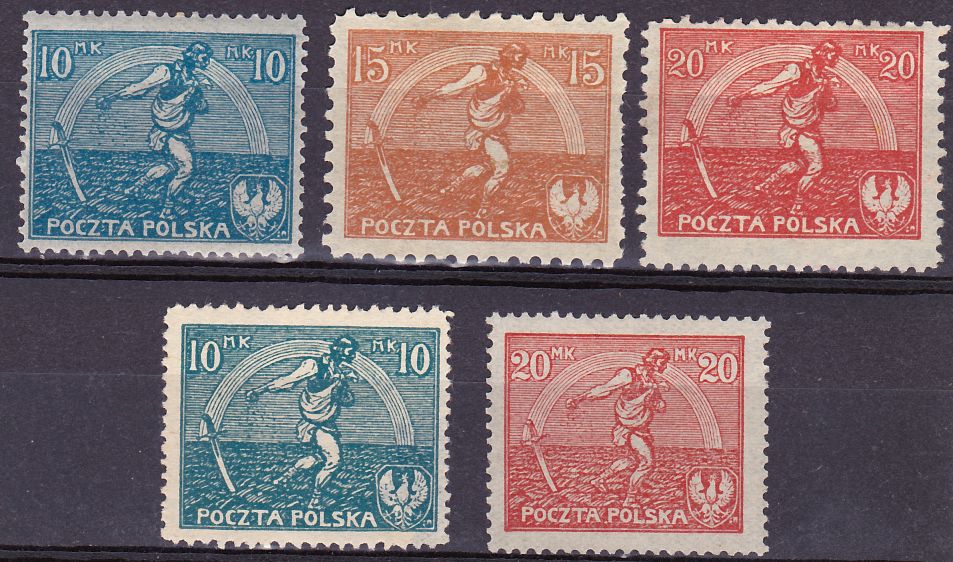
The 10 Mk value is the most complex. Of the larger first die (28x22mm) there are 7 colour, 4 paper & 33 perf varieties listed, not in all combinations but nevertheless a bewildering amount.
Colours listed in the Polish catalogues are - matt dark blue, dark blue, blue, light blue, grey blue, greenish blue, & something called 'bladoniebieski' which translates as 'periwinkle-blue'.
Papers are listed as - vertically laid, white wove, bluish wove & thin.
The perforations are going to give you nightmares & range in combination between 9 & 14.5. All the Polish definitives from 1919-1924 have numerous perf varieties. In an article on Austrian machines used on Polish stamps, reference is made to two workers who were tracked down & reminisced about helping transfer 20-30 old Austrian perforators to Warsaw in 1919. Some were pedal-powered, others, more modern electric ones. One of the workers stated "...as far as I heard, Czechoslovakia got better quality machines & more modern..."
The smaller die (27.2x21.5mm) is much easier, only two colours - greenish-blue & dark blue, two papers - white wove & thick spongy, but 45 perf combinations are listed, again between 9 & 14.5.
THAT'S THE EASY PART.
There are 5 sub-types of the larger die of the 10 Mk. depending on how the rays in the rainbow meet, or are cut away from, the face & the hilt of the sword. This, on top of all the colours, papers & perfs...
The 15 & 20 Mk values are somewhat easier re. colours & papers, but just as bad re perfs (no sub-types here though).
To finish, a couple of single uses of the 10 Mk which was the Polish domestic letter rate up to 20 gms - Sept 1 1921- June 30 1922
Jan 1 1922 Kowel to Lublin, on military matters - Large die
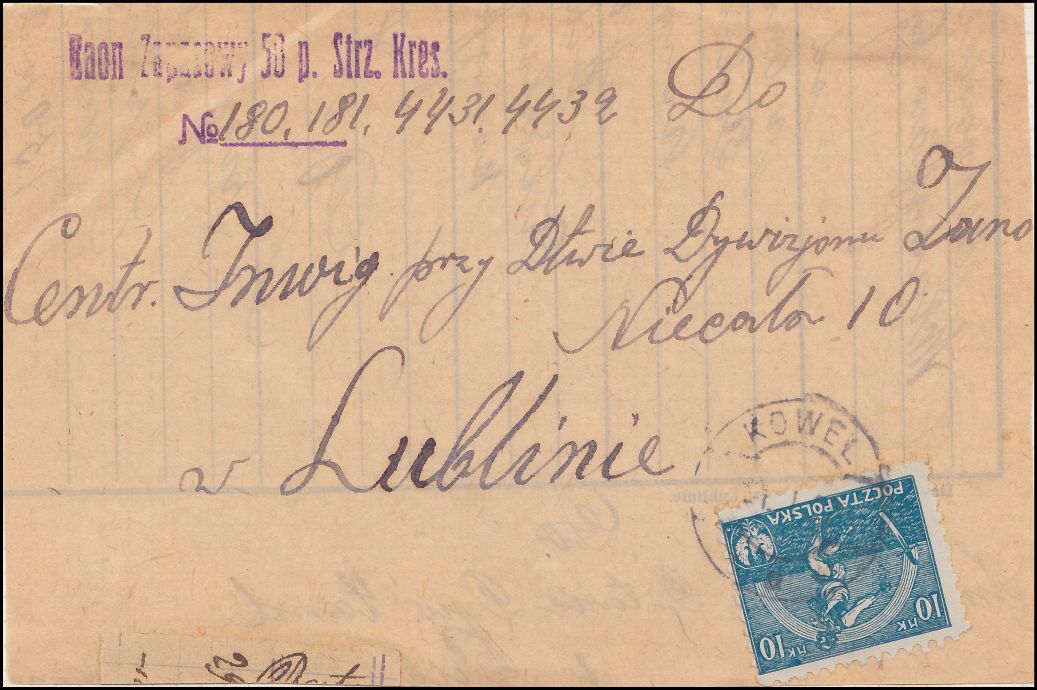
June 19 1922 Lodz to Warsaw - Small die
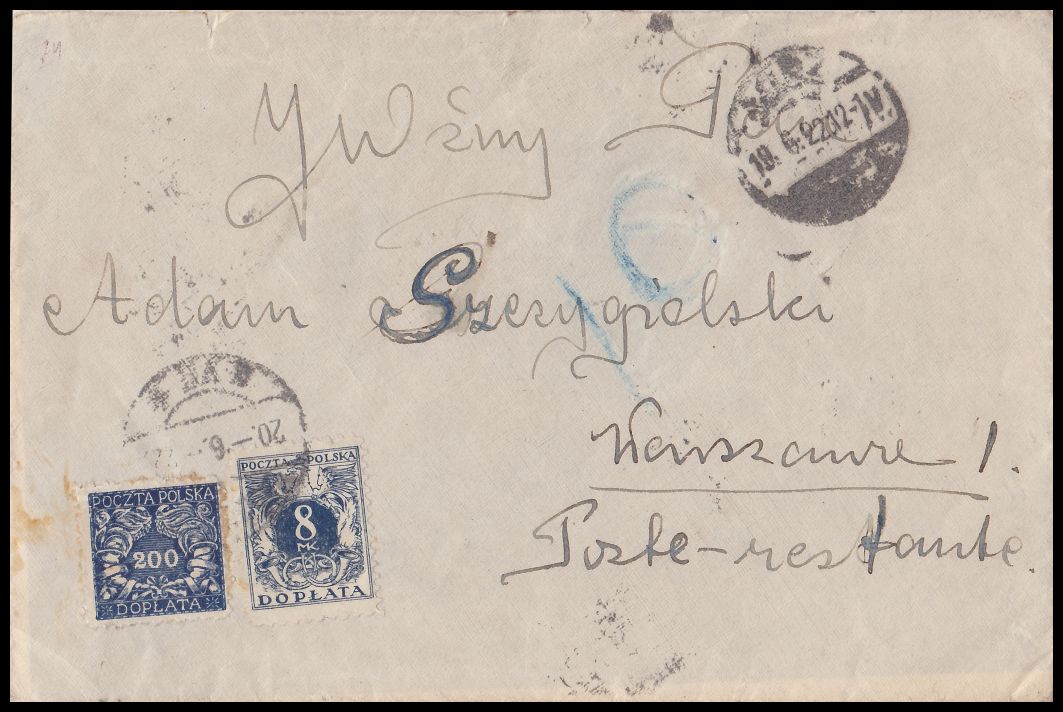
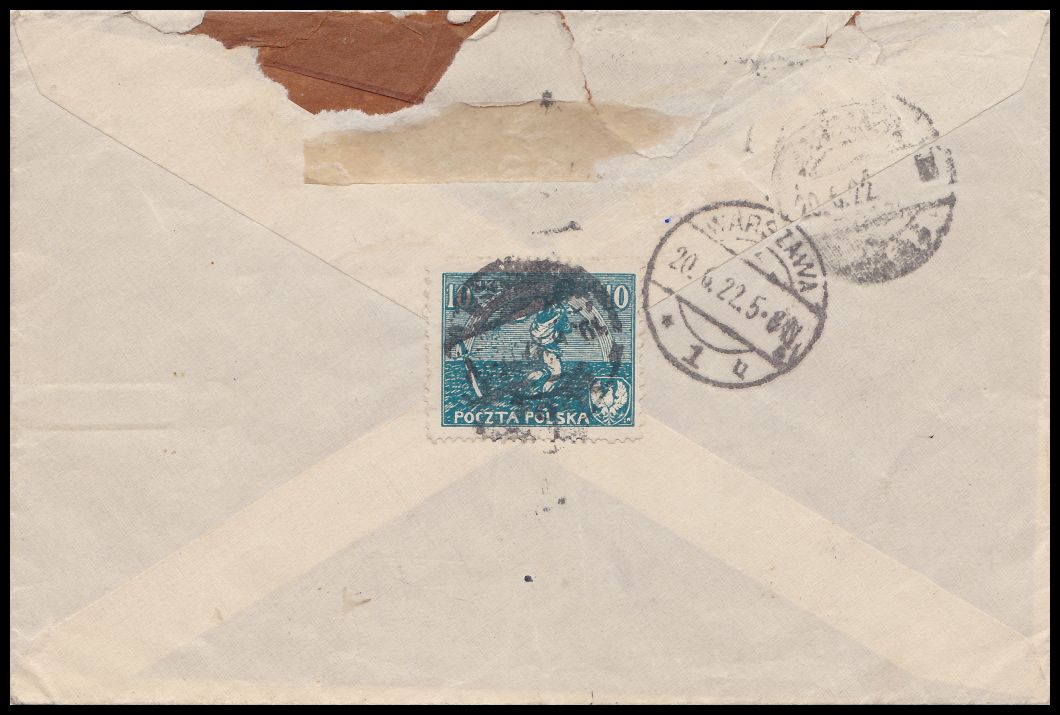
Note that the 10 Mk Postage-Due (Doplata)is not for deficient postage but rather the Poate-Restante fee





 Posted 05/04/2016 11:26 am