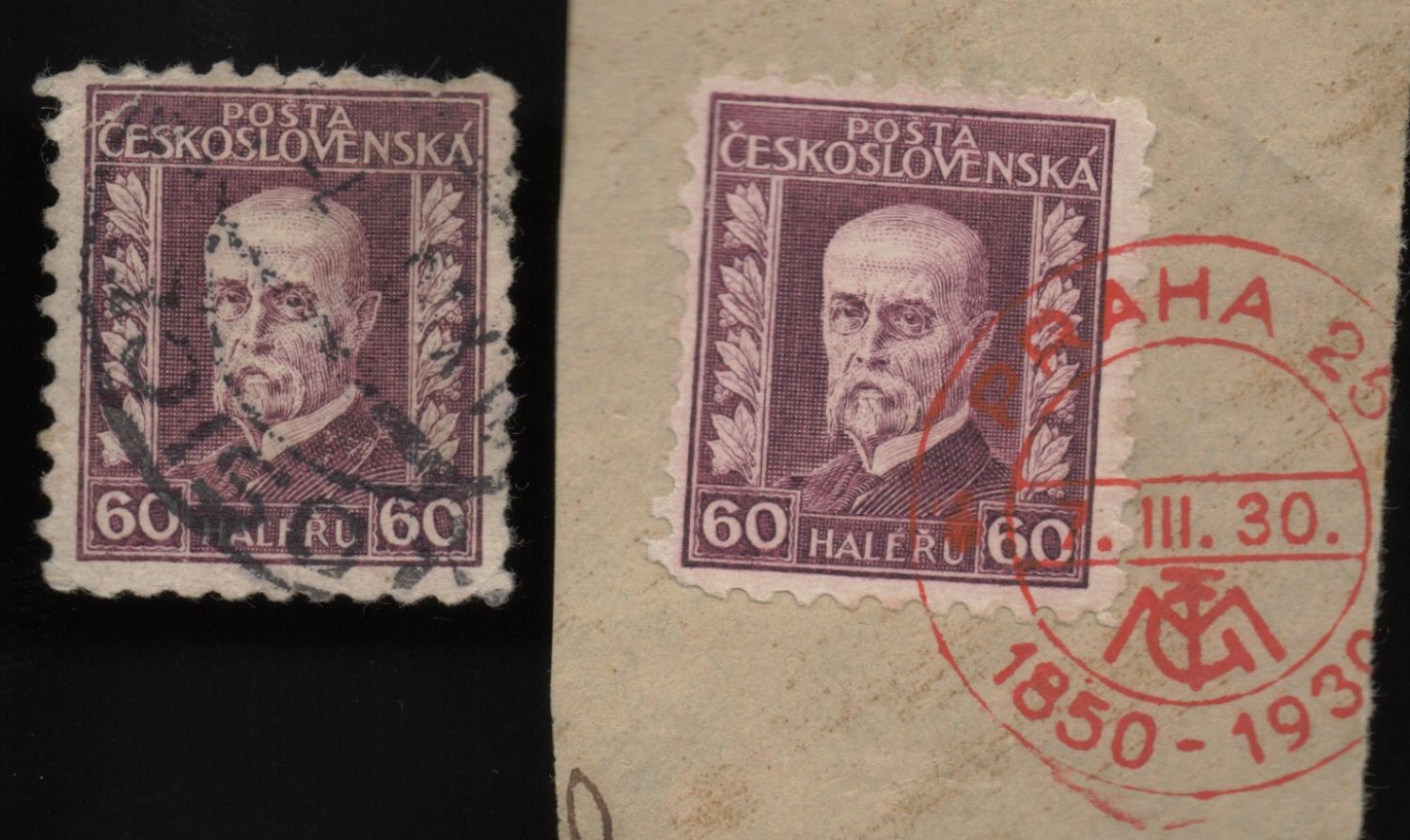
Hi Peter & Tim, thank you for your answer. I had to translate some thing for you guys so it toke me some time... I think there is difference between the two stamps in side perf and in size
This's from the Czechoslovak catalog I have.
Issue stamps were reported provision no. 67 VMPT no. 10 dated 26 June 1926.
Payout signs after 50 h (green) and 60 (purple) with a picture of President of the Republic TG Masaryk, issued March 7, 1925, have until now been manufactured caused two sizes of depth (neotypií).
After July 1, 1926, these stamps manufactured similarly postage stamps denominated values stamping from deep in the American rotary press.
Ignoring different method to the design (formerly neotypií - now recess) differs new adjustment pattern marks by editing existing substantially by numerals (50, 60) indicating the value, are white in the color field (label) and the flange sought is a straight line, whereas the existing regulation marks (neotypické) have a colorful figure in the white box and trim forms a wavy line. Printed new stamps surface forms a vertical rectangle of 22 mm x 18 1/2 mm, paper is white with a water mark (linden leaves) and serrations 10th
It should be noted that the dimensions given in the tables are the average of the measured values with a tolerance of up to + - 0.1 mm.
Regarding the value of 50 h , it is known in two types : I. and II. Here it should be noted that the image of the mark by II . Type is substantially different than the type I , whose size is 18.6 x 21 , 7 mm. The image size at II . type is about 18.9 x 22.0 mm .
The stamps were withdrawn from circulation in the provision no. 8 VMPT no. 6 dated 11 February 1937 and on 28 second 1937. The period of validity was 15th 3rd 1937th
printing stamps
The stamps were printed both in adjusting sheet, both in adjusting roll (only the value 50h) rotary stamping machine Stickney.
First values were printed mark 50h is always in the form of two-platen 200 pieces (20 x 10). Marking plates was carried out by conventional Arabic numerals (1,2,3 etc.), with the first sheet and the numeral with the letter A in the second plate (1A, 2A, 3A, etc.).
Already after 50 hours of printing type it was released in coils, used exclusively slabs labeled 2, 2A. Those tic plate designation, however, was the production of coils cut off, so the marks do not occur or only a tiny part. These two values are printed on paper with watermark.
The same signs, that is. 50h (only in drawing II. Type) and 60h, accompanied by a sign value of CZK 1 with slightly altered artwork underground labels were issued again a year later, on paper without a watermark.
Regarding the number of ingestions plates can be in this publication to determine because of prior findings exactly.
manufacturing defects
Manufacturing defects are frequent in this edition . We divide them like the previous release to the press and others.
To print defects include those which arose during printing on sheets parts of a number of colored spots and blurred colors , especially in the value of CZK 1 and 50h . These print imperfections were largely captured control , yet in a small amount given to the postal counters. Double prints , printing plates or defects retouching is absent.
The other defects include some minor imperfections in the serration .
Thorough inspection has not released this edition stamps sheets with perforations very imperfectly. Found only signs skipped one or two perforation holes , which was created by breaking the perforation needles . It occasionally appears omitted vertical serration with plate number.
color marks
Prominent colors are not known. There are only marks with greater or lesser color saturation for all values, but especially at 60h and 1 CZK.
Paper, gum, watermark, perforation
The paper is usually somewhat porous, white, colored and often slightly colored paint marks. Rarely occurs in the value 50h and thick paper.
Better signs are usually yellow. you marks on paper with watermark is better smooth, whereas later issued stamps, printed on paper without a watermark, we find better, not only smooth, but with a known vertical striations, similarly as stated in the previous release also marks printed rotary stamping. We can therefore speak of the same banding, which sometimes has a different, albeit slight change in the thickness of the striations. Quite often it happens that vertical stripes are not entirely clear. In terms of the number of occurrences are signs without any traces of lanes ranked a little higher.
Besides stamps issued on paper without a watermark, the watermark is found only in the horizontal position both at 50h (I and II. Type) and 60h in all four positions.
According to the rarity of the position of the watermark No.5 and 6 II. Type significantly more sought a position no. 7 among the rare, especially for those marks in MNH condition.
|





 Posted 07/10/2016 3:36 pm