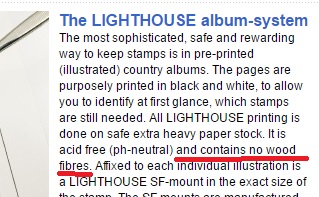
Cheap albums use cheap paper. Cheap paper, even if is marketed as 'acid-free' is a fools' errand. You get what you pay for, archival paper is expensive.
Advertising paper as 'acid-free' is a lot like the marketing of food as 'all natural'. There is no industry standard for 'acid free'; paper manufacturers use the term 'acid free' simply because they do not add any acids during the production process and/or add some Calcium Carbonate for buffering. How much they add, how 'acid free' the paper really is can be anyone's guess. Throw a bit in there, and you can sell it as 'acid free' paper.
Paper, like water, has the ability to hold buffer in reserve. As time and environmental conditions evolve, the buffer that is held in reserve can be drawn upon to neutralize the paper. It might be able to neutralize the paper for 10 years, it might be able to neutralize the paper for 1 year. And the ability to neutralize is impacted by the environmental conditions. If there is high humidity and temperature conditions, or if there are large variations and swings in the temperature and humidity, the need to consume the remaining neutralizing buffer reserves is much greater.
You can also find a large amount of paper marketed as 'acid free' even when it includes recycled wood fiber! Any time you have wood fiber in the paper it means that there is pulp and the resulting Lignin. Lignin is the 'stuff' (organic substance) that binds cells and fibers in wood. It is the source of the acid. If you have Lignin in the paper, you have the potential to produce acid over time.
This is the fallacy of acid-free paper marketing; how much buffering a paper may contain to neutralize the acidic Lignin organics is undefined. The paper can also still contain a substantial amounts of Lignin. Simply using a paper that is sold as 'acid-free' and thinking that you are covered for decades is foolish. This is especially true if you purchased the cheapest acid-free paper you could find.
I think that if a person wants true archival paper they should look for paper buffered with at least 2-3% calcium carbonate, has a cotton content of 25% or greater, and should only contain high alpha cellulose pulp from purified wood fiber (contains no Lignin). Then store albums and stamps in environmentally controlled areas. Heat and moisture accelerate the chemical reactions that cause paper to deteriorate, and high moisture levels can result in mold growth. A cool, dry and stable storage environment is paramount; temperatures should be held at a constant 70°F with a relative humidity held between 30% and 50%.
To learn more you can check out these links
http://www.loc.gov/preservation/care/paper.htmlhttp://www.niso.org/publications/tr/tr01.pdfDon
APS #094826





 Posted 08/07/2016 07:05 am