| Author |
 Replies: 11 / Views: 4,186 Replies: 11 / Views: 4,186 |
|
|
Valued Member
United States
16 Posts |
|
|
I found these among my grandfather's stamps. I've found a number of similar stamps at the mystic stamps site, and I gather that very subtle differences can make a big difference in value. Along the edge of each you'll see part of a grid whose lines are 1/2 cm apart, if that helps. I'd love any info you can give, both about the stamps and about how to discern those subtle differences, as he also had a number of other early stamps whose design was apparently used in a number of issues. (My guess is that none of them are the high-value issues, since he never mounted them.) Thanks! 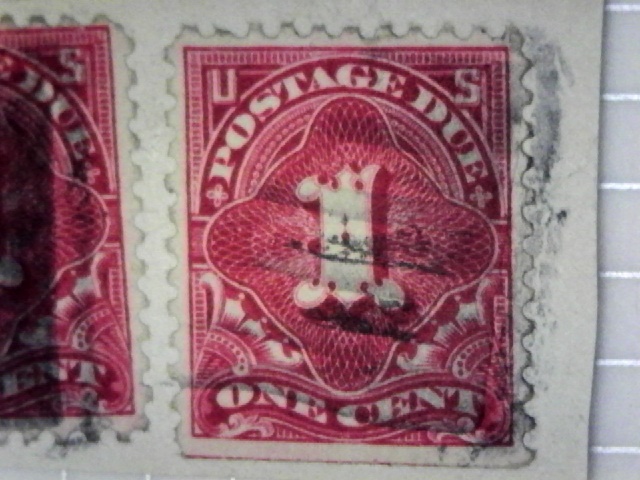 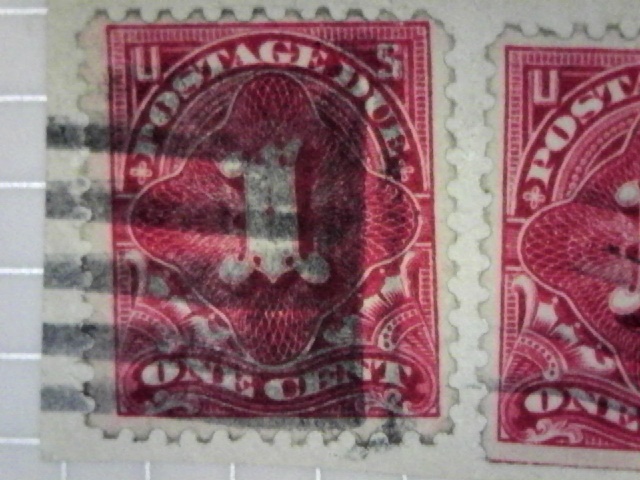 *** Moved by Staff to a more appropriate forum. *** *** Moved by Staff to a more appropriate forum. *** |
|
Send note to Staff
|
|
|
|
|
Pillar Of The Community
United States
8956 Posts |
|
|
Twslisa, one of the best ways to go about this is your local library. They probably have a Scott catalog and that book lists all of the different issues and printings of the older stamps.
Peter |
Send note to Staff 
|
|
|
Valued Member
United States
254 Posts |
|
|
Valued Member
Canada
110 Posts |
|
|
That second link is extremely helpful in identifying some of the US stamp varieties. Thanks so much for posting it Aurora! |
|
Send note to Staff
|
|
|
Valued Member
United States
254 Posts |
|
|
Pillar Of The Community
United States
532 Posts |
|
|
Valued Member
United States
16 Posts |
|
|
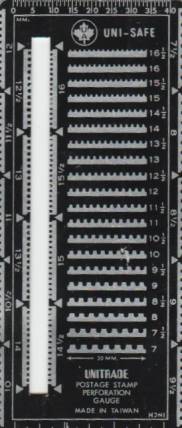
Yeah, I will probably eventually cave in and get one. For now I downloaded a PDF with a scale perforation gauge.
But it sounds like with these the only way to tell will be watermarks. Which leads to another question: with a used stamp that is affixed to the paper, how the heck would I see if there's a watermark? |
|
Send note to Staff
|
|
|
Pillar Of The Community
United States
6668 Posts |
|
|
For used stamps still on an envelope (cover in the collecting world) there is no way to tell for sure. I have heard that a signascope (device used for watermark identification) can be accurate for stamps on covers but I can neither confirm or deny. The other ways are by dates on the cover or shades of a particular stamp, these can help determine exact stamp through the process of elimination. |
|
Send note to Staff
|
|
|
Pillar Of The Community
United States
850 Posts |
|
|
This design for this denomination was used on J29, J31, J38, J45, J52, J59, and J61. It doesn't look like perf 10 or 12. Therefore are most likely perf 11 - J61. |
|
Send note to Staff
|
|
|
Bedrock Of The Community
Australia
38679 Posts |
|
|
Learner driver. This 1c I presume J70 postage due. Is the squiggle under the Left hand Value tablet an EFO? or a plate flaw? Thank you. 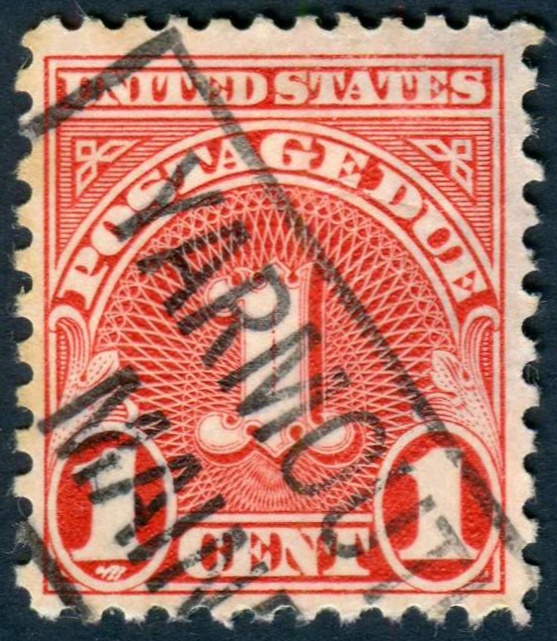 |
|
Send note to Staff
|
|
|
Pillar Of The Community
6366 Posts |
|
|
Rod, You mean the perf 11x10.5 J80. This appears to be a "dry printing" of the very late 1950s, noted by the bubbly appearance of the ink, especially in the ovals around the bottom numerals. I would attribute the inking on your stamp to poor ink adherence. An oddity and not a constant variety. |
|
Send note to Staff
|
|
|
Bedrock Of The Community
Australia
38679 Posts |
|
|
Thank you John.
I didn't check the guage, my bad.
Too impatient to query the EFO.
Your advice on my album page.
|
|
Send note to Staff
|
| Edited by rod222 - 06/15/2020 7:46 pm |
|
| |
Replies: 11 / Views: 4,186 |
|



 Posted 11/13/2016 07:52 am