| Author |
 Replies: 14 / Views: 2,730 Replies: 14 / Views: 2,730 |
|
|
Valued Member
United Kingdom
18 Posts |
|
|
|
Greetings fellow Stampers, what does this fine community think about Mint Hinged Stamps?
I am in the process of listing my World collection on an Excel spreadsheet. As well as other headings, I have 3 condition headings: "Mint, Mounted Mint & Used. Mint to me is "Post Office Fresh".
I am in 2 minds whether to list the MH, MM stamps. How do you value these? I was thinking that the way to go was to average the catalogue price of the mint & used price. Any thoughts?
Regards,
Lee.
|
|
Send note to Staff
|
|
|
|
|
Pillar Of The Community
United Kingdom
8632 Posts |
|
|
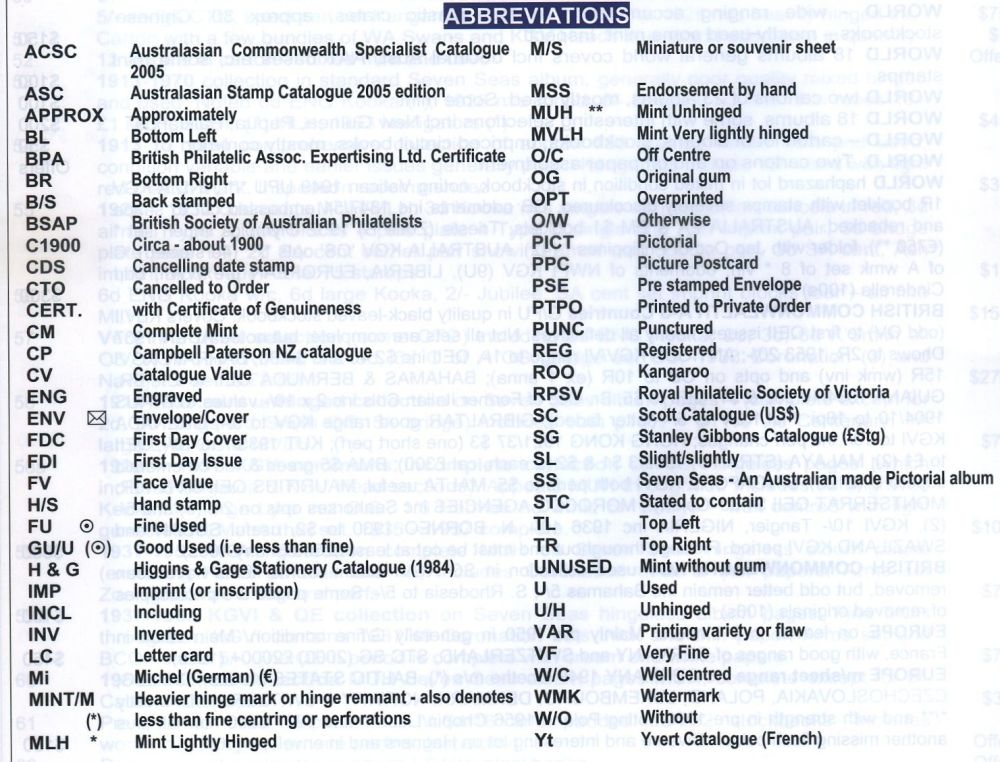
You could use catalogue symbols, where ** is unmounted mint (UM or UMM), * is mounted mint (M) and (*) is unused, no gum. As to CVs, it depends on the period. Different catalogues start listing only UM from different points - eg SG (I think) from GVI for Commonwealth, Yvert from independence for French Colonies. Halfway between UM and used seems a reasonable compromise, unless the used is worth more! Earlier material can have bigger variations between UM and M. |
Send note to Staff 
|
|
|
Pillar Of The Community
United States
2055 Posts |
|
|
Valuing mint hinged vs. never hinged depends quite a bit on the area and era. Averaging NH and used probably isn't a good rule of thumb - some stamps are worth more used than mint, for example. Also, "classic" NH material may sell for multiples of up to 5-10x the hinged price (or even more), whereas for more modern material it may be well under 2x. If you're talking anything of real value, you really need to use catalog pricing (or a fraction thereof) at some point as the premium for NH can vary a great deal. There really isn't a simple rule of thumb you can use in all circumstances. |
|
Send note to Staff
|
|
|
Moderator

United States
12330 Posts |
|
|
I would use one column for catalog value; you may update this over time with new catalog prices. I would use another column to list mint/used. And another column hinged/not hinged. The last column in the sheet would be a Excel formula based upon the other columns. This column would reflect any increase or decrease over catalog value from the other columns.
And of course if you wanted to get more detailed you could also add columns for condition/grading which could also be accounted for in the calculated formula column.
But the key to keep columns separate so you have the most flexible and options for years to come.
Don |
|
Send note to Staff
|
|
|
Pillar Of The Community

United States
1951 Posts |
|
|
I would opt for classifying stamps as mint, mint hinged (or mounted mint). and used.
Jack Kelley |
|
Send note to Staff
|
|
|
Valued Member
135 Posts |
|
|
You are forgetting the most important column, what you paid for the stamp. That is ultimately what it is really worth. |
|
Send note to Staff
|
|
|
Pillar Of The Community
United States
1043 Posts |
|
|
When I first came on this forum, I was criticized for using the term "mint with no gum" or "mint previously hinged" or "mint hinged". It came to my attention that Scott doesn't use these terms either. "Mint" means mint never hinged. Only exception is mint NGAI. Otherwise stamps should be labeled "unused" if they lost gum or hinged? Perhaps worldwide collectors use different terminology and the use of the word "mint" has a broader scope? |
|
Send note to Staff
|
|
|
Bedrock Of The Community
Australia
38679 Posts |
|
|
My own personal standard, I like the terminology MUH (Mint Unhinged) or MH (Mint hinged) and USED
As a WW collector, I do prefer the stamp face unmarked, yet the back has no relevance, unless a "thin"
I can understand others preferring Mint as Mint.
I have come across one lately HR on a scan "Hinge Remnant"
|
|
Send note to Staff
|
|
|
Pillar Of The Community
United Kingdom
8632 Posts |
|
|
rg
If you look at a UK auction, you'll see that the auctioneer differentiates between UM (or UMM) and M, which is taken to mean previously hinged, as well as unused (usually meaning no gum).
Geoff |
|
Send note to Staff
|
|
|
Pillar Of The Community
United States
1043 Posts |
|
|
Geoff, are you saying there is different philatelic terminology in USA collecting versus British? |
|
Send note to Staff
|
|
|
Pillar Of The Community
United Kingdom
8632 Posts |
|
|
Some of the terms themselves obviously differ - eg "unmounted mint" versus "mint never hinged" - but some of the differences popping up here seem to reflect personal preference. And the terminology has changed over time. An old Gibbons catalogue would imply refer to unused or used. I don't think it matters as long as, when selling, people clearly define their terms. |
|
Send note to Staff
|
|
|
Bedrock Of The Community
Australia
38679 Posts |
|
|
Moderator
United States
12330 Posts |
|
|
In the StampSmarter Glossary the term ' Mint' is defined as Quote:
A stamp in the same unused condition, including full gum, in which it came from the post office. "Mint" is casually, and incorrectly, used to include stamps with disturbed gum, with signs of previous hinging, and even with yellowed or toned stamps. It is often used as a synonym for "not cancelled" or "not used", although that is clearly not the literal meaning. On the APS site the term ' Mint' is defined as Quote:
A stamp in the same condition as originally issued. This means it has its full gum and has not been hinged. In this forum Glossary (link above left of this page) the term ' Mint' is defined as Quote:
A stamp in the same state as issued by a post office: unused, undamaged and with full original gum (if issued with gum). Over time, handling, light and atmospheric conditions may affect the mint state of stamps. Many philatelic words and terms have differing definitions depending upon the source and/or the time when it was used. A good example is the name used to describe ink on the back of stamps picked up as they were stacked still wet. The words 'offset' or 'setoff' are used interchangeable. And philatelic abbreviations and acronyms also have differing definitions depending upon the source. Not really helpful to newer hobbyists but I guess its is just something that everyone has to deal with. Don |
|
Send note to Staff
|
|
|
Pillar Of The Community
United States
1043 Posts |
|
|
Very helpful Don... I just wanted to chime in because some forum members pointed out to me the "proper" definition of the term "mint" to me early last year. I have found that Scott uses term "mint" only for stamps that are unused original gum and never hinged. High end auction houses also only use the term "mint" in this select scenario or the uncommon mint NGAI. Some "not so high end" auction houses use the term "mint" very loosely.....for every unused stamp without cancel regardless of gum condition etc!
I saw this thread and noticed different set of terminology. I guess personal preference rules but it seems terminology changes depending on specific country that we are collecting and what part of world we live in. |
|
Send note to Staff
|
|
|
Pillar Of The Community
United Kingdom
8632 Posts |
|
| |
Replies: 14 / Views: 2,730 |
|



 Posted 12/06/2016 01:34 am