| Author |
 Replies: 286 / Views: 51,682 Replies: 286 / Views: 51,682 |
|
|
|
Valued Member
Norway
451 Posts |
|
|
dudley - I need a little more help than that. You are responding to a slightly autistic person, so please be more direct. Are you hinting that the stamp is more likely a Plate 2 and not a Plate 3? If so, what makes you think that this might be the case? I don't take any expertizing entity's opinion as absolute proof, but this stamp does have a PF cert (#452388) that calls it a Plate 3. I also thought the dark blue color and the fairly pronounced ink film made it highly probable that it is a Plate 3 even if it can't be plated. I narrowed my search by measuring the distance between ornament "L" and the stamp on the right. It is 1.0mm, and allowing for a 0.1mm margin of error, I concentrated on vertical rows 1, 3, and 5 on the left, and rows 7, 8, or 9 on the right. The alignment of the stamp on the right is what I believe Ashbrook would call even or slightly lower, so I eliminated vertical row 3 on the left pane. The problem is that the guide dot on my stamp doesn't match with Ashbrook's description for any relief "B" stamp in any of these vertical rows. I tried looking at Plate 2, but there isn't a single vertical row in either pane that satisfies the spacing and alignment of my example. 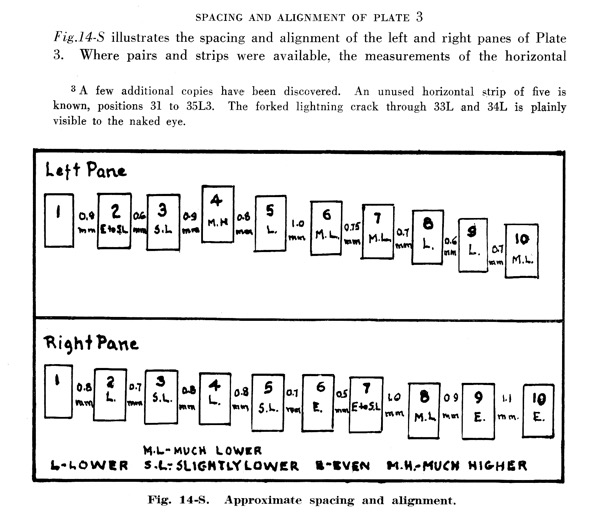 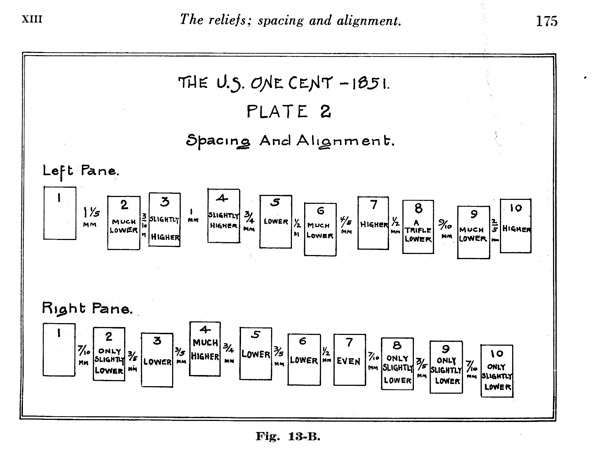 |
Send note to Staff 
|
|
|
Valued Member
Norway
451 Posts |
|
|
It helped me to go through the process of elimination again. I found a good match at 25L3. I hopped over this position in my initial search, because the Neiken diagram doesn't show a guide dot here. This was proved to be incorrect by the 24-26L3 strip in the Wagshal collection. Doporto makes mention of this, too. 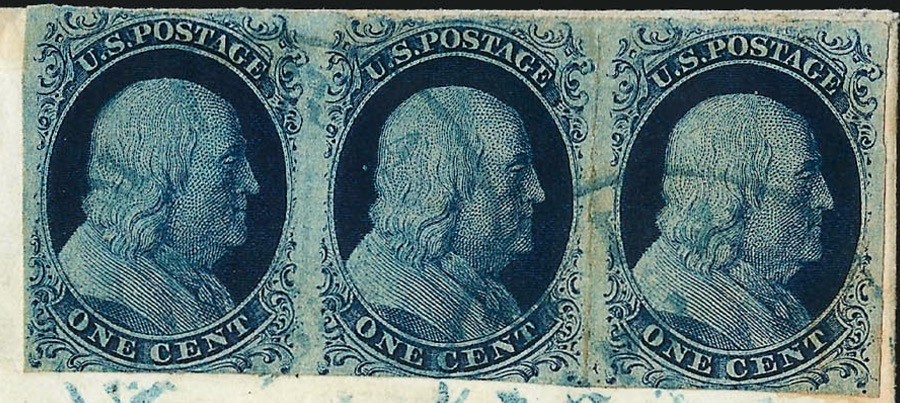 |
|
Send note to Staff
|
|
|
Pillar Of The Community
United States
1820 Posts |
|
|
Sorry, widglo, I thought you were asking for a nudge. Check out position 63L2 at the Doporto site. |
|
Send note to Staff
|
| Edited by dudley - 07/12/2021 1:05 pm |
|
|
Valued Member
Norway
451 Posts |
|
|
dudley - A nudge is fine, and I welcome any input you can give. I'm always especially interested in hearing an expert's approach to plating. It is helpful, too, to learn of any corrections or plate marks that have been added to the Neinken maps.
I eliminated 63L2 because of the vertical row alignment with 64L2. 64L2 is slightly higher than 63L2, while the small portion of the stamp visible on the right margin of my stamp is aligned significantly lower. I know 25L3 doesn't match all of the plate marks in the Neinken book, but judging from my limited experience, that seems to often be the case. |
|
Send note to Staff
|
|
|
Pillar Of The Community
United States
1341 Posts |
|
|
Sorry Widglo46, I agree with Dudley that the stamp is 63L2. Your stamp is rotated 0.72 degrees clockwise which gives you an inaccurate height of the stamp to the right. Your stamp has the correct plating marks of 63L2. Position 25L3 does not have the two plating marks shown and the guide dot is covered by an ink blur on 25L3. 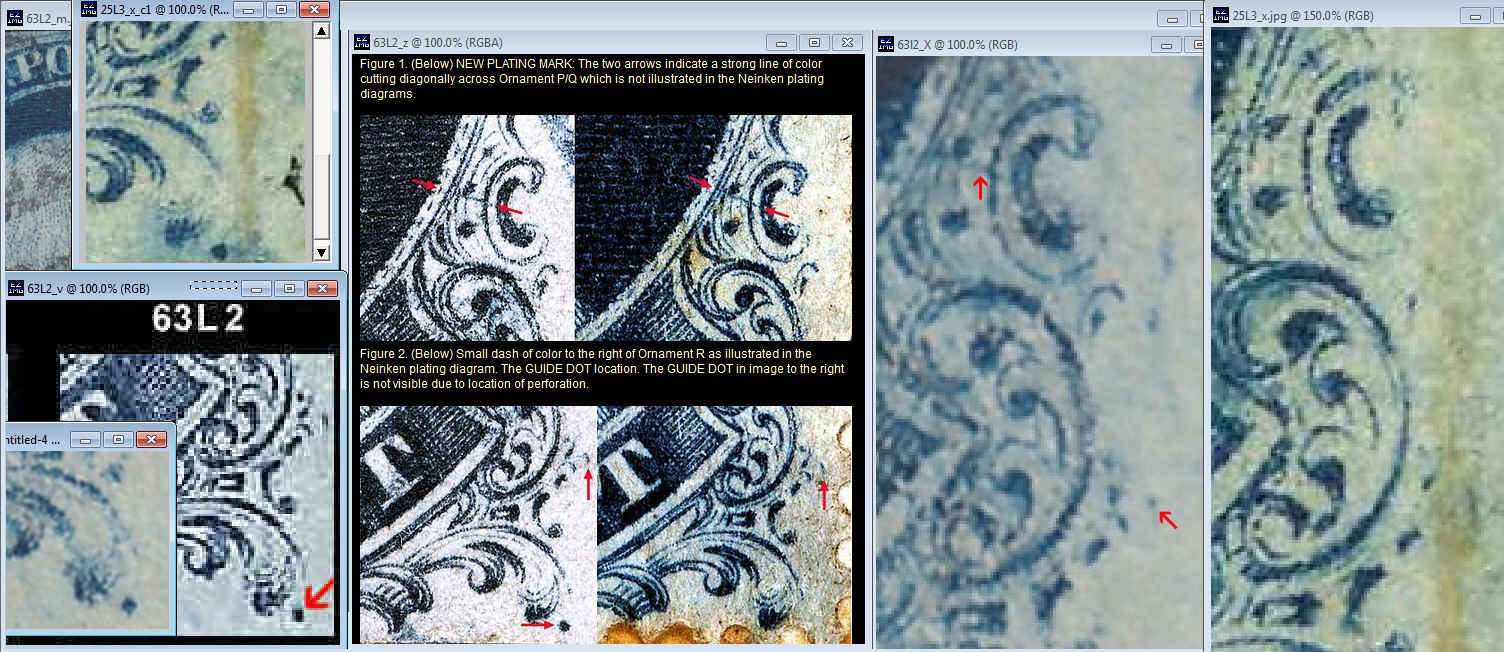 |
|
Send note to Staff
|
| Edited by jaxom100 - 07/11/2021 3:12 pm |
|
|
Valued Member
Norway
451 Posts |
|
|
jaxom100 and dudley - How could I ever have questioned pros? I'm humbly convinced - 63L2 is surely correct. The diagonal plate mark between ornaments "P" and "Q" clinches the case for me. It is not only on the used example on Doporto's site, it can be clearly seen in the Ex. Neinken and Wagshal block of 24 (Siegel sale 1216, lot 54). I studied the Siegel photograph of this block carefully because I was confounded by Fig. 13-B in Neinken's book that labels vertical row 4 as " slightly higher" than vertical row 3. Reliance on this is what led me to make the wrong plating conclusion. I think that the mistake I made was in how I interpreted the alignment. After studying the entire block, which is much easier to align vertically than a single stamp, and by aligning identical ornaments from horizontal pairs, I could determine that vertical row 4 was, indeed, slightly higher than vertical row 3. This isn't apparent, however, by just looking at ornaments "L" and "A" of respective pairs. My image of a single stamp may need a slight counterclockwise rotation to be brought into vertical (I measure just 0.4 degrees), but that isn't enough to bring the bottom of ornament "A" higher than ornament "L", which was what I mistakenly had expected. I still don't understand why Neinken measures the alignment the way he does. He illustrates his method in !!-D and 11-E, but I don't think his description of the alignment at various positions is consistent. As mentioned, he describes vertical row 4 on Plate L2 as "slightly higher" than vertical row 3. If that is the case, why don't ornaments "L" and "A" align more like what is described and illustrated for vertical rows 4 and 5 on Plate 1L which is also described as "slightly higher". In the latter example, the bottom of ornament "A" is visibly higher than the bottom of ornament "L" (see posted diagram). The other thing that I learned from studying the large block is that the distance between horizontal rows can vary slightly, and Neinken's alignment figures have to be interpreted with an understanding that the alignment may not be the same for all horizontal rows. Looking at another block from Siegel (sale 1239, lot 522), the variance is quite apparent in a comparison of the ornaments at 3L2/4L2 and 13L2/14L2 with pairs in lower horizontal rows. Thanks for help on this, and I hope I haven't been kicking a dead horse with too much detail. I'm not protesting my mistake, and it won't disappoint me too much that I was wrong about this stamp if you both tell me that my stamp is one of the rare examples of Plate 2 stamps with the dark blue ink and the ink film characteristic of Plate 3. The blue does look darker to me than any of my other Plate 2 stamps, and I can see the ink film on many areas of the stamp. Perhaps this was enough for the PF to mistake it for a Plate 3. 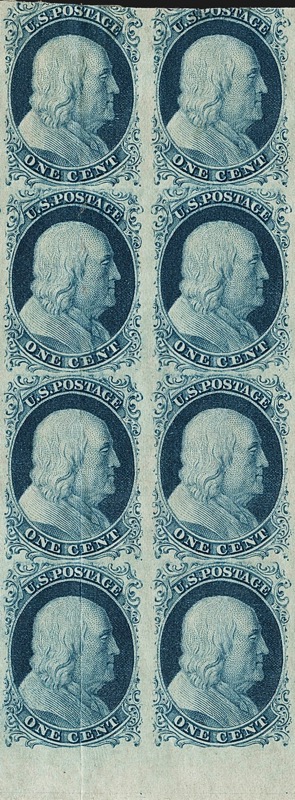 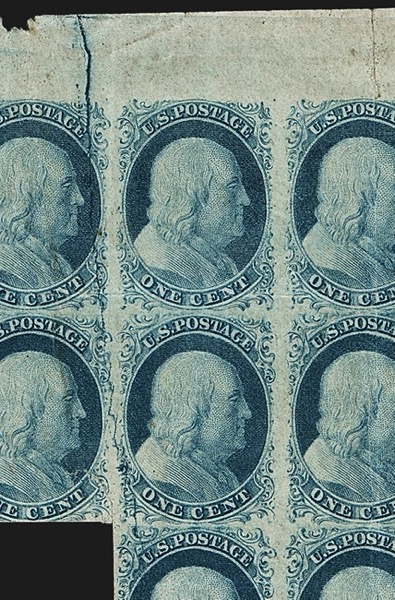 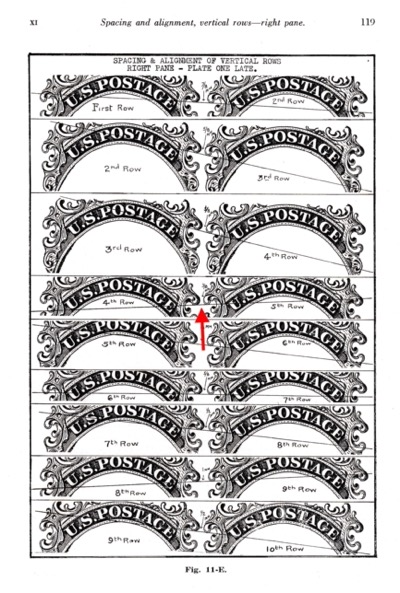 |
|
Send note to Staff
|
|
|
Pillar Of The Community
United States
1341 Posts |
|
|
Beware of any stamp, certified or not, that is called plate 3 without a position indicated. When judging stamps by the adjacent stamp height, also consider the spacing. The spacing between columns vary. |
|
Send note to Staff
|
|
|
Valued Member
Norway
451 Posts |
|
|
jaxom100 - Quote:
Your stamp is rotated 0.72 degrees clockwise which gives you an inaccurate height of the stamp to the right. You made the above point, and it begs me to question. How are you determining to within 0.01 degrees the true vertical position when you only have a single stamp to work with? I have tried to find reference points on the design that I could use by aligning the image of a large block to the point where all of the stamps are square to a grid. I then looked for reference points that were aligned horizontally or vertically on a single stamp within the block. I don't always take time to do it, but I've decided that by aligning the top of ornament "R" with the top of ornament "H", I am probably getting to within 0.02-0.03 degrees of accuracy on a single stamp. There may be a better way to do it, but I don't know how. In my experience, most stamps probably don't have impressions sharp enough to do much better than that. |
|
Send note to Staff
|
|
|
Pillar Of The Community
United States
1341 Posts |
|
|
I had issues finding the right rotation as well. Here is the points that I use to align this issue marked with the red line. 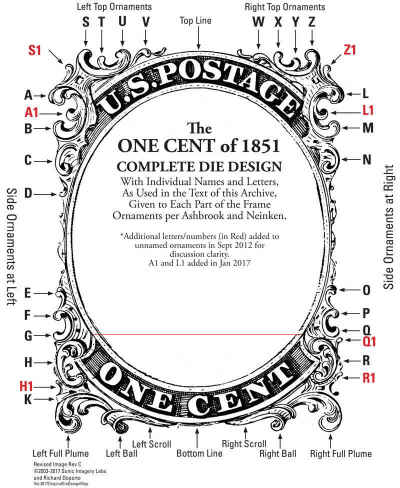 |
|
Send note to Staff
|
|
|
Valued Member
Norway
451 Posts |
|
|
Pillar Of The Community
United States
1341 Posts |
|
|
Pillar Of The Community
United States
571 Posts |
|
|
I have to say that this has been one of the most educational topics/threads that I have read in a while. The finer details of plating this issue are appreciated. |
|
Send note to Staff
|
|
|
Valued Member
Norway
451 Posts |
|
|
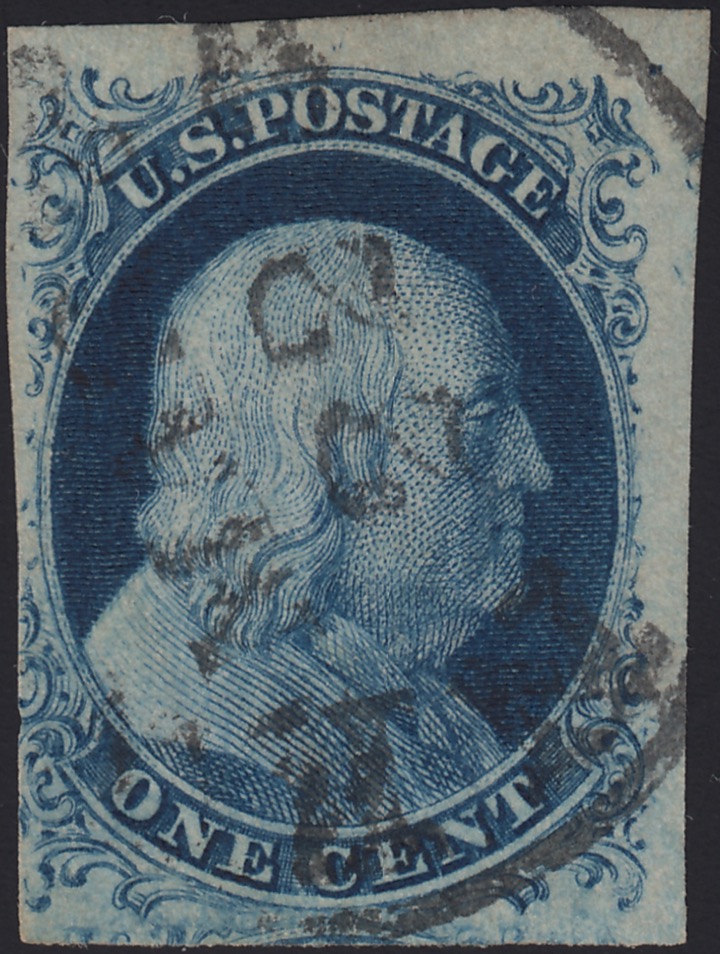
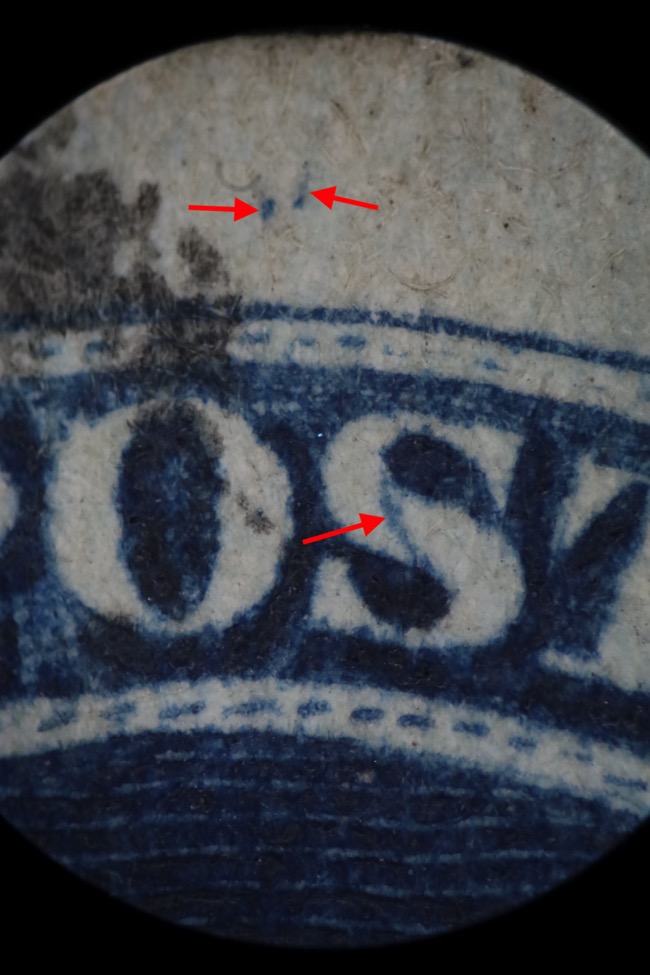
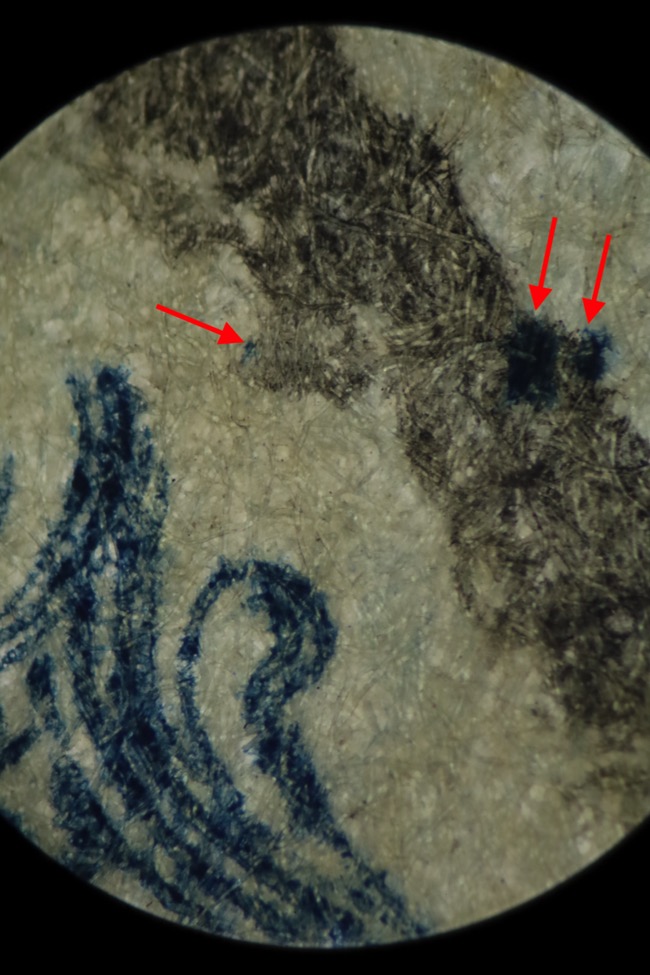
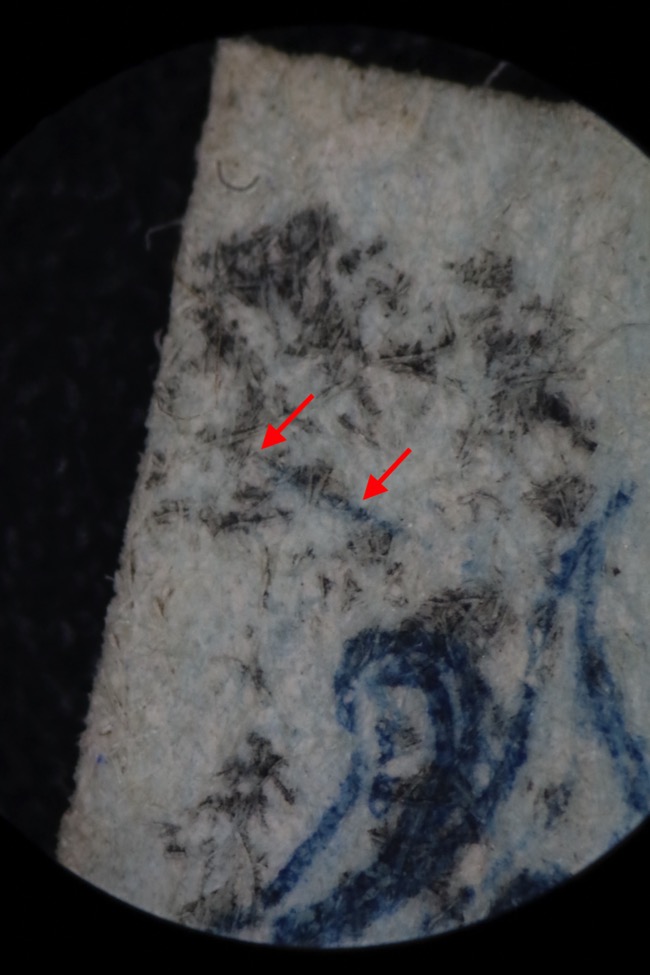
I'm a little paranoid now when I see stamps offered as Plate 3 but without a plate position, even if they have a PF or PSE cert. In their sale this week, Kelleher had a couple of Plate 3 #7's (lots 434 and 438), but I shied away from both of them because I couldn't plate them from the images in the catalog. I have another stamp that is plated as 39R3 by the PF (#164613). I don't see that the guide dot in the margin at the top right corner matches the Neinken diagram, however. It seems to me that the guide dot on the stamp above (just barely visible) is not far enough to the right for it to be from 29R3. The guide dot from 63R3 seems to be a much better match, which would make my stamp a 73R3. The problem is that none of the other plate marks for 73R3 are on my stamp. There are several relief "B" positions on Plate 2 with guide dots low enough to be visible on the stamp below. I've looked at 55L2 and wonder if it's a better match to my stamp - the blur over ornament "T" in particular. So the question is, do the Plate 3 characteristics of my stamp override the exact plating concerns? My stamp does have both the characteristic ink film and mottling (the latter at top right and bottom right), and as Ashbrook wrote, "Very early impressions from Plate 3 may show a combination of ink film and mottling. Such imperforate stamps come only from this plate." Neinken agreed. 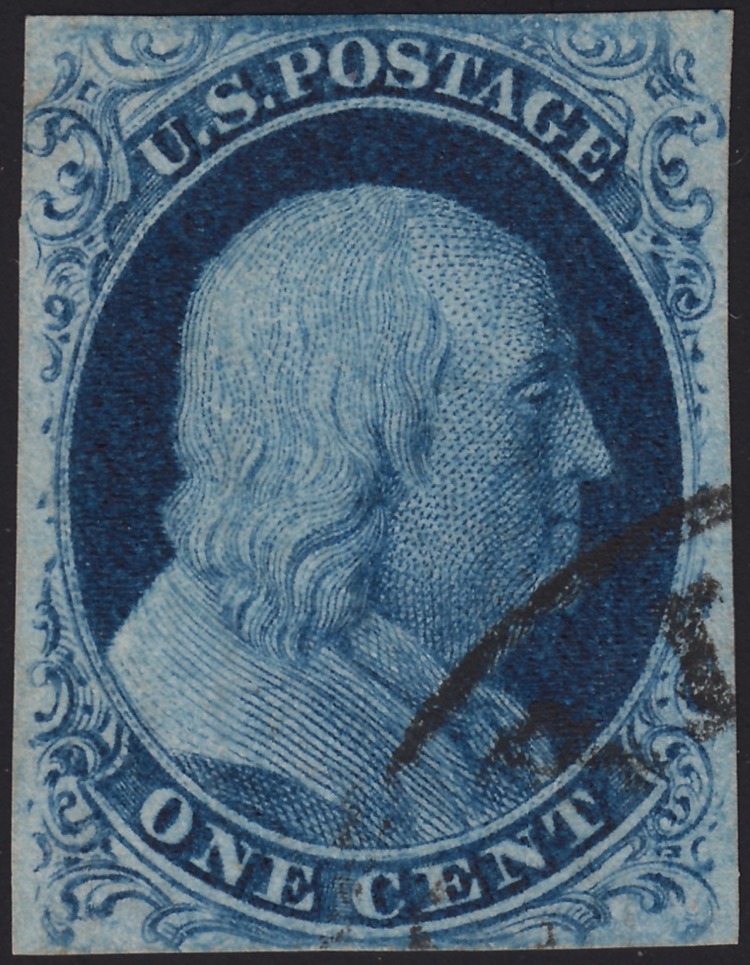 |
|
Send note to Staff
|
|
|
Valued Member
United States
103 Posts |
|
|
Pillar Of The Community
United States
3532 Posts |
|
|
The 39R3 you posted definitely needs to be "plated", so to speak. It is in the bottom image in my post referenced below, middle stamp bottom stockcard - https://goscf.com/t/52774&whichpage=6#484562I had it for some time, and was unable to verify the plating. Ron Cipolla had it as 39R3 in his collection in the 1980s, and I'm not sure who originally plated it. I always had my doubts that the plating was correct -- as I had a block with 39R3 in it, and this stamp did not appear to match. Its a pretty stamp, regardless. I was unable to definitely plate it, but the last time I tried was probably 20 years ago. We have better resources now. The stamp certainly seems to be a likely plate 3 item ... but As I know you are aware, the Dark Prussian Blue is certainly found on plate 2 stamps - a bit more often than one might think. The color was used in Nov-Dec 1856 for both plates (2 & 3). Ink film alone is not enough to separate the plates, and as you note, usually enough mottling or, of course, the fine plate cracks seen on plate 3 can be differentiators. I wouldn't 100% rule out plate 2 for this just yet. For stamps like these, often real minutia can help in the determination. Very fine scratches/blurs, etc .. that require comparison of detailed scans with a reference copy. This one may take some time to verify - but the guide dot will help. For what its worth, all platers have problem-patients in their collections. Stamps that are not easy to definitely plate. I'm sure, with enough effort, and the right resources available, this can be plated. Including or eliminating Plate 2 would be a good starting point here, since there is much more plate 2 reference material. I know you were starting to look at that anyway. |
|
Send note to Staff
|
|
|
Replies: 286 / Views: 51,682 |
|




 Posted 07/10/2021 3:28 pm