I had a similar issue with these a couple of years back
https://goscf.com/t/36095I've come up with the following brief summary:
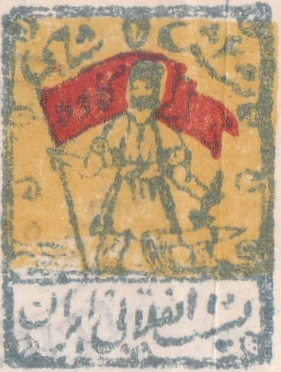
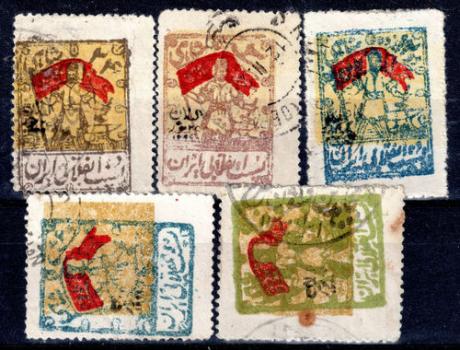
One set of stamps was prepared. They are printed by lithography on thick, white paper, existing both imperf. and either perf. 11 ½ or perf 10; the perf. gauge is somewhat variable! The designer and printer are unknown. The inscription in Farsi reads "Post Inquilabi Iran" (Post of Revolutionary Iran). The values represented are 3,6,9,12 and 24 shahis. They are also locally hand-stamped "Gilan 25 Soor 1299" ("Gilan 15th May 1920"). None have ever been recorded on cover and "used" examples are CTO with a circular canceller "Resht 62 X 21".
The stamps depict Kaveh the Blacksmith holding a red flag with his name on it. Kaveh is a symbol of unity and national resistance against despotic foreign rule in Persian and Iranian mythology.
You don't see these "stamps" too often. It begs the question, do we classify them as cinderellas or not, since the country of origin actually existed? Or are they just propaganda labels? There are a couple of other "stamps" around at roughly the same time from the Sattar Khan uprising, which were later overprinted and printed for Azadistan.





 Posted 02/16/2017 9:06 pm