| Author |
 Replies: 8 / Views: 2,266 Replies: 8 / Views: 2,266 |
|
|
New Member
Netherlands
4 Posts |
|
|
Hi, I am not so familiar with old France stamps and just started to collect. So, I really hope someone can help me. I am using the Maury Cat 2009. My questions are: 1) The catalog does not mention all of the diamond cancels with smaller and bigger numbers in the middle. Why is this? 2) I have a stamp No4 25C blue that has the diamand cancel with the smaller numbers: 2666. In the catalog it falls under Groupe 5 (L6a-5). But the catalog gives only a value of the series (L6-8 --> L6-11) and (L7-11). Does this mean there is no specific value for the Groupe (L6a-5)? Thanks in advance! 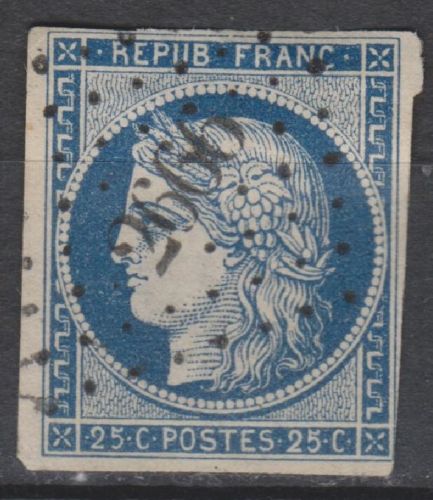 |
|
Send note to Staff
|
| Edited by smallstampcollector - 02/26/2017 07:35 am |
|
|
|
|
Valued Member
United States
259 Posts |
|
|
Maury doesn't list all postmark numbers. Most common postmarks are lumped together under "All Other" subtitle (you find it after all other postmark categories).
As to your 25c blue Ceres, look at it closely. As far as I remember, French stamps of the first issue rarely come with "petites chiffres" postmark. Could your stamp be from General Colonies later imperfs? (This is what often confuses beginners — General Colonies stamps were printed from 1870s cliches but they are imperfs.) Also, make sure your stamp is not one of the Bordeaux Ceres issues.
All this aside, I also found some postmark groups not listed for certain Ceres and Napoleon stamps. I guess these are the most common ones, yes.
Good luck with French classics! Just remember, it's not so much as a result, it's a process that matters... |
Send note to Staff 
|
| Edited by tvorog - 02/26/2017 06:24 am |
|
|
Pillar Of The Community
United Kingdom
8630 Posts |
|
|
New Member
Netherlands
4 Posts |
|
|
Wow thanks for the quick responses, however this will leave me with more questions haha.
@tvorog: it's indeed a progress, something I forget sometime :)
But what do you mean with "make sure your stamp is not one of the Bordeaux Ceres issues"? Because the colony stamps looks a lot like the the Ceres stamps from 1840s?
I have a very hard time seeing if a 25c blue Ceres is a colony stamp or not. Any clues other then checking the cancels? I have been reading about checking the shadow lines, but that's not really helpful. Type of paper that is used?
Great info: "French stamps of the first issue rarely come with "petites chiffres" postmark."
If you can provide me more tips and info that would be really helpful :)
@GeoffHa: Thanks, I will take a look! |
|
Send note to Staff
|
|
|
Pillar Of The Community
France, Metropolitan
3756 Posts |
|
|
New Member
Netherlands
4 Posts |
|
|
Pillar Of The Community
France, Metropolitan
3756 Posts |
|
|
Valued Member
United States
259 Posts |
|
|
Now that we have a picture, things become much easier to discuss.
First of all, it is France No. 4 indeed, though I would say it is 4 (blue), not a 4c (darkish blue), though it is duffucult to be sure on the basis of a scan.
Maury doesn't list the "small digits 2666" among rare cancels; therefore, it belongs to the last group L6-11 (les plus courant = the more common ones). I don't see it in the group L6-5.
Please be advised that groups of postmarks with "a" in their Maury numbers are for "petits chiffres des gros chiffres" (large digits replaced by small digits) postmark, which, as stated in Maury (unfortunately, in Italics, without any clear subtitle), came into being only in 1863, and can be identified correctly only on cover bearing a date.
Besides, I don't see "2666" postmark in L6a-5 group either (check it again, these numbers are small), and 1849-issued stamp would not be possible with a 1863-type cancel in any case.
Now, how to tell French stamps of the 1st issue from General Colonies? The easiest way is to compare your stamp with those of 1871-1875 issue (which are pretty common). If your stamp looks like it is from 1870s but is imperforate, it is from General Colonies.
However, with some experience it's becoming effortless to tell these apart, because 1849 stamps of the 1st issue are much sharper engraved, and their colors are different.
My rule of the thumb is that 1849 Ceres stamps have much more prominent, "standing out" ears of wheat on Ceres' head, with their ends much better shown in such a way that they appear closer to the frame, while the same ears of wheat on General Colonies stamps look weaker, flatter, kind of murky at their ends, and thus appearing a bit farther from the frame.
On used stamps, postmarks are also indicators of time period and of use in colonies. |
|
Send note to Staff
|
| Edited by tvorog - 02/26/2017 12:41 pm |
|
|
New Member
Netherlands
4 Posts |
|
|
Thank you for the information, I have some homework to do. As for the number 2666, sorry, it is on the list L6a-6. 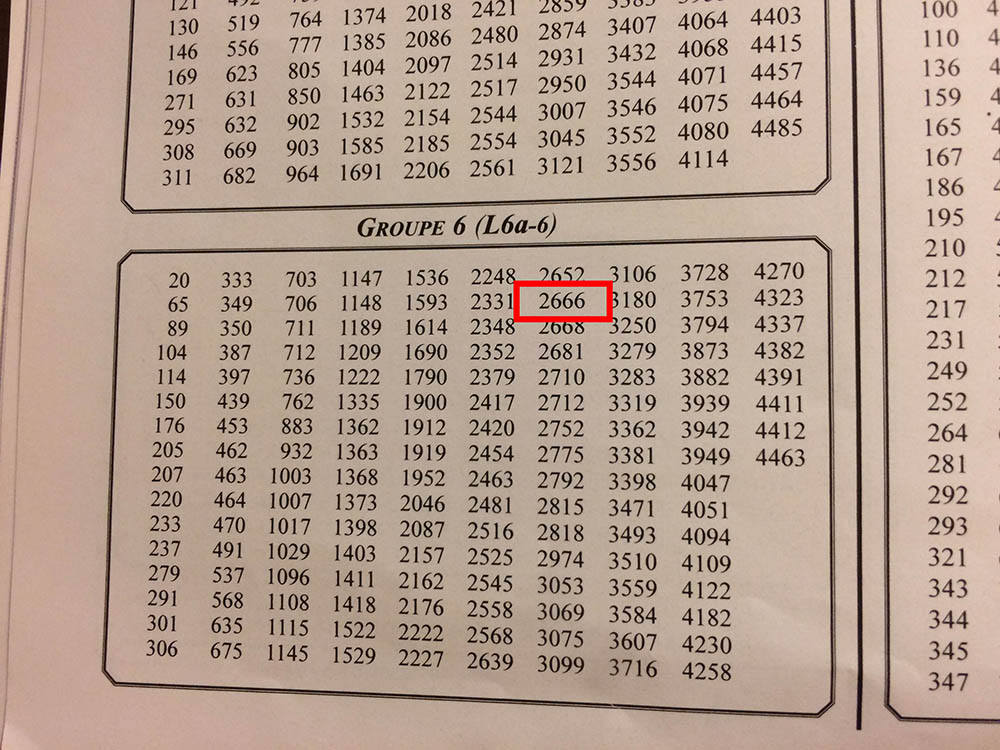 |
|
Send note to Staff
|
| Edited by smallstampcollector - 02/26/2017 3:49 pm |
|
| |
Replies: 8 / Views: 2,266 |
|



 Posted 02/26/2017 06:05 am


