| Author |
 Replies: 17 / Views: 3,576 Replies: 17 / Views: 3,576 |
|
Rest in Peace
United States
1738 Posts |
|
|
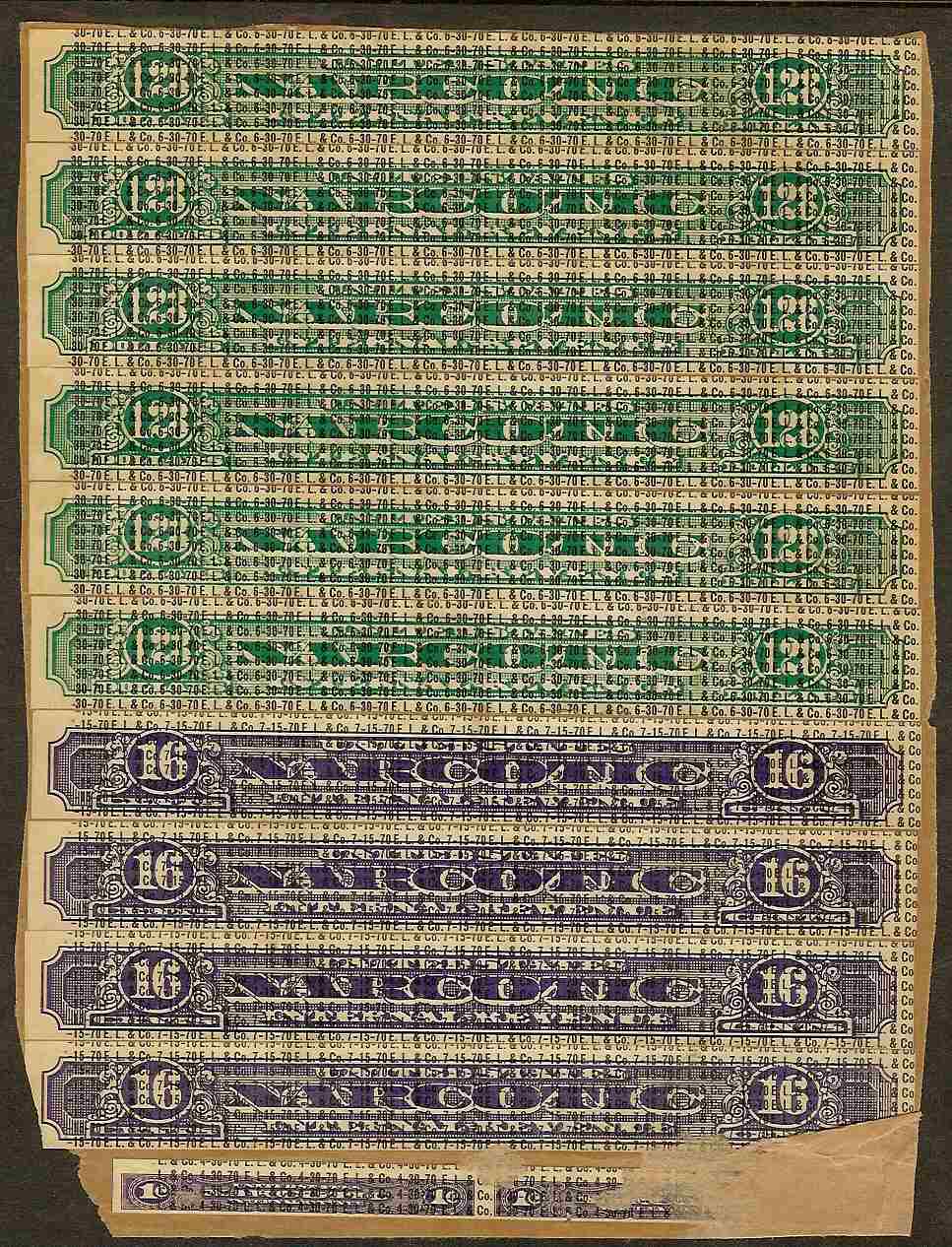
Hi Does anyone have an explanation why there are two sizes of the $1.28 narcotic strip stamps (and ONLY the $1.28 stamps)? The type with wide side margins was recently added to the Scott Specialized catalog. I'm looking for a proven, documented reason why this variety was manufactured. Use on a particular product I would guess, but which one? Any ideas? Thanks Jim   |
|
Send note to Staff
|
|
|
|
|
Pillar Of The Community
United States
868 Posts |
|
|
All the used copies of the wide margins that I have seen are cancelled by Eli Lilly from 1948 - 1958. I have Lilly cancelled $1.28 stamps that are the narrow margins in the 1960's. That would suggest that Lilly must have changed equipment circa 1960. So another question might be why do the unwatermarked wide margin $1.28 stamps exist. Probably because of the inertia of past practice. We did not know of the wide margin unwatermarked stamps until the Smithsonian disgorged some of what they deaccessioned at auction. I have not seen any reference to a used $1.28 with no watermark!
To put this into historical context, my guess is that Lilly had machinery in the 1948-58 period of time for which the wider margins were needed. Charles Biro has in fact documented that the two sizes were listed on the Internal Revenue order forms during the relevant period.
I should add that this is for the imperforate version of the $1.28.
|
Send note to Staff 
|
Ron Lesher |
| Edited by revenuermd - 03/09/2017 2:27 pm |
|
|
Pillar Of The Community
United States
5894 Posts |
|
|
Rest in Peace
United States
1738 Posts |
|
|
Thanks, that helps to explain the two sizes.
This is nearly identical then to the issuance of RJA105 and RJA106, for Wyeth Laboratories for their Tubex products? A particular size stamp made for a particular manufacturer for their particular product?
The only question remaining is that, as far as I am aware, the imperforate stamps without gum were issued for use in machinery, which separated them and applied them, while the rouletted stamps with gum were issued for application of the stamp by hand. This explains RJA74b, and you've explained why RJA103d was made (inertia), but why was RJA74d made? Why make a rouletted, wide stamp when it was going to be used on machinery? Any idea?
And any idea of the name of the Lilly product that weighed eight pounds?
Jim
|
|
Send note to Staff
|
|
|
Pillar Of The Community
United States
868 Posts |
|
|
I did not address the wide margin question for the rouletted stamps. I own a pair of the wide margin rouletted with wide margins that is cancelled P. D. & Co. (Parke Davis & Co.). In 1960 Parke Davis was using the narrow margin version of the $1.28.
If anyone would like to compare notes on other users of the $1.28, both narrow and wide margins, I would be glad to correspond via email. |
|
Send note to Staff
|
Ron Lesher |
|
|
Pillar Of The Community
United States
868 Posts |
|
|
Jim,
I think that the $1.28 was used on gallon containers (128 fluid ounces). I do not know the name of the product. |
|
Send note to Staff
|
Ron Lesher |
|
|
Pillar Of The Community
6366 Posts |
|
|
Pillar Of The Community
United States
868 Posts |
|
|
Although others eventually used the imperforate narcotic stamps, they did not appear until 1925 after the request from Eli Lilly. In fact the imperf narcotics can be authenticated by the presence of a Lilly printed cancel even if the margins are small. |
|
Send note to Staff
|
Ron Lesher |
|
|
Pillar Of The Community
United States
868 Posts |
|
|
John Becker's delightful wrapper with lots of imperf Lilly cancelled stamps was probably for paying the tax on the raw opium. Once processed it got taxed a second time when the manufactured medicine was sold.
|
|
Send note to Staff
|
Ron Lesher |
|
|
Rest in Peace
United States
1738 Posts |
|
|
I want to be sure I understand these denominations. Is this correct:
"The $1.28 stamps were used on a product that were in one gallon containers (if a liquid), or weighed eight pounds (if a powder or solid)."
Thanks,
Jim
|
|
Send note to Staff
|
|
|
Pillar Of The Community
United States
868 Posts |
|
|
I think that is correct. An ounce of water (weight) is one fluid ounce (volume). Yes, on raw opium, which is not a liquid, the ounce refers to weight. But on liquid manufactured narcotics the tax was based on volume and on tablets it was based on weight. Perhaps someone else more knowledgable about pharmaceutical products would like to weigh (GROAN!) in on this subject. |
|
Send note to Staff
|
Ron Lesher |
|
|
Rest in Peace
United States
1738 Posts |
|
|
The four dollar stamp must have been used on a twenty five pound package then.
Converting 400 ounces to gallons gives a weird volume of 3.125 gallons. I doubt that anything would be sold in that odd of a size. I would conclude that the $4.00 stamp was used only on a powder/solid package, but the $1.28 could be used on either a liquid or a solid.
Jim
|
|
Send note to Staff
|
|
|
Pillar Of The Community
United States
868 Posts |
|
|
3.125 gallons is very close to 12 liters and the medical community has long been using metric measure.
|
|
Send note to Staff
|
Ron Lesher |
|
|
Rest in Peace
United States
1738 Posts |
|
|
That's true but I don't see any other federal or state tax stamp that rounded up or rounded down to make an even dollar amount. The $1.28 stamp for example, not a buck and a quarter but exactly $1.28. Even stranger denominations found in the beer stamp area, etc.
The tax was one cent per ounce, with no mention of the amount per milliliter. One fluid ounce is 29.5735 milliliters. No stamp with that amount exists.
If in fact a 12 liter container was used, then we'd expect to see a $4.05768 stamp, right?
Jim |
|
Send note to Staff
|
|
|
Bedrock Of The Community
United States
10869 Posts |
|
|
Although the exact value tax idea was done with the wine stamps, the govt may have decided it was not worth it for what turned out to be a relatively small usage. After all, the $4 is a fairly scarce value. |
|
Send note to Staff
|
|
|
Rest in Peace
United States
1738 Posts |
|
|
Well, the point basically is that the $4.00 stamp works out exactly for a package of 25 pounds for a solid or powder, and doesn't work out evenly for a container with a liquid (3.125 gallons or 11.8294 liters).
The $1.28 on the other hand works out exactly for a one gallon container or an 8 pound package.
The conclusion then is that the $4.00 stamp was only used on a container holding 25 pounds of a solid/powder, and not on a container with liquid in it.
Also, name one other U.S. tax stamp, that rounded up or down. That would imply that either the taxpayer overpaid (granted, not by much per stamp), or the government (federal or state) didn't collect the proper tax amount that was due (i.e. the taxpayer underpaid). Neither of these scenarios are likely, in my opinion.
Jim
p.s. The $4.00 stamp is uncommon because a) it was in use for only 1 year and b) 25 pounds of narcotics is a LOT of drugs. Not too many individuals would buy that much at one time, in my opinion. Probably only used by one manufacturer (Eli Lilly) for one size of one product. |
|
Send note to Staff
|
| Edited by James Drummond - 03/09/2017 5:24 pm |
|
|
Replies: 17 / Views: 3,576 |
|




 Posted 03/09/2017 1:40 pm