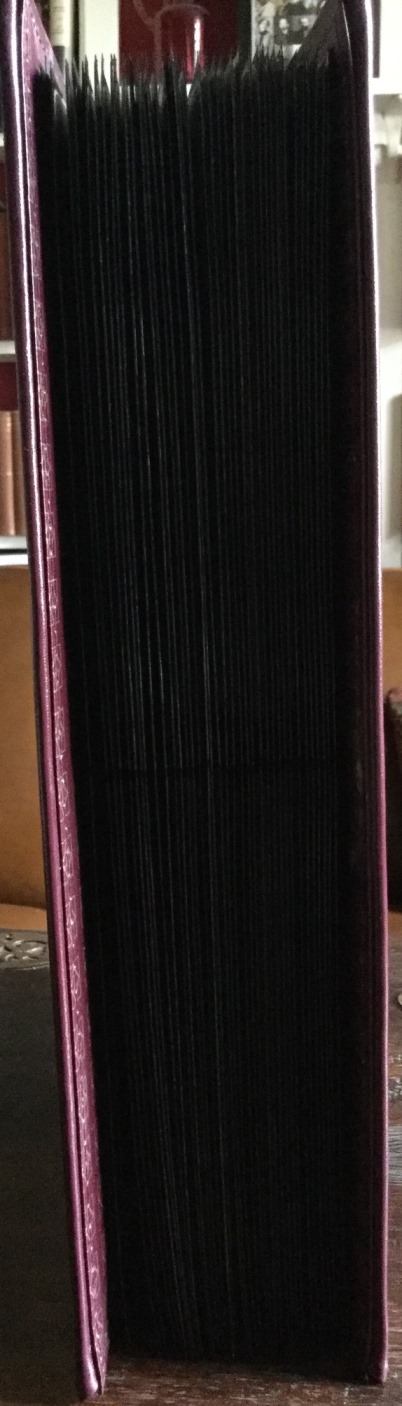
I absolutely hate the large Scott 3-ring binders, so you're not going to get an unbiased opinion from me.

The 2-post binders are the more classic choice, and I think they look much better, but they have the disadvantage that the pages bend somewhat (maybe "curve" is a better word) when the album is open. This apparently puts off a lot of collectors and may have been the main factor that led to the 3-ring option which Scott began producing some years ago.
The solution to the bend/curve problem with the 2-post binders was always there, but just not used by many collectors -- don't put so many pages into the 2-post binders (never fill them up) and be sure you use page "spacers" which are made out of cardboard. These spread out the pages more. Fewer pages helps prevent an enormous curve in the pages as you flip through the album. It works, believe me. The spacers hold everything nice and snug, and it all looks just fine. It is a pain to add and remove pages, however, with the posts and rods which must be pulled out, etc. This is a big advantage to the ring binders where you just snap them open to add or remove a page.
Pages in the 2-post binders are held snugly and don't move back and forth on the posts. So the holes don't wear as fast as they do in the 3-ring binders where holes can wear much faster. After all, you slide the page up and down the ring every time you turn the page. It has to wear.
Or you could (at one time) use smaller sized 2-post binders which accomplishes the same thing. Or at least you could when they were available. Unfortunately, Scott discontinued the smaller sized 2-post binders around this time, perhaps to force collectors to move to the 3-ring binders. Or is my conspiracy theory showing? I don't know, but it was a sad day in Stamp Land when they went to only the one larger 2-post binder, in my opinion, as I liked the smaller ones as easier to handle, less bulky, and so on.
Fortunately, Scott also produces a smaller (meaning not as thick) 3-ring binder that I find much more appealing for a number of reasons. To put it simply, it's much less bulky than the larger 3-ring binder. In the smaller binder, the space between right-hand and left-hand pages is not occupied by an enormous distance filled with giant metal rings. It's narrower and the rings are much smaller and less obtrusive. If I were starting my collections over again (God forbid) I would seriously consider putting all pages into the smaller 3-ring binders.
Of course, due to their smaller size, it would require twice as many binders, but the overall look along with the ease of removing and inserting pages makes it worth it. Larger binders can hold *maybe* 200 pages give or take while the smaller ones hold *100* pages at most. Also, both size 3-ring binders sell for the same price. The 2-post binder costs even more. I have no idea why this is.
Don't forget your stamps take up a lot of space, too, so don't overcram them. You want room (hence using spacers for the 2-post version). There are no equivalent spacers for the 3-ring binders, so pages just sort of flop around on the three rings (one reason I don't like the larger 3-ring size -- too much wear on the holes).
Okay, so that's my history of the modern Scott binder, and whatever options still exist. You may not care because you, presumably, already have your binders. They're probably the large 3-ring size, so you'll do the best you can with these ungainly things. I'm joking a little, and they're fine even if somewhat enormously bulky, etc.
As for page arrangement, do whatever you want. It is entirely your collection. Always remember that. Most people follow the (rather silly) Scott catalogue arrangement. Unlike nearly every other major stamp catalogue in the world, Scott chooses to list Semi-postals, airmails (and so on) separately after other stamps. To me, this makes no sense, but there you have it. Normally, then, you'd arrange your pages by time period in each binder with airmails, etc. toward the end.
I think this is weird since it means that after you've looked at stamps from an era and gone on to modern stamps, you then get to look at stamps from the earlier era again, stamps often done in much the same style, except they're "segregated" later in your album because they're airmails or whatever.
I don't do that (as you probably guessed) since I prefer all stamps issued in the 1920s, for example, to be together. So I put 1920s airmails with other 1920s stamps (and so on through the years). This is the way it's done in Europe and most other countries, combining all stamps issued in each year or decade or era together. Each to their own, though.
It doesn't always work as Scott often puts airmails (and other stamps) from different years on the same page, assuming everyone will simply combine all such pages together in one section. My solution is to put pages in my album at the location of the later stamps. If you follow Scott, however, you'd just put all such pages at the end of each binder. And when you're mounting stamps, you do have to look a little harder for the airmail and semi-postal pages in the right years.
Leave space for the stamps you're going to mount and don't cram in too many pages in each binder! Have fun.





 Posted 04/22/2017 10:56 pm