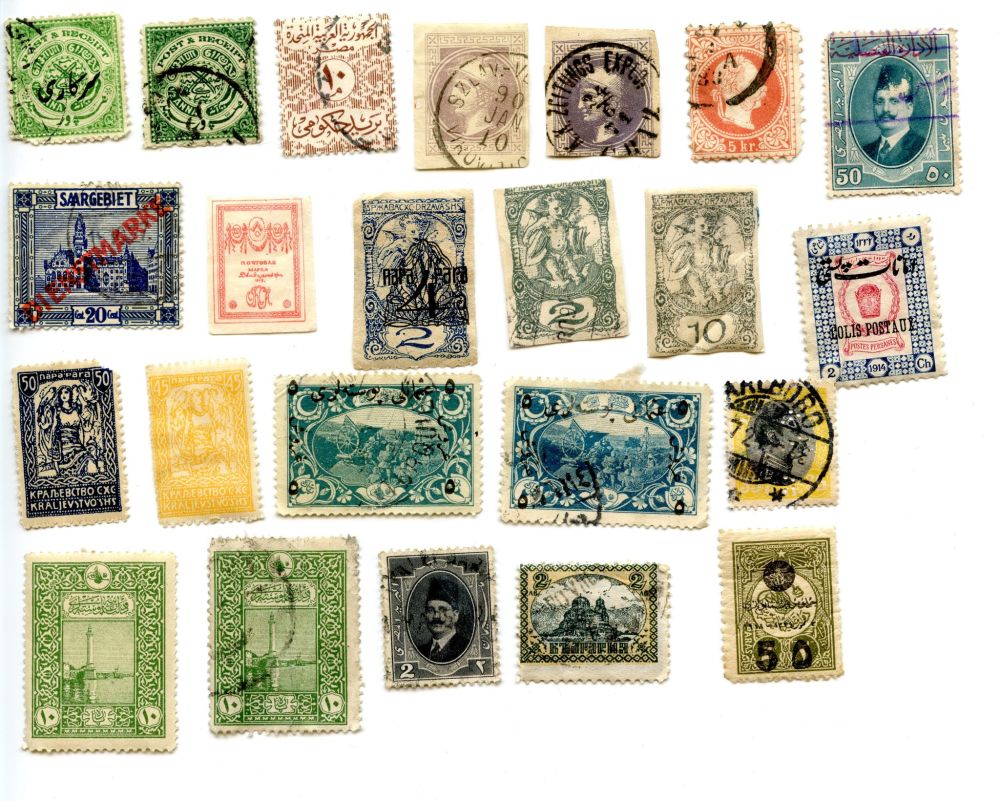
Technically the Haydarabad stamps are postal-fiscals which were issued to be used for the dual purpose of postage as well as revenue acting as receipt stamp.
Hopelessly, Gibbons or other catalogs do not list the 1915 issues as postal-fiscals.

The ½A denomination was issued primarily to pay the basic letter postage ½A for weight upto 11.66gm (1 tola), the rate in effect from 1880 to May 5,1930 which was also applicable to official mail from January 3,1909 when official stamps were reintroduced after being discontinued in 1887.
Vignette: The central circle shows the Tugra with the Farsi inscription
Sarkar I Asafiyyah which means Government of Asaf, denoting the Govt. of Asaf Jah VI, the official title of Mahbub Ali Khan Siddiqi (1866–1911), the ruler of Haydarabad (1869–1911).
The central circle also shows the Arab numeral 1331 which denotes the year 1331H (Hijri) i.e. 1913 which is the year when the plates of this issue were engraved.
The Tugra is encircled with 4 curvasive panels bearing the denomination in 4 languages viz., Marathi, Telugu, Urdu and English (clockwise from top left) which alongwith Farsi make this stamp thus a quinlingual stamp.
The lower panel opposite to that of
POST & RECEIPT reads
Tappa wo Rasid i.e. Post and Receipt.
The watermark also reads
Sarkar I Asafiyyah.
High resolution scans might help to identify the cancelations.





 Posted 04/27/2017 12:12 am