| Author |
 Replies: 30 / Views: 4,576 Replies: 30 / Views: 4,576 |
|
|
|
Rest in Peace
Canada
5701 Posts |
|
|
Quote:
Many experimental of tagging stamps are made in 60s in Canada and many things are mistery. This look like one of these. No. I have studied Canadian tagging for 40 years. |
Send note to Staff 
|
|
|
|
Valued Member
Montenegro (Crna Gora)
31 Posts |
|
|
Partime-If you have many stamps like this please post pfoto of one of tham because we all want to admire your stamp. |
|
Send note to Staff
|
|
|
Moderator

United States
5106 Posts |
|
|
Nothing to admire ... quite the opposite. I'll look around this weekend to find some better examples. |
|
Send note to Staff
|
|
|
Valued Member
20 Posts |
|
|
This 1c stamp is from a booklet pane; none of these booklet panes were ever tagged and there was never any tagging experimentation done on them.
As BeeSee has pointed out, the discolouring on the back of the stamp is due to contamination from the underlying envelope from which the stamp was removed.
There is no "error" here, or even a variety of any kind. The stamp is damaged, both by the torn perfs, and the discolourization on the back and should be thrown out. Period.
Since you feel otherwise, you should send it to the Vincent Graves Greene Philatelic Foundation in Toronto for certification. Pay the $40 submission fee and let them tell you the same thing you have been told here. |
|
Send note to Staff
|
|
|
Valued Member
Montenegro (Crna Gora)
31 Posts |
|
|
I thought than damage like this which is made in production process of stamps is ERROR. That is my mistake. It's a pleasure to hear Your profesional opinion. |
|
Send note to Staff
|
|
|
Moderator
United States
5106 Posts |
|
|
What you are reading are NOT professional opinions, but comments made from stamp collectors. If you want a Professional Opinion, please spend your money on a certification from the Vincent Graves Greene Philatelic Foundation in Toronto, as recommended by several people on this forum.
However, please note that most of use believe that the basis for your claim is incorrect. You keep saying that this mark is from the production process, while your fellow stamp collectors are pointing out that this is simply a design from the envelope on which it was stuck, coming through during the time it was on the envelope, and then during the soaking / removal operation. I'm quite amazed that you haven't seen it before.
Anyway, good luck on your search. |
|
Send note to Staff
|
|
|
Valued Member
Montenegro (Crna Gora)
31 Posts |
|
|
Soaking stamp on craft paper manufactured in Canada can cause bleeding of the sodium sulphate. This bleeding results being a reddish color on the back of the stamp. Bleeding is sparse and without clear forms. Line is a form and looks like a tagging issue. That is confuse but I beleve you.thanks Partime |
|
Send note to Staff
|
|
|
New Member
France
3 Posts |
|
|
Hm very unusual.
Lines are normally applied to the face of the stamp over the printed image, when lines are also found on the reverse of the stamp, this has been applied in error. Some experts claim that reason is a printing roller has picked up ink by mistake and deposited it to the rear of the sheets. Second reason - wet ink has been transferred from one sheet to another during the stacking proces. |
|
Send note to Staff
|
|
|
Rest in Peace
7742 Posts |
|
|
I have a couple of British stamps with the same lines on the back...Trying to remember why though.
Robert
|
|
Send note to Staff
|
|
|
Pillar Of The Community
United Kingdom
8623 Posts |
|
|
You may be thinking of the graphite lines applied to the Wilding definitives in the late-'50s. A pre-phosphor experiment, I think. |
|
Send note to Staff
|
|
|
Rest in Peace
7742 Posts |
|
|
Hi Stampsfield First of all you stamp is backwards...The red line is on the left side of your stamp and not the right side as you posted the back of the stamp.... 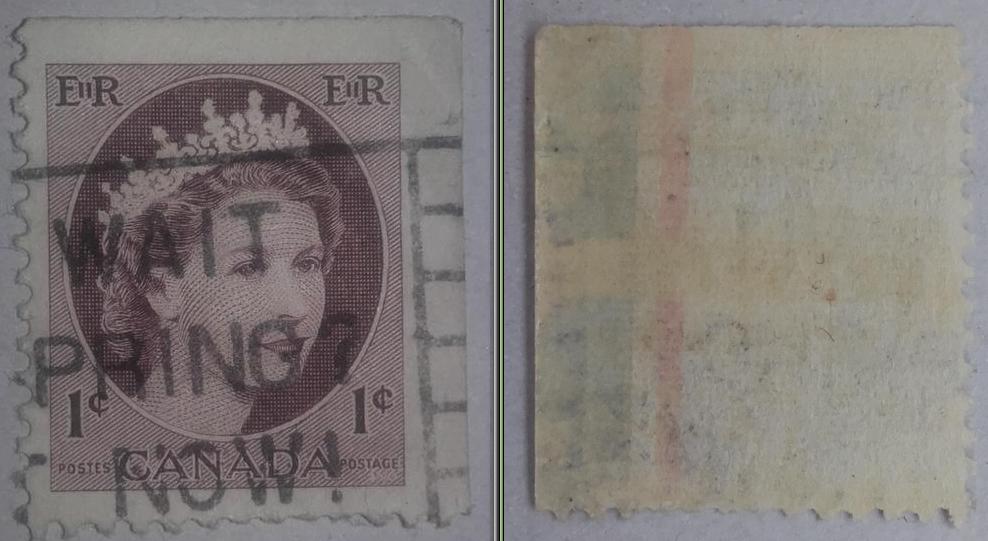 Anyways it could have picked up a portion or a red cover/card as shown by the example below..Licking the stamp and with the moisture, it could have transferred the colour to the back if the stamp. 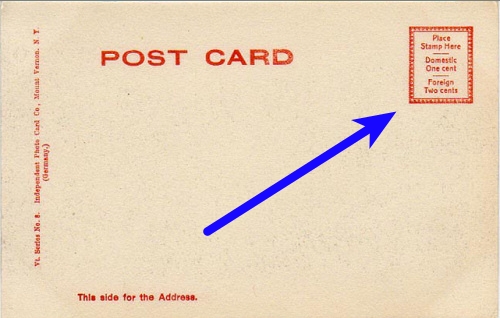 Correction..not red but black. 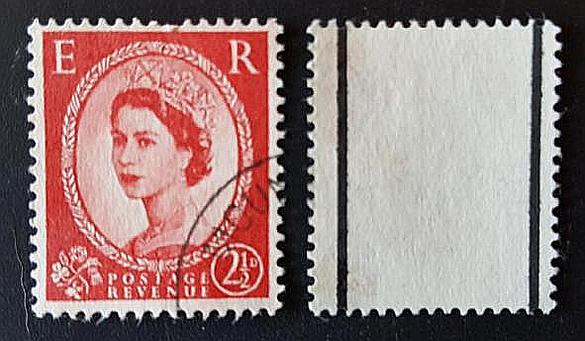 Robert |
|
Send note to Staff
|
| Edited by wert - 01/01/2019 6:40 pm |
|
|
Pillar Of The Community
Canada
1647 Posts |
|
|
My two cents worth! Wow, definetly not tagged. It very well may be the red and blue stripped border of an airmail cover. It definetly is on the side that was at the edge of the cover and when it soaked, the dye of color transferred to the stamp.
I noticed that no- one mentioned that the red line is actually two red lines and the blue or black is two parts also, just as it appears on old airmail cover.
Tagging is as others previously stated, on the front side, giving an afterglow, and had never been red.
Mike |
|
Send note to Staff
|
| Edited by No1philatelist - 12/31/2018 9:39 pm |
|
|
Pillar Of The Community
Canada
1401 Posts |
|
|
I agree with the others that the red line(s) is a transfer from the envelope that it was on. The first Canadian issue with pink (not red) tagging is the Canada-French "Founding of Quebec City" joint issue of May 16, 2008. SC2269 - Pane single 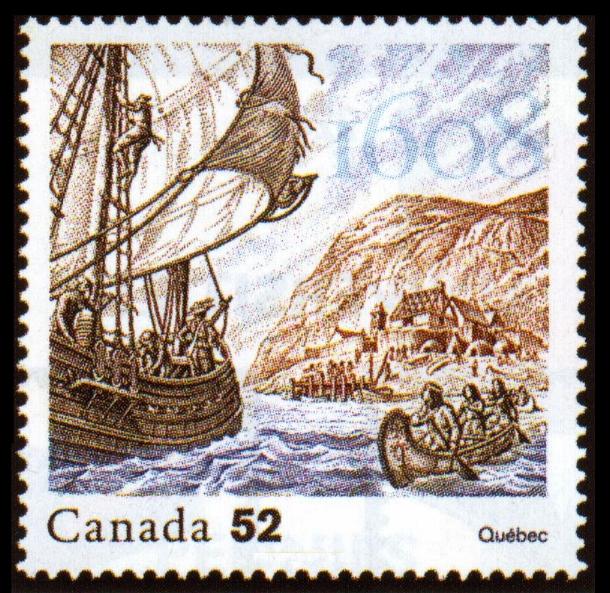 SC269ii - Souvenir sheet  UV exposes the 'Style 6' 4 bar inset red tagging on the Canada stamp at the far left and the 'blob' red tagging in the upper right of the pane single Canadian 52 cent stamp that is placed on top of the souvenir sheet.  The first example of 'red' tagging appears as an overprint on the SC 2323 "International Year of Astronomy" Souvenir Sheet of April 02, 2009.  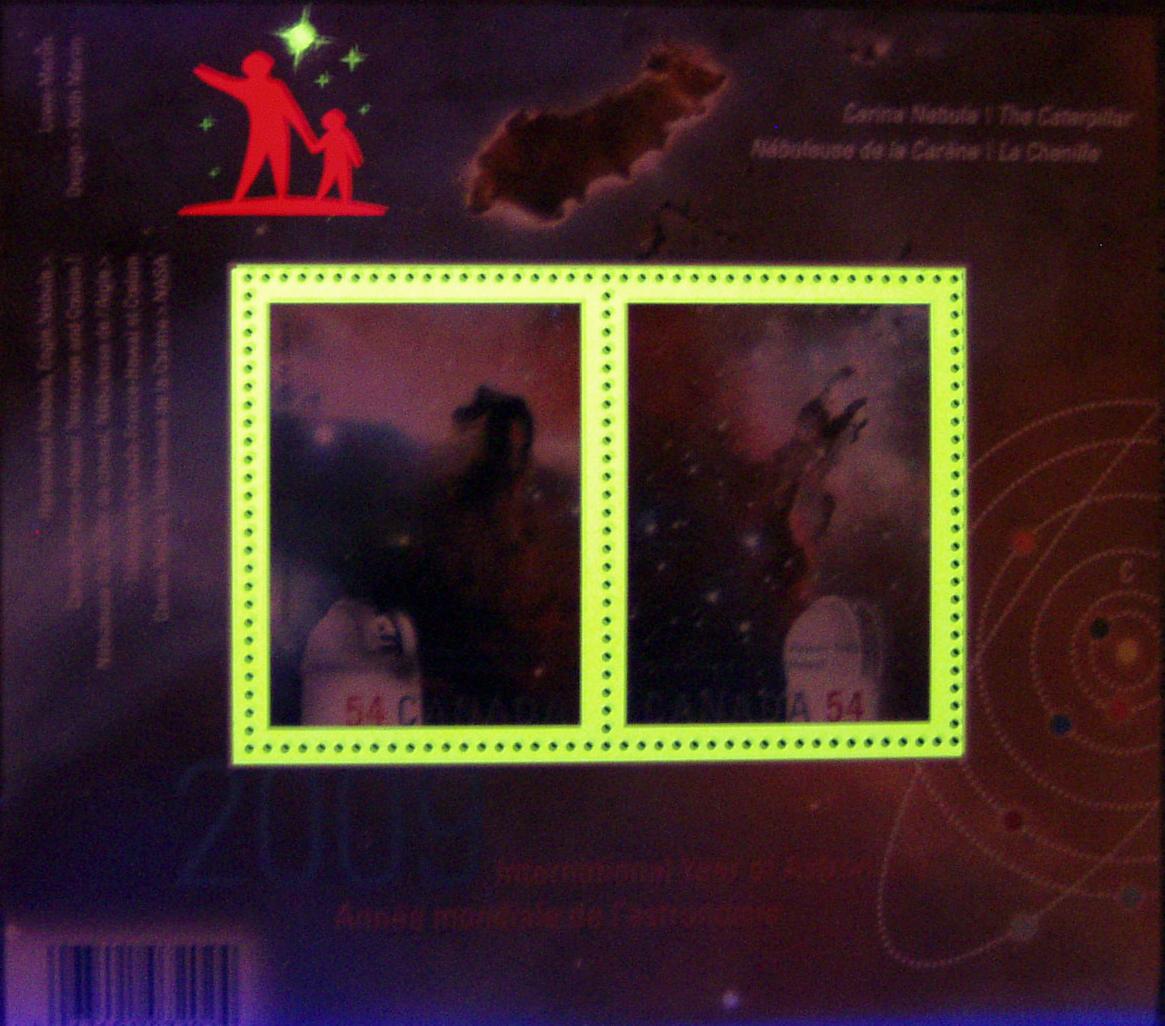 |
|
Send note to Staff
|
|
|
New Member
France
3 Posts |
|
|
Wert you don't have stamps in which you can see red line on naked aye.I'v been researching houndreds.
1. The color transferred to this type of glue would spill.
2. The line or anything else can not be precisely transferred.
3. The transfered line can not be beneath the glue.
Some taggant were mixed with many varnish (experimental). This is maybe some variations but with error side, or printing roler made big mistake and deposite on the back.
|
|
Send note to Staff
|
|
|
New Member
France
3 Posts |
|
|
The size of red line is also non-compilant with size of cover/card lines.
It is scarse but 'Segregator mark 1 'machine for tagging in 50s and 60s could do this mistake. |
|
Send note to Staff
|
|
|
Replies: 30 / Views: 4,576 |
|




 Posted 06/27/2017 10:05 pm


