Stamp Community Family of Web Sites
Thousands of stamps, consistently graded, competitively priced and hundreds of in-depth blog posts to read


Stamp Community Forum
 
Username:
Password:
Save Password
Forgot your Password?

This page may contain links that result in small commissions to keep this free site up and running.

Welcome Guest! Registering and/or logging in will remove the anchor (bottom) ads. It's Free!

1934 National Parks Series And 1935 Farley Reprints

Previous Page | Next Page    
 
To participate in the forum you must log in or register.
Author Previous TopicReplies: 154 / Views: 50,012Next Topic
Page: of 11
Pillar Of The Community
United States
1804 Posts
Posted 09/29/2017   5:31 pm  Show Profile Bookmark this reply Add GregAlex to your friends list  Get a Link to this Reply
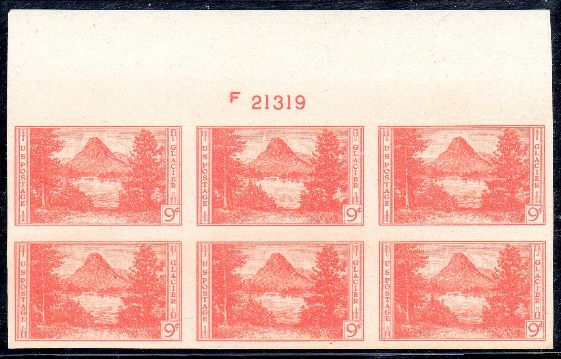
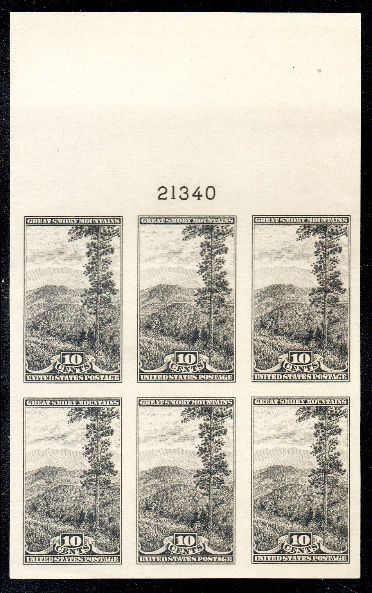
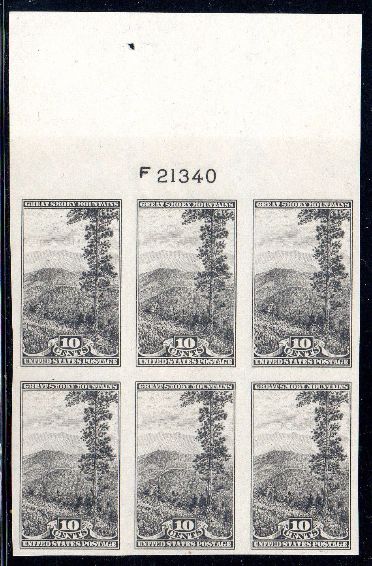
What did the F indicate next to the plate number?
Send note to Staff  Go to Top of Page
Rest in Peace
United States
1189 Posts
Posted 09/30/2017   2:09 pm  Show Profile Bookmark this reply Add Stampman2002 to your friends list  Get a Link to this Reply
The "F" on a plate block, if I remember correctly, denotes that the plate has been hardened and ready for use. When creating plates, the die is used to impress the plate with the design. Once all the positions have been entered into the plate, it is then heated and cooled in oil to make the soft steel hard. It is then used to print the stamps.
Send note to Staff  Go to Top of Page
Pillar Of The Community
1151 Posts
Posted 09/30/2017   4:14 pm  Show Profile Bookmark this reply Add stampmaster to your friends list  Get a Link to this Reply
Hi Stampman2002, I think you get an "A" for your posting on the "F".

Stampmaster
Send note to Staff  Go to Top of Page
Rest in Peace
United States
1189 Posts
Posted 10/02/2017   7:48 pm  Show Profile Bookmark this reply Add Stampman2002 to your friends list  Get a Link to this Reply

Scott 764

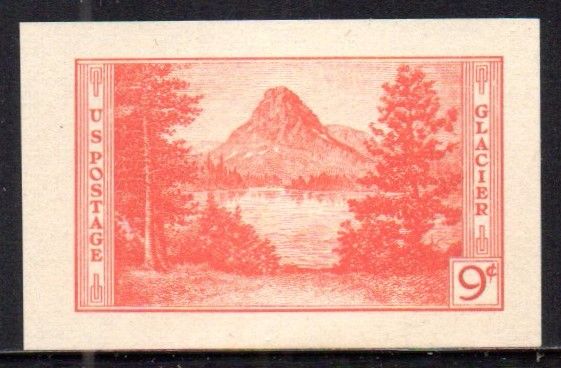
The next stamp in the series of Farley Reprints is the nine-cent Glacier National Park stamp in the National Parks series. As with all of the Farley Reprints, these were issued on March 15, 1935.

Here is a nice jumbo margin example:


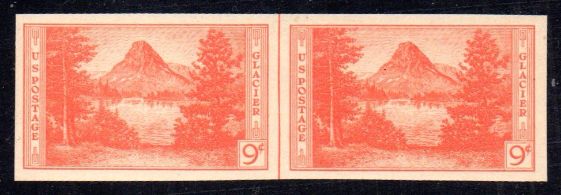
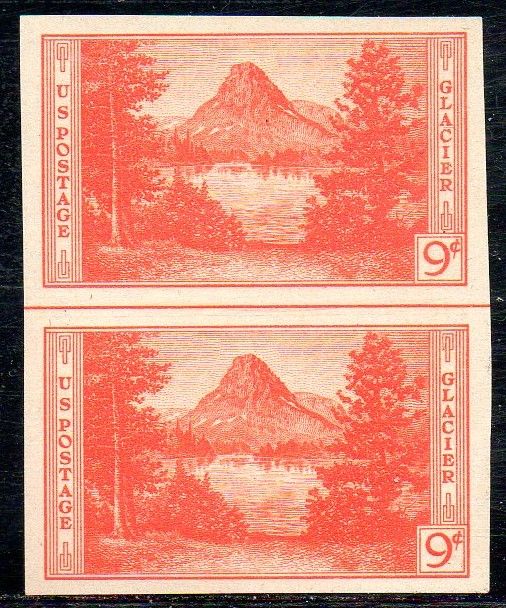
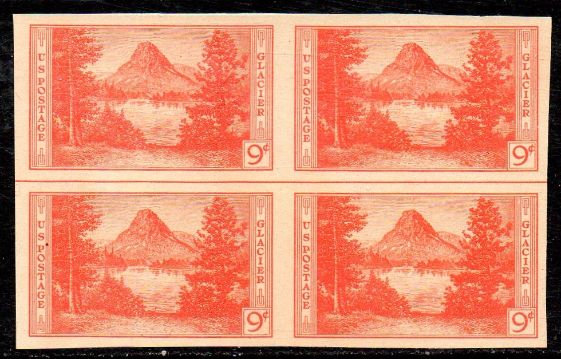
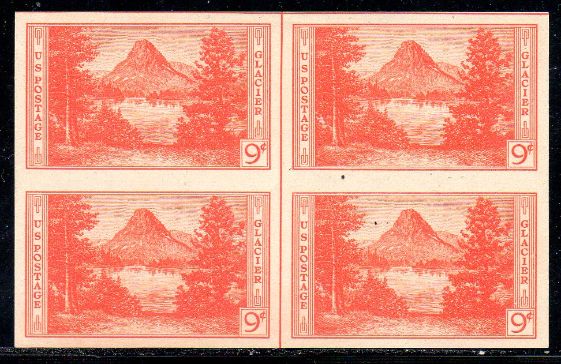
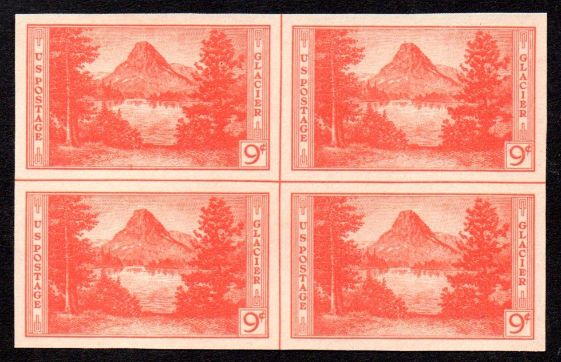
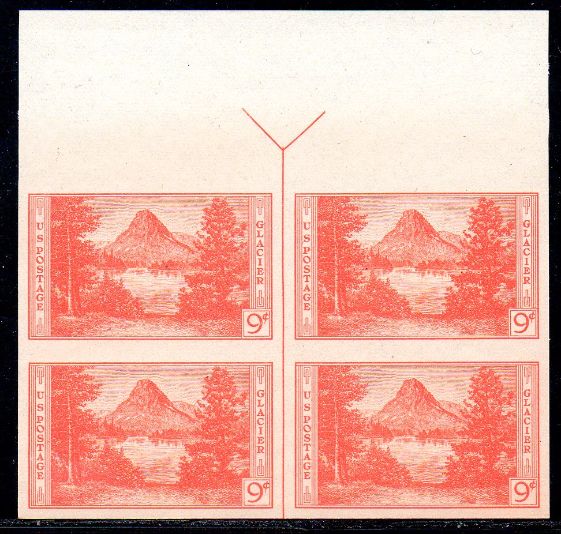
Position pieces for this issue remain the same as for the other issues of the National Parks Reprints. These include the horizontal pair with vertical line, the vertical pair with horizontal line and the blocks of four with vertical lines and horizontal lines. These are shown next:


The centerline block is the key position piece as it occurs only once per sheet where the four panes meet in the middle of the sheet. This is shown below.


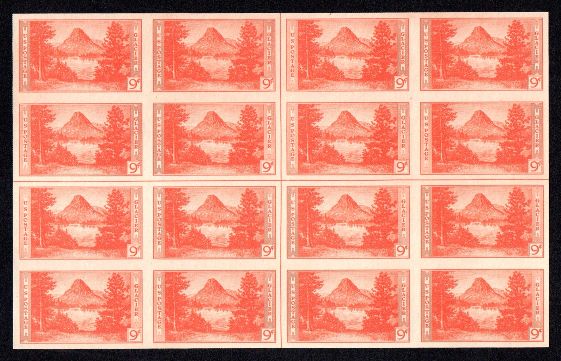
My penchant for larger blocks is met for this issue by the centerline block of sixteen shown below:


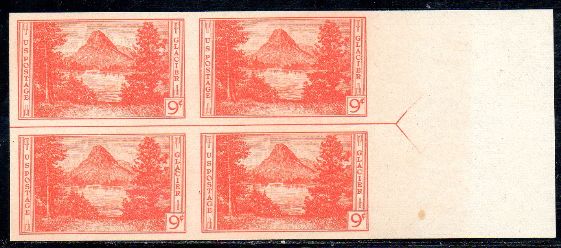
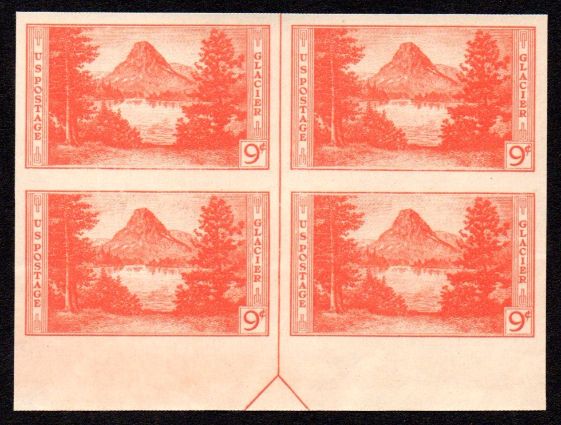
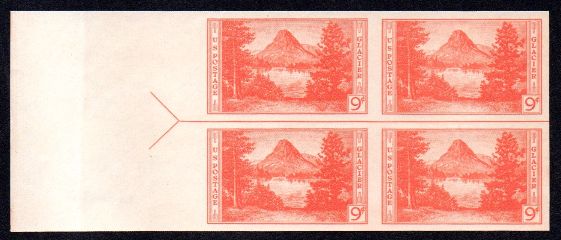
On the outside edges of the full sheet, these pane dividing lines begin with an arrow. In normal production, the panes would be separated along these lines. The four arrow blocks are at top, right, bottom and left. These are shown below:


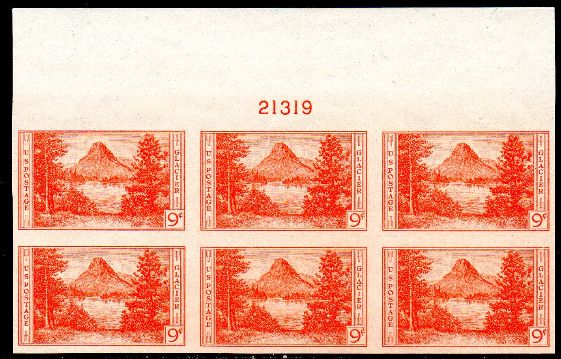
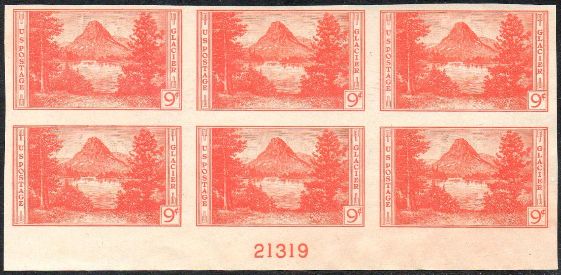
The remaining position pieces would be the plate blocks. These occur at the top, in two variations, and at bottom. There were four plates used in the production of this issue. The last plate used, plate number 21319, is shown below as a full set of plate blocks.


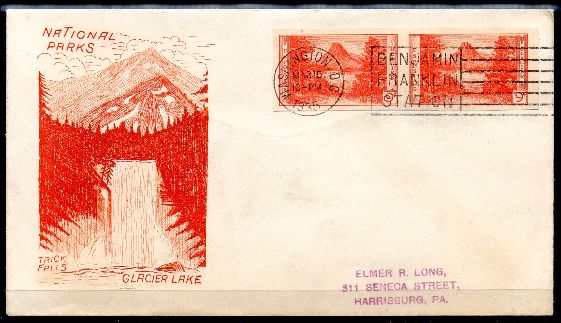
The First Day covers I've chosen to share here will begin with the Grimsland cachet. This is Planty-Mellone 764-001. There is a different design for each of the stamps in the series, with the color matching the stamp. This FDC has a horizontal pair and is addressed to Elmer Long, a well known stamp dealer of the period.


The next FDC features the A.C. Roessler cachet. The cachet is the same for all issues in the series and appears in the same color without variation. This is Planty-Mellone 764-7.


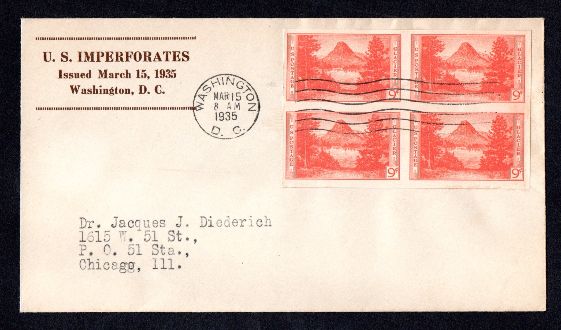
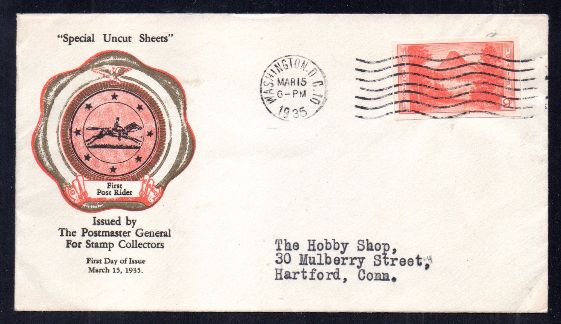
The final selection is the F.R. Rice cachet. The cachet design is constant, but the colors match the stamp's color. This is listed as Planty-Mellone 764-20. I've often been puzzled by the numbering system adopted by the Planty-Mellone catalogues as the F.R. Rice number for the regular series is 748-5 (using the perforate counterpart to this stamp). Why then, is it a different number for the Farley Reissues? At any rate, here's the Rice FDC, addressed to "The Hobby Shop," another well done retailer of the period:


The next installment on this thread will discuss the ten-cent Great Smokey Mountains National Park issue in the Farley Reprint series.

As always, comments and questions are encouraged. If you have collateral material which fits this thread, please share it.
Send note to Staff  Go to Top of Page
Pillar Of The Community
United States
3485 Posts
Posted 10/02/2017   8:31 pm  Show Profile Bookmark this reply Add txstamp to your friends list  Get a Link to this Reply
So if "F" means that the impression was made from a hardened plate, does that imply that plate numbers without an "F" are proofs? i.e. test or trial printings?
Send note to Staff  Go to Top of Page
Valued Member
United States
132 Posts
Posted 10/02/2017   8:38 pm  Show Profile Bookmark this reply Add rugface to your friends list  Get a Link to this Reply
The "F" indicates the upper-right pane from the printing sheet. It may also mean the plate has been hardened; I'm not familiar with that meaning.
Send note to Staff  Go to Top of Page
Rest in Peace
United States
1189 Posts
Posted 10/02/2017   8:59 pm  Show Profile Bookmark this reply Add Stampman2002 to your friends list  Get a Link to this Reply
As I explained previously, a plate is created by "rocking" the hardened die into the soft steel of a plate. Once all positions had been impressed in the soft steel, the finished plate was carefully inspected and, if cleared, it was then heated. By the 1930's the Bureau of Engraving and Printing was using an oil bath to cool the heated plate as that produced a harder plate than other methods of cooling. Just prior to heating the plate, the "F" was added to the top right position on the plate, as rugface had previously stated. The production of stamps was then done.

There are four panes to a plate. The "F" was used only once, indicating that the plate had been hardened and was ready for use. If the panes are separated, as normal for perforated stamps or imperforate stamps regularly sold (think Scott 481, 482, 483, 484) you would find four panes with a regular number at top, an "F" and number at the top and two bottom panes which had no other markings for each sheet.

So, the lack of an "F" does not indicate the other positions are proofs, just that they are not the top right position on the plate.

Hope this helps you visualize it.
Send note to Staff  Go to Top of Page
Edited by Stampman2002 - 10/02/2017 9:06 pm
Pillar Of The Community
United States
3485 Posts
Posted 10/02/2017   9:48 pm  Show Profile Bookmark this reply Add txstamp to your friends list  Get a Link to this Reply
I see, thanks.
Send note to Staff  Go to Top of Page
Valued Member
United States
11 Posts
Posted 10/05/2017   4:55 pm  Show Profile Bookmark this reply Add nlrsc61 to your friends list  Get a Link to this Reply
Super thread very enjoyable and informative read.
Send note to Staff  Go to Top of Page
Pillar Of The Community
United States
8956 Posts
Posted 10/05/2017   5:55 pm  Show Profile Bookmark this reply Add Petert4522 to your friends list  Get a Link to this Reply
Stampman, I wrote earlier in this post that I enjoyed all this tremendously.
Now I have been reading a related article in The United States Specialist which is also fantastic, but I have a feeling that you already know about that!

Peter
Send note to Staff  Go to Top of Page
Rest in Peace
United States
1189 Posts
Posted 10/05/2017   7:36 pm  Show Profile Bookmark this reply Add Stampman2002 to your friends list  Get a Link to this Reply
Guilty as charged, Peter!

While I've been doing this, I've begun writing a series of articles which highlights the essays, proofs and errors in one place for publication in the United States Specialist. The last couple of articles will deal with the imperforate 1934 stamps, which I really believe should be Scott listed by this point in time.

I have to say I'm really enjoying working with the USS editor, Len Piszkiewicz. I've written a couple of dozen short articles for the Precancel Stamp Society and one or two for the United Postal Stationery Society which were all short, so this has been my first foray into feature length articles. Len has been extremely patient and unbelievably helpful during this process. The USS is really fortunate to have such an editor.
Send note to Staff  Go to Top of Page
Edited by Stampman2002 - 10/05/2017 7:37 pm
Rest in Peace
United States
1189 Posts
Posted 10/07/2017   05:47 am  Show Profile Bookmark this reply Add Stampman2002 to your friends list  Get a Link to this Reply

Scott 765

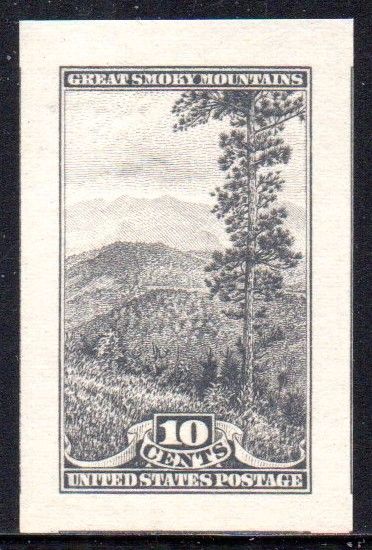
The high value of the National Parks series, both in the perforate 1934 series and the imperforate 1935 Farley Reprint series, is the gray black Great Smokey Mountains National Park design. As with the other stamps of the Farley Reprints, these were issued March 15, 1935. An example of a single is shown below:


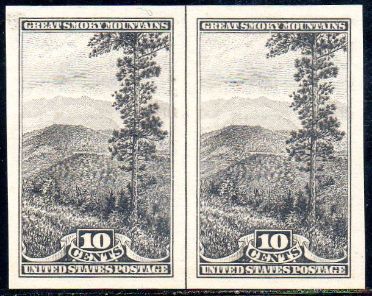
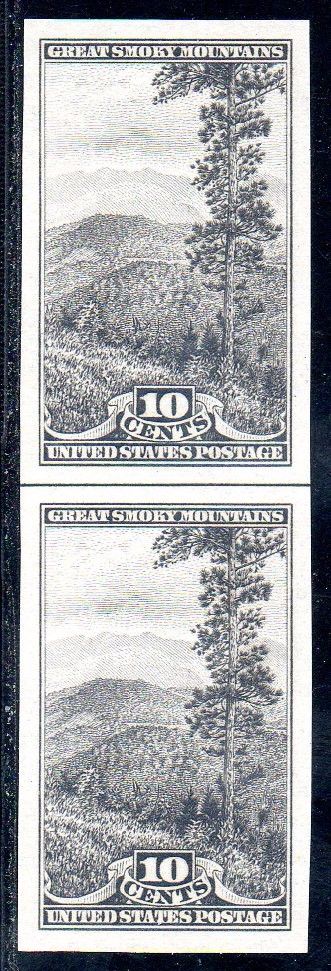
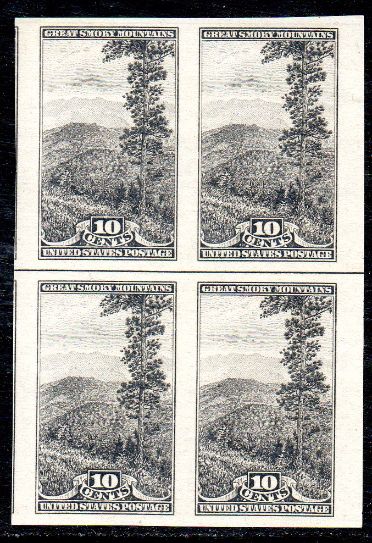
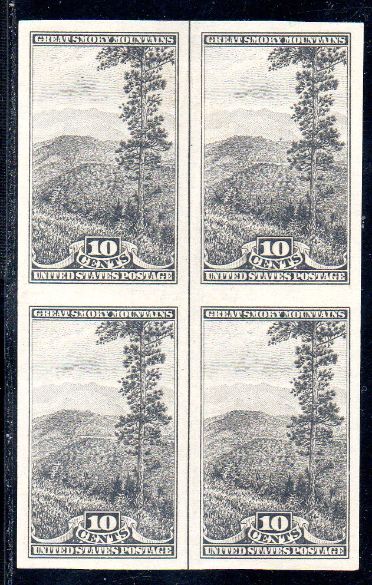
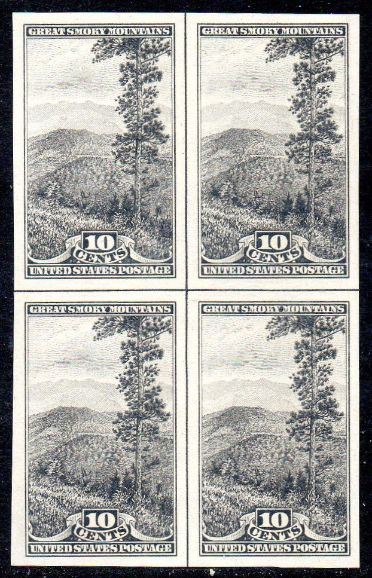
Position pieces for this issue remain the same as for the other issues of the National Parks Reprints. These include the horizontal pair with vertical line, the vertical pair with horizontal line and the blocks of four with vertical lines and horizontal lines. These are shown next:


The key to the position pieces is the centerline block, where all four panes meet in the center of the sheet. An example is shown below:


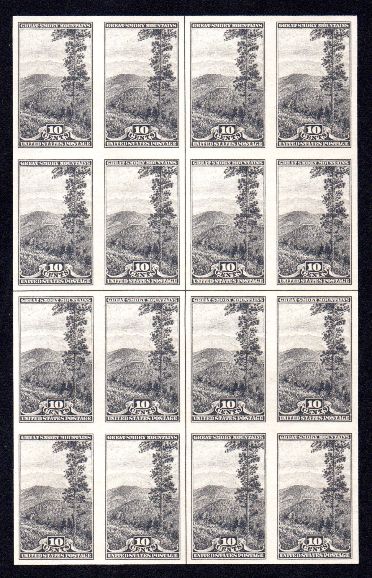
As you are aware, I love larger blocks of stamps. Here a centerline block of sixteen. I think these blocks of sixteen are simply spectacular ways of showing this position piece.


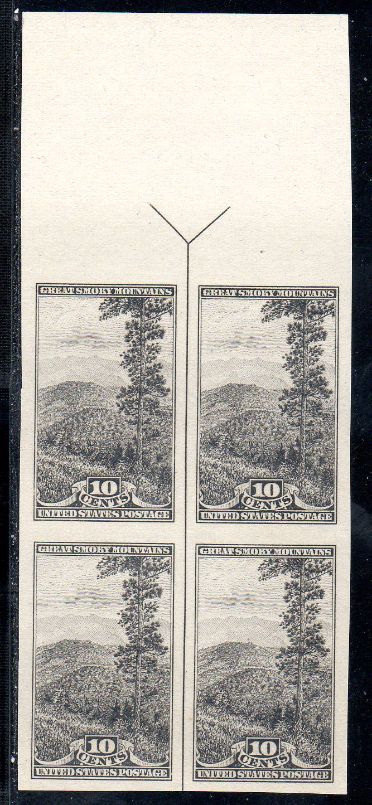
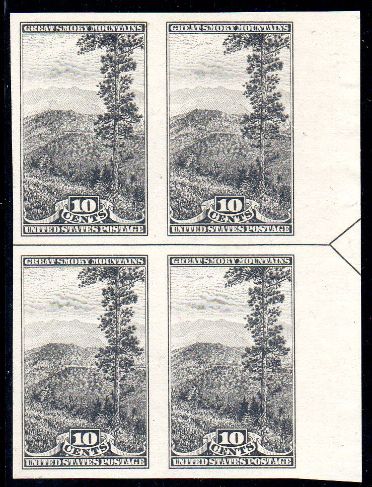
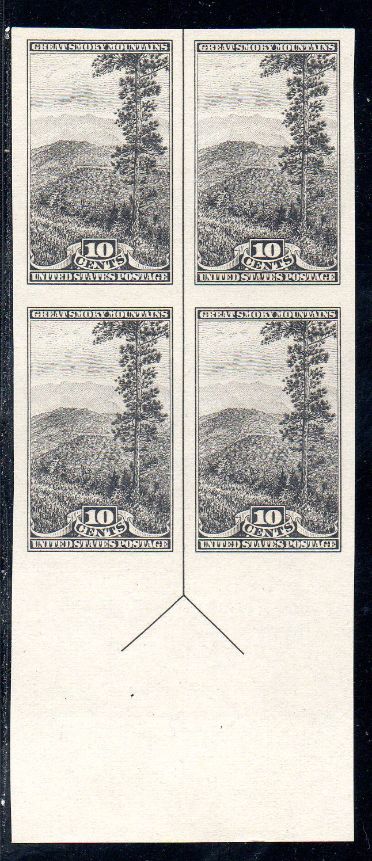
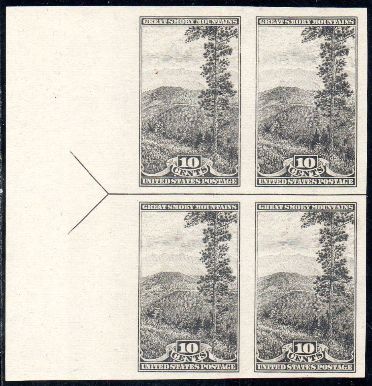
Next up are the arrow block position pieces. These are where the dividing lines between panes begin on the margins of the sheet. The four position are shown in clockwise fashion with the top, right, bottom and left positions being shown below:


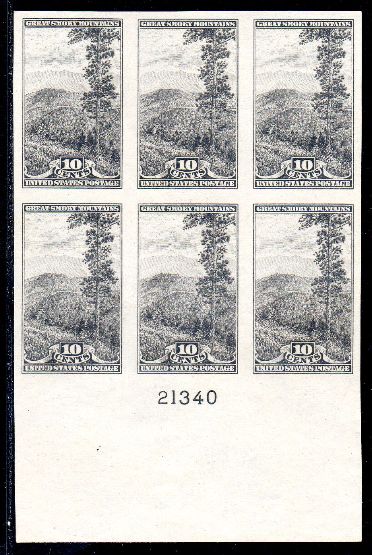
The last position pieces are the plate blocks. There were four plates used to print the Farley Reprints for the Great Smokey Mountain stamp. The following represents the full set of plate blocks for plate 21340:


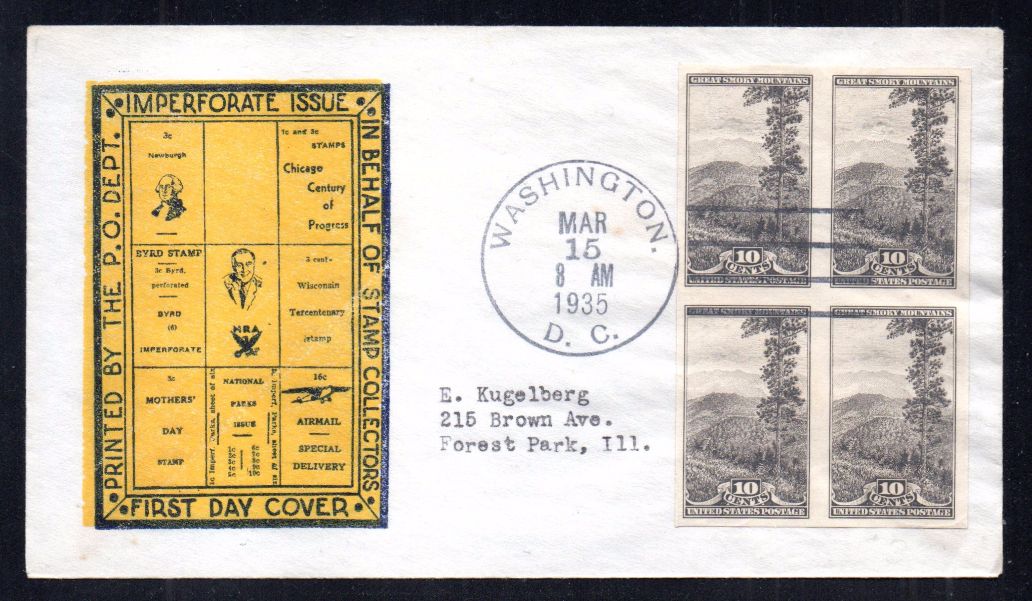
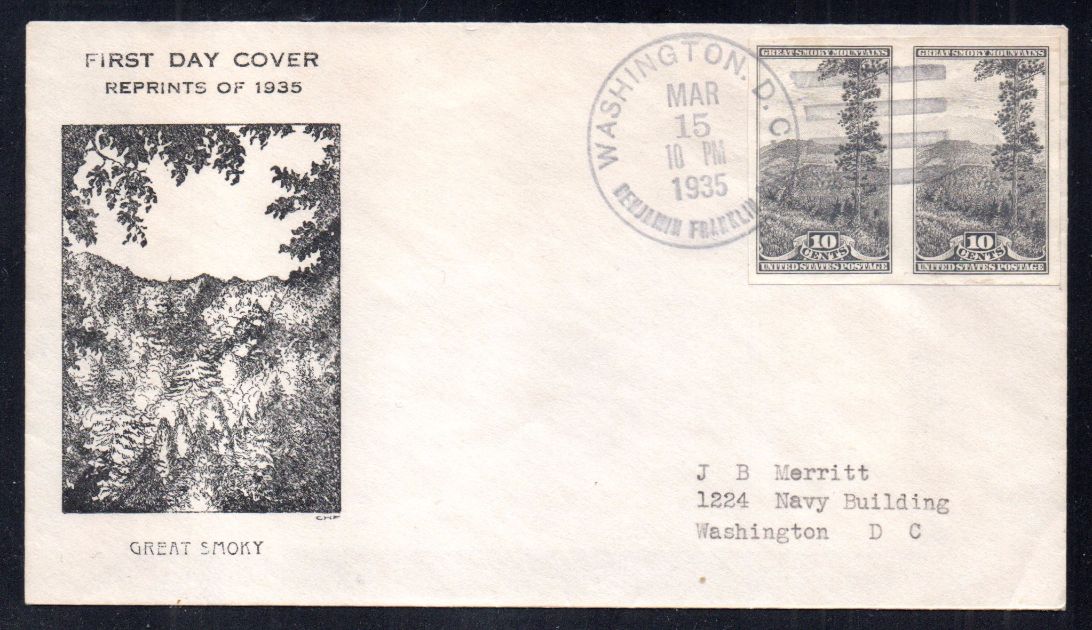
Finally, the following are representative examples of the First Day Covers for the issue.

First up is the Kapner cachet, in yellow and black, with a block of four. This is listed in Planty-Mellone as 765-20:


Next is one of my favorite cachet designers, Clara H. Fawcett. This is listed in Planty-Mellone as 765-26:


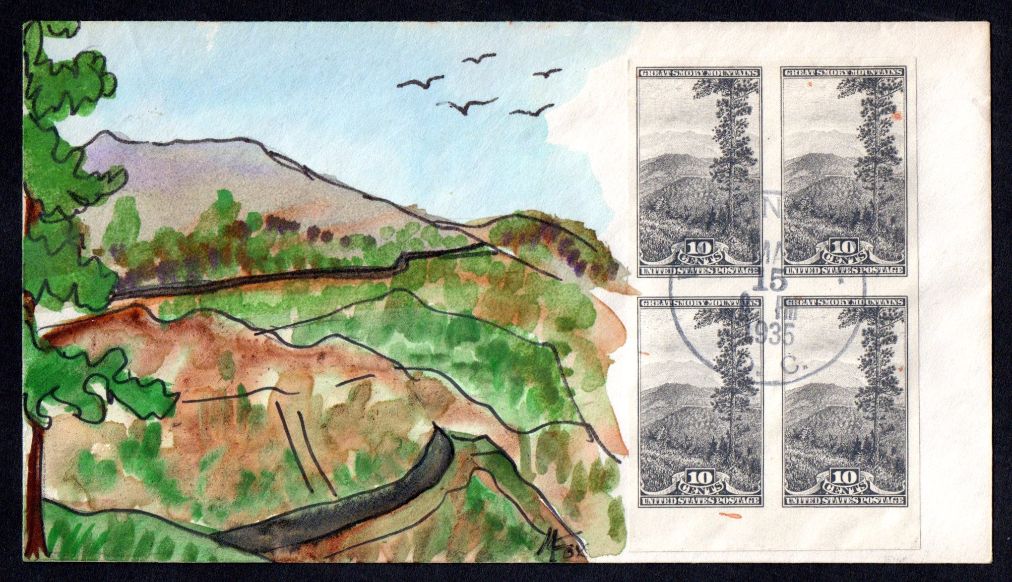
The final one is a hand-painted add-on cachet by M. Fox, done well after the fact, in 1996. I haven't shown any of these late add-on cachets, but they are out there. I found this one attractive. It is not listed in Planty-Mellone, and there are literally hundreds of covers, if not thousands, which are not listed. The cover is shown below:


The next installment on this thread will discuss the one-cent Century of Progress Farley Reprint, Scott 766.

As always, comments and questions are encouraged. If you have collateral material which fits this thread, please share it.
Send note to Staff  Go to Top of Page
Pillar Of The Community
United States
567 Posts
Posted 10/07/2017   6:26 pm  Show Profile Bookmark this reply Add rlmstamps2012 to your friends list  Get a Link to this Reply
Very nice presentation.

Congratulations on your past and future articles. As I stated earlier,
this would be an exhibit that I would not walk by. Have you, or do you have plans to exhibit your very interesting story?
Send note to Staff  Go to Top of Page
Edited by rlmstamps2012 - 10/07/2017 6:28 pm
Rest in Peace
United States
1189 Posts
Posted 10/08/2017   12:46 am  Show Profile Bookmark this reply Add Stampman2002 to your friends list  Get a Link to this Reply
rlmstamps2012, I greatly appreciate the comments. No, I have not exhibited yet and I'm thinking seriously about it, but that will have to wait until I retire. I just do not have the time to do it now.

By the way, the series of posts to this thread is not done yet. I've still got the last six issues of the Farley Reprints to post, along with a final post on the combination covers.
Send note to Staff  Go to Top of Page
Rest in Peace
United States
1189 Posts
Posted 10/13/2017   7:33 pm  Show Profile Bookmark this reply Add Stampman2002 to your friends list  Get a Link to this Reply

Scott 766

Scott 766 is the Farley Reprint version of the souvenir sheet first issued in 1933, Scott 730. The souvenir sheet, not previously discussed, was issued as one of two souvenir sheets for the Century of Progress Exposition in Chicago, also known as the Chicago World's Fair.

The souvenir sheets are identical; in point of fact, there is no way to distinguish a normal margin single from each other. The lack of gum on the reverse is not a valid factor, as it would be very easy to remove the gum from a single of Scott 730 to pass as Scott 766.

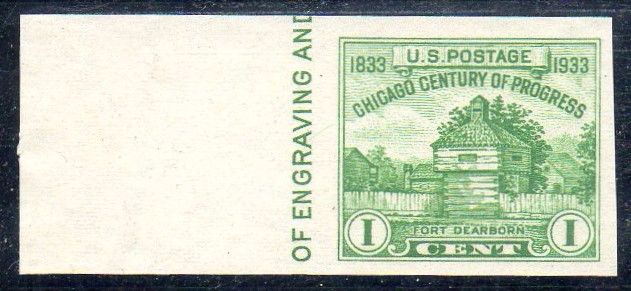
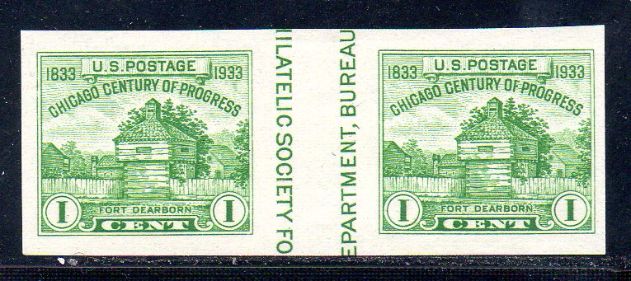
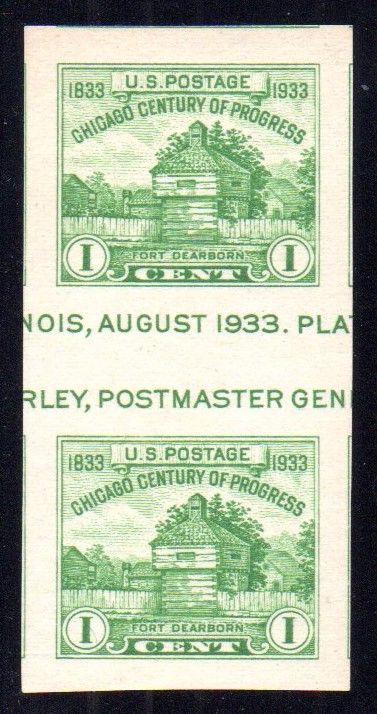
So how can these be distinguished from the earlier souvenir sheet? The only way is by the presence of the enlarged margins between the sheets, or as they are known, "gutter" singles, pairs and blocks.
Below is an example of a gutter single, followed by both horizontal and vertical gutter pairs.


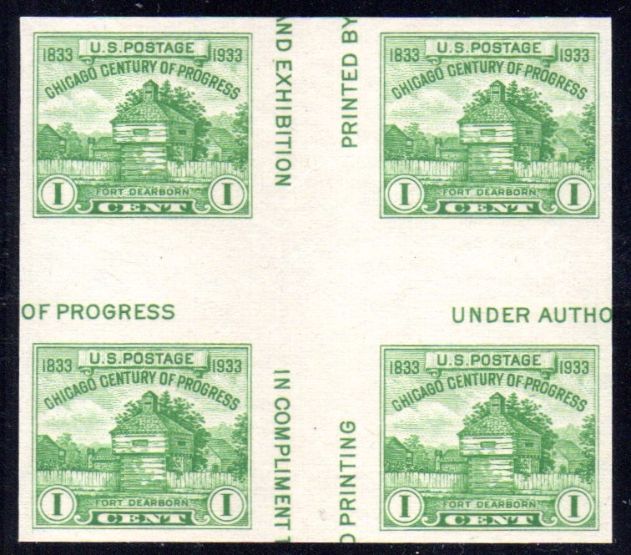
Scott 766 was printed in sheets of nine panes per sheet. Unlike the National Parks centerline blocks, where there would be only one per sheet, this meant there could be four center blocks, or cross gutter blocks, per sheet. An example of the way they are normally collected, in cross gutter blocks of four, is shown below:


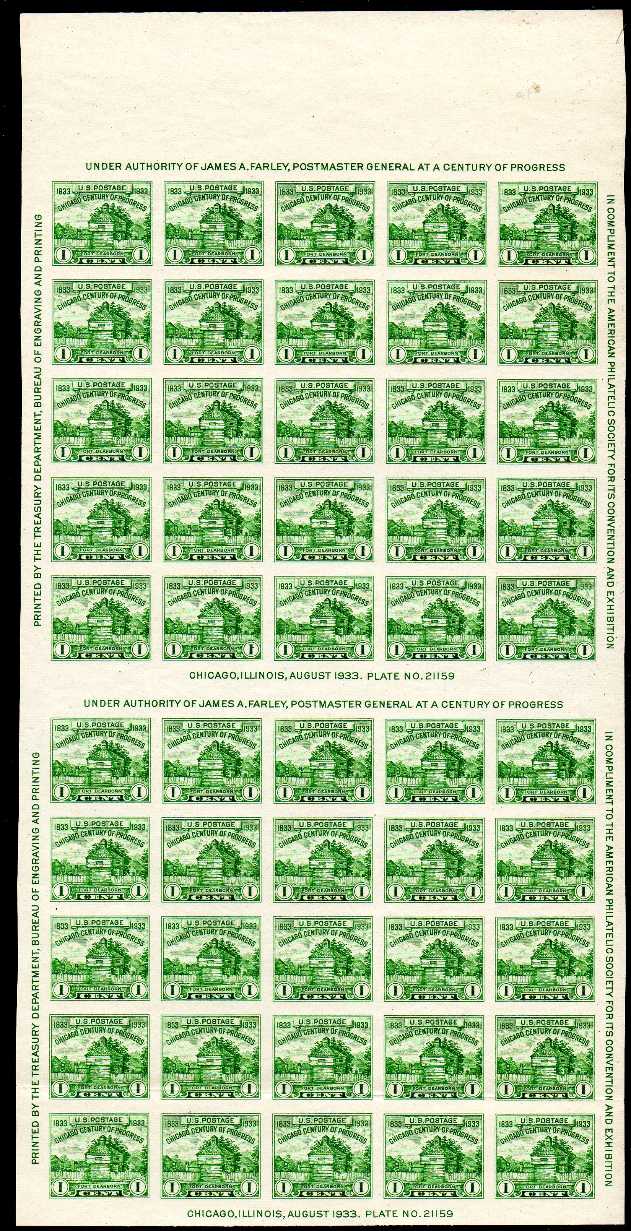
Even with the souvenir sheet whole, to qualify as Scott 766, it must have the large margins found on the outside gutters, contain part of an adjacent sheet or be in pairs. A vertical pair of sheets is shown below:


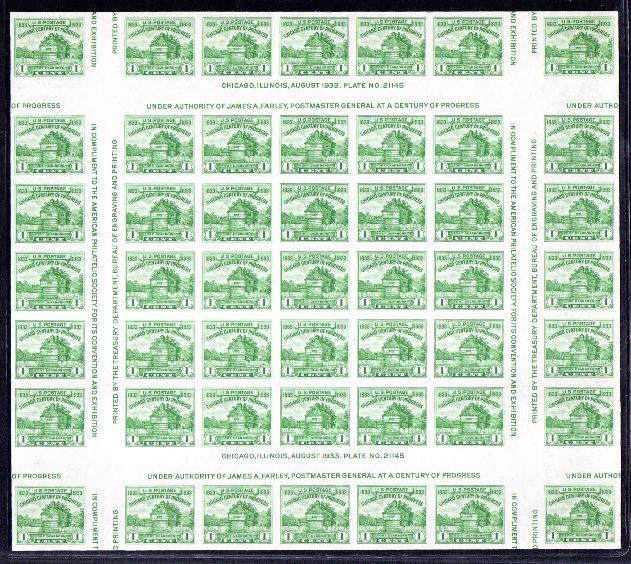
There is one possible way to make a unique position piece from an entire sheet. That would be to use the center souvenir sheet, and include parts of the other eight sheets surrounding it. This is shown below:


There are no proofs or essays for any of the Farley Reprints.

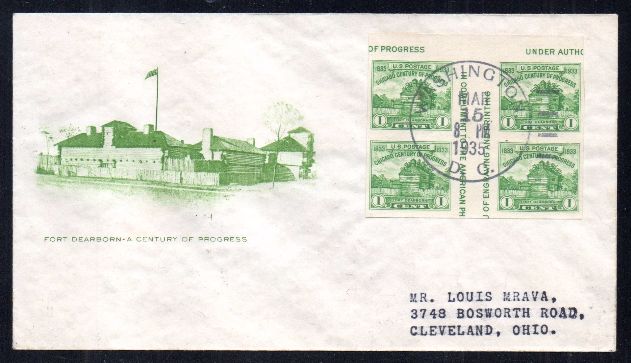
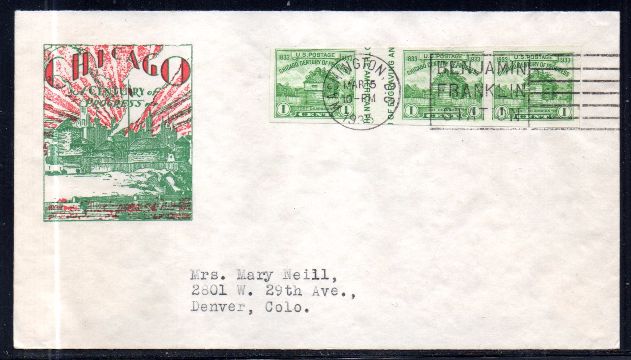
The First Day Cover selection follows. As with all Farley Reprints, they were issued March 15, 1935 in Washington, D.C. The first item presented is the Grimsland cachet in green, to match the stamp's color. This is listed as Planty-Mellone 766-1. I prefer to collect these with a gutter between to ensure they are Scott 766, although many collectors are satisfied with a cover dated March 15, 1934. This has a nice block of four with a vertical gutter between.


Next up is the First Day Cover cachet prepared by Harry Ioor. This features a horizontal strip of three with a gutter between the left and middle stamp. It is listed in Planty-Mellone as 766-2.


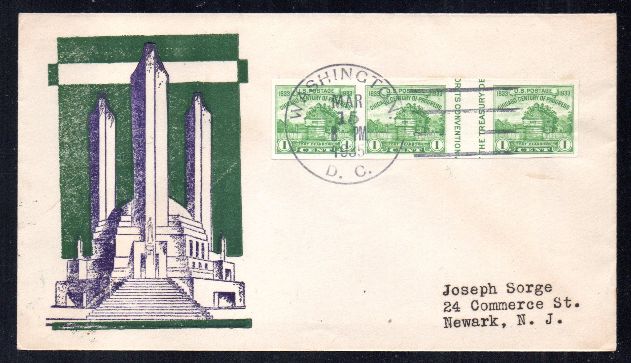
The next selection is a striking piece of Art Deco imagery. This cachet by Fairway is done in purple and green. It is listed in Planty-Mellone as 766-12a.


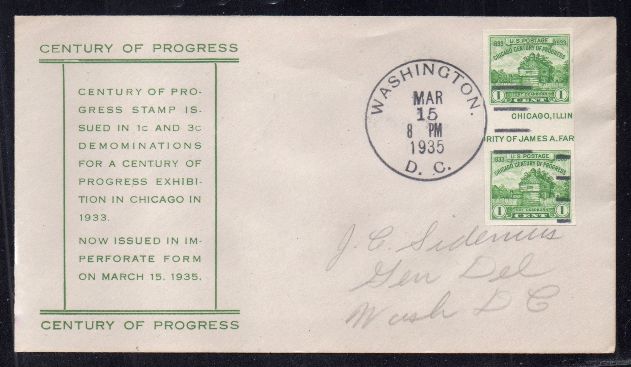
Ralph Dyer is credited with creating the cachet shown below. This feature a vertical pair with horizontal gutter between. It is listed in Planty-Mellone as 766-27b.


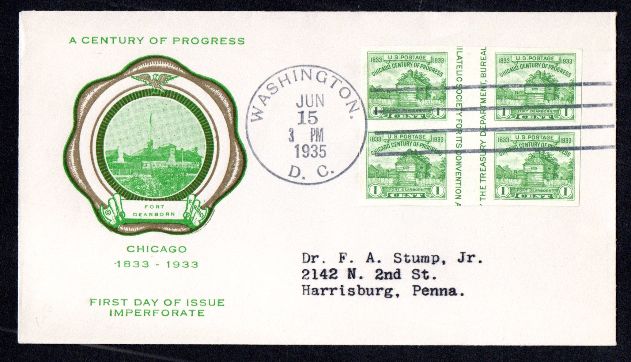
The final selection for this issue is the cachet prepared by F.R. Rice. It has a block of four with vertical gutter between. This is Planty-Mellone 766-32.


The next installment on this thread will discuss Scott 767, the Farley Reprint of the 1933 Century of Progress three-cent souvenir sheet.

As always, comments and questions are welcome. If you have anything to share related to this thread, I'd love to see it.
Send note to Staff  Go to Top of Page
Page: of 11 Previous TopicReplies: 154 / Views: 50,012Next Topic  
Previous Page | Next Page
 
To participate in the forum you must log in or register.
Go to Top of Page

Disclaimer: While a tremendous amount of effort goes into ensuring the accuracy of the information contained in this site, Stamp Community assumes no liability for errors. Copyright 2005 - 2026 Stamp Community Family - All rights reserved worldwide. Use of any images or content on this website without prior written permission of Stamp Community or the original lender is strictly prohibited.
Privacy Policy / Terms of Use    Advertise Here
Stamp Community Forum © 2007 - 2026 Stamp Community Forums
It took 0.2 seconds to lick this stamp. Powered By: Snitz Forums 2000 Version 3.4.05