| Author |
 Replies: 12 / Views: 2,331 Replies: 12 / Views: 2,331 |
|
|
Valued Member
United States
69 Posts |
|
|
Dumb question......My wife and kids have foreign PenPals. Today one of them received a letter (pic below) from Austria. Although I do not collect Austrian stamps, I still want to save them .... just because. How can I tell if these and other foreign self adhesives are soakable or not? I do not want to end up ruining the stamp if they are not. Is there an online source that tells which countries stamps / years will soak and which won't? 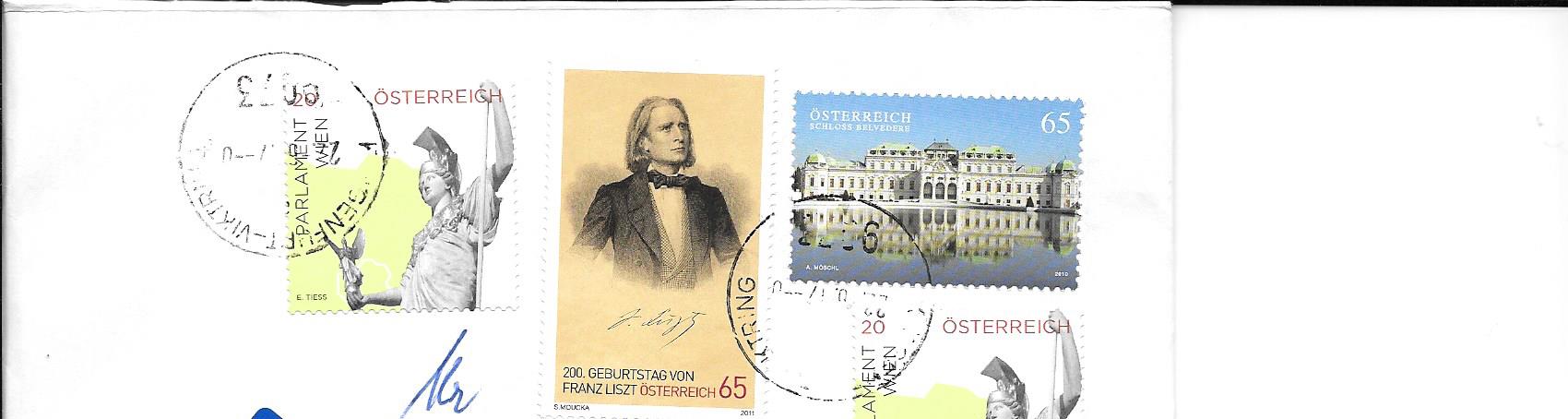 |
|
Send note to Staff
|
| Edited by Cougar01 - 06/29/2017 7:46 pm |
|
|
|
|
Pillar Of The Community
United States
8956 Posts |
|
|
Hi cougar. I am not familiar with an online source if there is one. But I do know that several stamp catalogs give this info, among others the Scott catalog. You might inquire at your local library if they have a recent Scott.
And this is not a dumb question! May I make a suggestion? Change your title from foreign to Austrian. Someone from Austria may ring in that way.
Peter |
Send note to Staff 
|
|
|
Pillar Of The Community
United States
7239 Posts |
|
|
Cougar, it comes down to experience. It isn't always consistent within a particular country.
My strategy is to try soaking with damaged stamps before I put anything in the water that I wouldn't want to lose. |
|
Send note to Staff
|
|
|
Pillar Of The Community
United States
3218 Posts |
|
|
If the technique for peel-n-stick stamps does not harm lick-n-stick stamps, try that first. |
|
Send note to Staff
|
|
|
Pillar Of The Community
United States
3224 Posts |
|
|
Quote:
How can I tell if these and other foreign self adhesives are soakable or not? In most quite a few cases, yes. Ones with internal cuts are purposely designed to fall apart when removed from envelopes. Quote:
Is there an online source that tells which countries stamps / years will soak and which won't? I doubt there's an all-in-one list. It presumes one person or one group has, since the 1970s, personally processed most all the different worldwide self-adhesives. Here's one method: https://goscf.com/t/31563&SearchTer...elf,adhesiveMore simply, you can also just neatly cut around each stamp, leaving a small frame of envelope. You could also save whole envelopes/covers. So it would be good practice to open the envelopes neatly. |
|
Send note to Staff
|
| Edited by hy-brasil - 06/29/2017 8:24 pm |
|
|
Bedrock Of The Community
Australia
38679 Posts |
|
|
Opinion:
1. If in doubt, save as is, no harm there.
2. Perhaps determine if these are actually die cut self adhesive, the 65o appears to be comb perfed, indicating traditional gum.
My experience with Canadian stamps, the modern self adhesives come off just as well in cold water.
|
|
Send note to Staff
|
|
|
Valued Member
United States
69 Posts |
|
|
Thanks for all of the replies! My local library does have newer Scott Catalogs (2014 edition). I was hoping to avoid having to run there every time another envelope arrives in the mail. LOL. Perhaps I'll just trim the envelope close to the stamp, and create a list of each stamp received. Then, take that list to the library every so often to determine if it does soak. If it doesn't, then at least the stamp is already trimmed and ready for mounting. I just wasn't sure if there was something online to reference or not.
|
|
Send note to Staff
|
|
|
Bedrock Of The Community
Australia
38679 Posts |
|
|
In the scheme of things, consider the scale of diminishing appreciation.
1. Keep the cover intact.
2. Cut the envelope to a fragment of the desired size, (the 3 stamps inclusive of any postmarks, auxilliary markings, etc )
3. Cut each individual stamp at least 4mm from the perforations. (here consider most stamps are available to purchase as soaked already, for a few pennies)
That said, one collects whatever way one desires.
|
|
Send note to Staff
|
|
|
Pillar Of The Community
United States
2055 Posts |
|
|
I've soaked quite a few recent Austrian stamps and never had a problem with getting them to come off paper; most of them soak off nearly as easily as those with traditional gum. I've actually soaked the stamp on the far left and bottom right, but I haven't soaked the other two that are pictured, so you never know. Most self-adhesives of European countries are soakable to one degree or another, however, so you're usually safe, some recent issues of Britain and Ireland being notable exceptions. |
|
Send note to Staff
|
|
|
Pillar Of The Community
United States
1495 Posts |
|
|
Unless this is a very recent change, Scott does not provide a soakability evaluation for foreign stamps, only U.S. stamps.
Robert |
|
Send note to Staff
|
|
|
Pillar Of The Community
Canada
5821 Posts |
|
|
First of all the two commemoratives the 65c Liszt and the 65c Schloss Belvedere are water activated sheet (10) stamps and soak off very easily in lukewarm water.
The 20c Parliament stamps are part of the 2015 definitives printed by Joh.Enschede Netherlands and are self adhesives issued in rolls (coils)and booklets.
They also come off the paper quite easily after soaking in lukewarm water for +/-10 minutes.
Austrian SA stamps do have a mildly sticky film layer which you can remove easily by gently rubbing the gum side with your thumb while still immersed in water.
|
|
Send note to Staff
|
|
|
Pillar Of The Community
United States
7239 Posts |
|
|
To add a bit to lithograving's advice, whenever you see a faintly milky cloud while soaking...or if the water becomes milky, it is a good idea to rub the remaining gum layer off the back of the stamps. I usually soak again in a fresh bath, also. The glue barrier in this case is PVA and it can pull the ink off the fronts of other stamps if they are stored in glassines and the backs are not completely clean. |
|
Send note to Staff
|
|
|
Pillar Of The Community
United States
2055 Posts |
|
|
Yes, with any self adhesive stamp, you want to make sure you get all of the gum off. Any little dollop that's left over will stick to anything and everything once it dries. |
|
Send note to Staff
|
|
| |
Replies: 12 / Views: 2,331 |
|



 Posted 06/29/2017 5:22 pm


