| Author |
 Replies: 69 / Views: 12,590 Replies: 69 / Views: 12,590 |
|
|
|
Valued Member
213 Posts |
|
|
Pillar Of The Community
United States
2555 Posts |
|
|
Quote:
Lets conduct a test argument; Under the "ink theory," the superior printings of 1856 should be due to rose red being "richer" than all others of the period. However, nobody is saying that. Nor were the plates used in 1856 considered "new". So, how come the 1856 RR impressions are so superior to others of the period? Hint, it's the same reason the '51 OB printings were so much better. Most of the YRR stamps discussed in this thread are from Plate 8 which was in fact a brand new plate. Also, good impressions were produced at many points during the 10 years that Toppan Carpenter produced stamps. Impression quality changed in lockstep with apparent changes in printing inks. Shall I post a beautiful example of a #26 that I have labeled as YRR? |
Send note to Staff 
|
|
|
Pillar Of The Community
United States
2948 Posts |
|
|
Quote:
Mr. Steel sought to re-introduce plate paper, and that's what resulted in the '56 RR printings. The words "sought to re-introduce" give me pause... are we assuming he accomplished this (use of plate paper) because the quality of printing? Or is there proof in the form of invoices, letters, cancelled checks... etc.? |
|
Send note to Staff
|
| Edited by stampcrow - 04/07/2018 8:10 pm |
|
|
Pillar Of The Community
United States
2555 Posts |
|
|
Here is a stamp that I have identified as a YRR shade, I believe printed in 1859. Nice impression I would say... 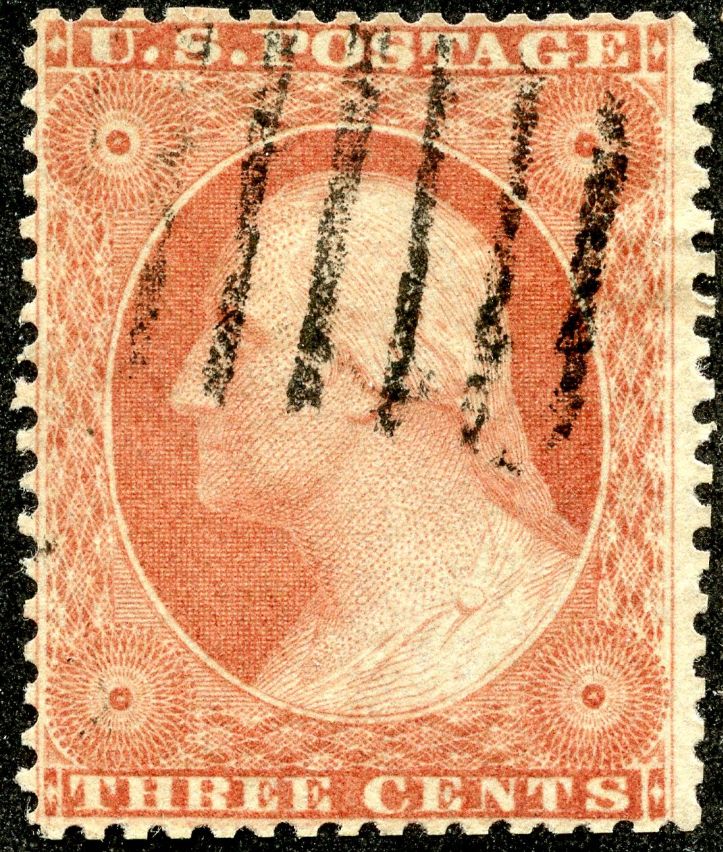 |
|
Send note to Staff
|
|
|
Valued Member
213 Posts |
|
|
I do apoligize, I've had a heavy work schedule as late and have been unable to follow-up more readily.
StampCrow writes: "is there proof in the form of invoices, letters, cancelled checks... etc.?" Actually, a first-person quote from Mr. Steel himself. Be advised, I originally wrote, "According to information supplied by the Smithsonian, Mr. Steel sought to re-introduce plate paper, and that's what resulted in the '56 RR printings."
This is a problem I struggled with for many years, and so I kinda know what readers are thinking, namely--how to tell the difference between plate paper and press paper. (Note: This is the same question as how to tell the difference between SCN #10 and #11.)
continued. |
|
Send note to Staff
|
|
|
Valued Member
213 Posts |
|
|
Within this thread there are a number of high resolution scans showing details of dots on Washington's nose, shading under the eye, toga button's, etc. One would naturally think, "Oh yes, that's got to be it!"
However, the above areas of the design are not deep enough to be used for comparison purposes. That is, when a design becomes worn, these are the areas that disappear first. In order to be consistent, what is needed is an area that is deeply engraved, and that would be the tessellation around the the medallion. The tessellation is deeply engraved, and shows up clearly on nearly every stamp.
And so, the thing to look for in comparing and contrasting print quality, and in relation to surface treatment of the paper, are details of the tessalation.
continued. |
|
Send note to Staff
|
| Edited by AJ Valente - 04/09/2018 09:39 am |
|
|
Valued Member
213 Posts |
|
|
Here are two '56 stamps, the first a paler rose red with red, and the other a pinkish rose. The colors are very close, but there's a big difference in impression quality. Here's a side-by side comparison. Can you spot the differences in the tessellation? 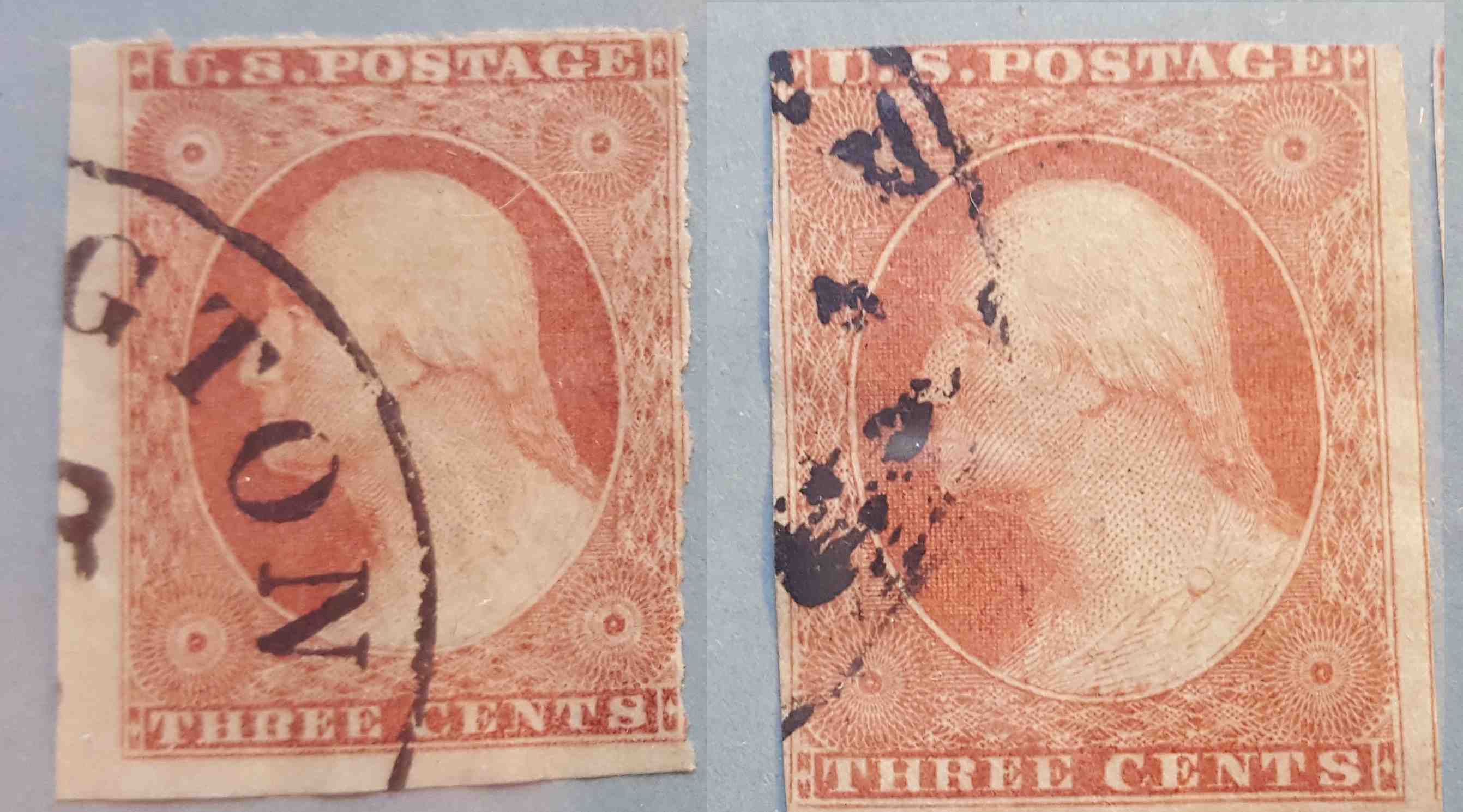 Now, take a closer look. The tessellation is deeply engraved on both stamps, but the clarity of impression on plate paper is markedly better. 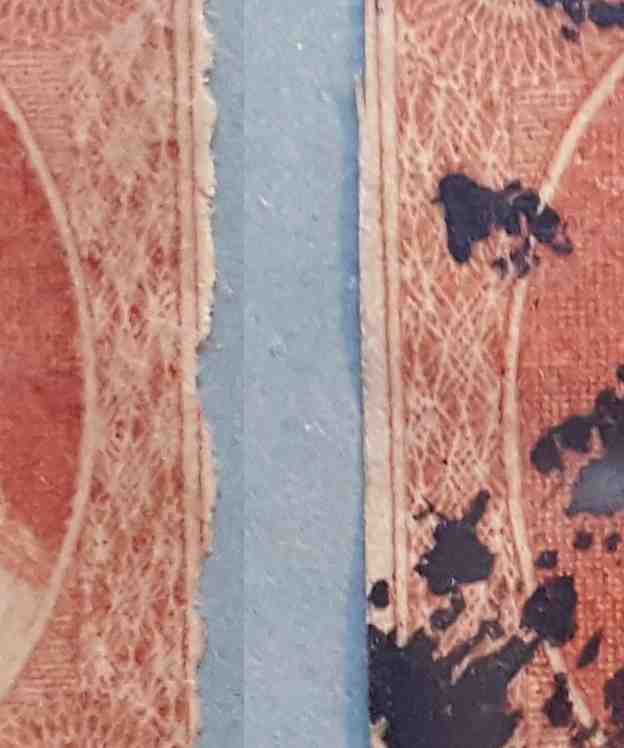 continued. |
|
Send note to Staff
|
| Edited by AJ Valente - 04/09/2018 09:40 am |
|
|
Valued Member
213 Posts |
|
|
One last comment, this regarding "new" plates. With regard to the fundamentals, and it is true with most all stamp issues, the first few sheets pulled from a new plate exhibit better than average impression quality. These I call "sharp early" printings. However the effect passes rather quickly and impressions soon revert to normal for the issue.
On the flip side of that discussion, with regard to the 3-cent 1851, press paper is normal for the issue. It is an excellent paper overall, but problems will still be encountered with dry printings, excessive inking, ink encrusted within the recesses of the plate, etc. Add that to environmental factors as IR fading, weathering, chemical treatment, etc. and we end up with a number of things that affect impression quality, but not related to the paper. In order to judge the paper properly, one must only consider well-inked samples on clean paper.
So, there you have it. If you wish to find plate paper examples from 1856, look at the tessellation. The tessellation is the guide to plate paper.
|
|
Send note to Staff
|
|
|
Pillar Of The Community
United States
2948 Posts |
|
|
AJ, I'm sorry if I come across as abstinent, but I guess I'm still stuck on semantics. Quote:
Actually, a first-person quote from Mr. Steel himself. Be advised, I originally wrote, "According to information supplied by the Smithsonian, Mr. Steel sought to re-introduce plate paper, and that's what resulted in the '56 RR printings." "sought to re-introduce", Is that the quote you're referring to? Or is there a more specific quote stating the paper was actually purchased and used? |
|
Send note to Staff
|
|
|
Replies: 69 / Views: 12,590 |
|




 Posted 04/06/2018 10:44 pm


