Here is a link to a Youtube video on the history of the Pan Am Clippers during World War 2. Clipper Postal History fans should enjoy this. It starts off with the development and expansion of PAA including many references to the first airmail routes.
At the 15 minute mark, it covers the last commercial flight of the Clipper Anza to Honolulu on December 7th, 1941. There was another thread regarding a cover that recently sold on ebay that was on this flight.
Its a facinating story of the importance of the established PAA routes during the war effort.
oTzpFX2BPPI
*** Edited by Staff to add YouTube tags. Please use them in the future. We prefer embedded video. ***
Not only the importance of PAA's established routes, but the personal of PAA. Already experienced made them great instructors, PAA's contribution of the V-Mail program. Very interesting, thank you for sharing the link.
While Juan Trippe is usually the face of the original PAA, it was originally created by Hap Arnold and three other US servicemen. The following is a page from an exhibit giving some background on the origin of PAA. When the Army took over PAA's foreign assets during WWII, it was then headed by Arnold, now Chief of the USAAF. I've often wondered if either Arnold or Trippe recognized the irony.
Blcjr - Very interesting information on the formation of PAA and nice cover.
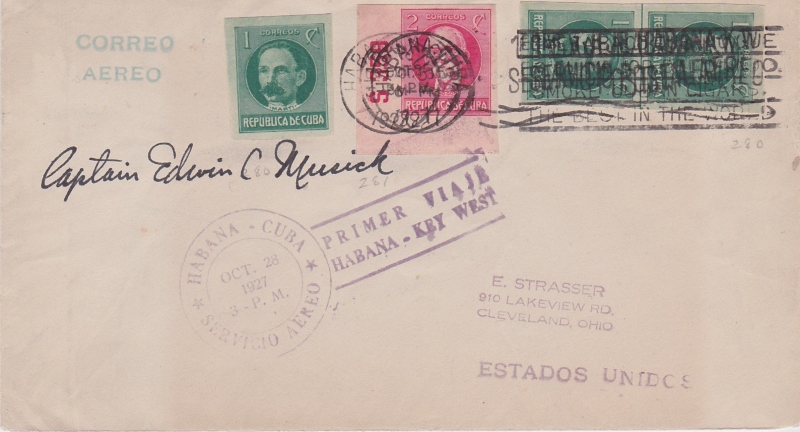
Was 2 cents the correct rate or was it underpaid? At first glance, the Habana marking appears to be a receiving postmark. However, the American Airmail Catalog indicates that it is a second Key West cachet. Are there any markings on the reverse?
Quote: Was 2 cents the correct rate or was it underpaid? At first glance, the Habana marking appears to be a receiving postmark. However, the American Airmail Catalog indicates that it is a second Key West cachet. Are there any markings on the reverse?
No markings on the reverse. While the Havana marking is described as a cachet in the AAMC, it served as the receiving postmark. The rate is correct. The formal airmail service, with the familiar C1-C3 airmail stamps, was discontinued as of July 19, 1919, and mail carried by airplane began to be carried at the standard first class rate of two cents. The second airmail series began in 1924 intended for night-flying transcontinental service, so wouldn't apply here.
Note, however, that Musick was NOT the pilot on FAM 4-2. He was however the pilot for the return flight, FAM 4-3. Here is a signed cover from that return flight:
Musick would go on, of course, to pioneer many of the Clipper flights.
The first flight from Miami to Havana was pre-FAM service but is listed in the American Air Mail Catalog as flights F4-1, F4-1a, and F4-1b which are all variations on this flight. They were flown on November 1 and November 4, 1920. The second first flight was flown under the Foreign Air Mail (FAM) service and was also the inauguration of Pan American Airways as an airline. This first flight was flown on October 19, 1927, is listed as F4-2, and it has a special octagonal rubber stamped cachet in either magenta or purple. The pilot on this first ever Pan Am first flight was Cy Caldwell. All of that mail was cancelled with a Havana receiving cancel/cachet that was a machine roller cancel with special wording in the killer bars in black ink reading "1er VIAJE HABANA-K.W. SERVICIO POSTAL AEREO". The return flight, one of which Basil illustrates above is listed as F4-3 and was canceled on October 29. 1927. The cachet for this flight is what you see in the center of Basil's cover and they are found in purple like his, and also blue and violet which are less common colors to find. The pilot of that flight was not Edwin Musick - rather he was the "Assistant Pilot" or co-pilot as we say today. The pilot who was in command of that flight was Hughie Wells.
Kimo, interesting information. What is your source for the information that Musick was the "Assistant Pilot." He's the only pilot listed for the flight in the AAMC (at least through the 5th edition).
Followup: I've found a source indicating the Wells was the pilot and Musick the "Navigator" on the Key-West to Havana flight on the 28th. That flight is not in AAMC because it was not the inaugural flight; that was FAM 4-2 on the 19th. The return flight of the 28th was delayed until the 29th because of rain. Is it possible that Musick WAS the "Captain" of the return flight per the AAMC?
The source for Musick as the Navigator of the Key-West to Havana flight on the 28th is:
My source is the 6th edition of the American Air Mail Catalog, Volume 3, page 26. The sixth edition has much more information than the old fifth edition. They list Huey with his full name of Huestice I. Wells, but I typically see him mentioned as Huey and he typically autographed things as Huey as well.
Kimo, are you able to post a scan of that page, or the relevant portion of the page? I can always try to get a copy of it from APRL if not.
I continue to research this because I'm considering using the FAM 4-3 cover in an exhibit, and want to understand the background as clear as I can. So I just now came across this:
Quote: At Key West, Pan American Airways representative J. E. Whitbeck learns on October 18 that a float-equipped Fairchild FC-2 belonging to West Indian Aerial Express, S. A. (WIAX), en route from New York to Barahona in the Dominican Republic, has stopped at Miami to fix an oil leak. Whitbeck quickly asks the careful pilot, Cy Caldwell, if he will fly 7 sacks of Key West mail (13,000 letters), plus another 15,000 just in by train, to Havana under contract to Pan Am. Caldwell, who will have to stop at Havana en route to the Republic, agrees. He reaches Key West at dusk and accepts Whitbeck's payment of $145.50.
At 8:05 a. m. on October 19, La Nina, piloted by Caldwell and carrying its 251-lb. Pan Am payload, departs Key West. One hour and 10 minutes later, she arrives at Havana. FAM-4 is at least temporarily secure and the prospects for Trippe's airline brighten greatly. Conversely, Caldwell inadvertently dooms his own employer to a future takeover.
During the next 10 days, the Meacham airfield becomes sufficiently serviceable to allow Pan Am's two Fokkers to fly in from Miami. Due to inclement weather, breakfast ceremonies marking the official inauguration of FAM-4 and the company's first regularly scheduled flight are held in a Key West hotel, La Concha. From the little one-hangar field on the island at the end of the Florida Keys, the inaugural Fokker, piloted by Hugh Wells with Edwin C. Musick as navigator and John Johansen as engineer, lifts off for Havana with 772 pounds of mail at 8:25 a. m. on October 28.
An hour and 20 minutes later, the Dutch-built aircraft lands at the Cuban capital, where it is met by President Gerardo Machado, who rechristens it General Machado. A foot of rain falls on Havana overnight delaying the Fokker's return; Musick and Wells change seats for the flight back to Key West on the morning of October 29. Landing at noon, the aircraft picks up another load and returns to Cuba before sundown.
The details are so precise I feel that they must have been copied from some other source, but there is no attribution and Google cannot find any other source.
Let me see what I can do in a few minutes on the Volume 6 text. In the meantime here are a couple of FAM 4 covers from my collection. The first is an F4-2 with the pilot, Cy Caldwell's autograph. The second is an F4-3 with both pilots, Hughie Wells and co-pilot Ed Musick's autographs.
Hughie Wells was the pilot in command since at that point Ed Musick did not have his license to command an aircraft though I am sure Wells allowed him to take the controls for a part of the flight under his supervision. Pan Am allowed Musick to portray to the public that he was the pilot, but the reality was that it was Wells who was legally the pilot in command no matter which seat they each sat in. It would be like back when I was a student pilot I got to sit in the left seat while the instructor pilot sat in the right seat, but it was the instructor pilot who was fully licensed and as such was the pilot in command. I have not yet come across the reason why they wanted Musick to be portrayed as the pilot in command, though one guess is that perhaps Musick was officially a Pan Am employee while Wells was not and was hired just to give Musick both the legal coverage he required as well as the appearance of Pan Am actually being in charge. If so it would be a little like what Pan Am did on the flight from Miami to Havana where the day came for the first flight and Pan Am had to fly the mail to meet the terms of their Post Office Contract under their new Foreign Air Mail (FAM) contract route number 4. However, on that day Pan Am still did not have any planes or pilots who could fly the mail so they hired Cy Caldwell who had just happened to be going through Miami ferrying a seaplane. For $150 he agreed to fly the mail that day and so allowed Pan Am to say they complied with their Post Office airmail contract and stay in business.
Here is a photo of part of the pages in the Sixth Edition of the AAMC that describe F4-2 and F4-3. Note the caption under the photo.
While we are chatting about the beginning of Foreign Air Mail Route number 4, I thought people might like to see an example of F4-1, the very first, first flight which took place in 1920. Back then the air mail contract was awarded by the Post Office under what they then called Route 1 from Miami to Havana. It was awarded to Aeromarine West Indies Airways, Inc. This first, first flight occurred on November 19, 1920. This example is from my own collection and they are quite rare. So far I have not seen any others but I am sure they must be a few out there somewhere. Below are photos of the front and the back. Notice that there are two cachets on the front, one being a straight line "FIRST TRIP" and the other being a 4 line text cachet reading "FIRST TRIP / NOV.-1-1920 / U.S. - CUBA / AIR MAIL". Both of these are unofficial cachets. Both are hand stamped in purple ink. On the back is a small circular date stamp along with a machine cancel receiving cancel. The round one by itself is actually the official flight cachet and they were applied to the backs of the covers as you see in this one. It reads "CORREO AEREO PRIMER VIAJE" around the outside edge and in the middle it reads "1o NOV. 1920" Note that the 1o is actually a numeral "1" with a small letter "o" after it which is the Spanish abbreviation for "first" and it is not the number 10.
am I reading it right that there is no "Seventh Edition" yet for the FAM material in Edition 6, Volume 3? And I cannot tell which Volume of Edition 6 would cover CAM routes; would you know?
As ever, thanks for sharing your expertise with the forum.
I'm still unsure what to think about who piloted the return flight from Havana on Oct 29th. The idea that it was Musick must have originated somehow. I could see how he was listed as the assistant or navigator (as in some sources) and still actually took command of the return flight. But I'd want more confirmation before being sure about that. I'll keep looking.
Disclaimer: While a tremendous amount of effort goes into ensuring the accuracy of the information contained in this site, Stamp Community assumes no liability for errors. Copyright 2005 - 2026 Stamp Community Family - All rights reserved worldwide. Use of any images or content on this website without prior written permission of Stamp Community or the original lender is strictly prohibited. Privacy Policy / Terms of UseAdvertise Here





 Posted 07/24/2017 8:49 pm