Volume 3
My third installment in this series centers on a rare and misunderstood stamp from Nigeria. In 1965, Nigeria issued a colorful definitive set depicting wild African animals, Scott 184-97 (Gibbons 172-85). The set has various varieties such as shades, perf changes, and multiple redrawn designs. Scott and Gibbons both list the redrawn stamps as separate sets- Scott 258-67 and Gibbons 220-30 plus 231-2.
Image of the original set from 1965:
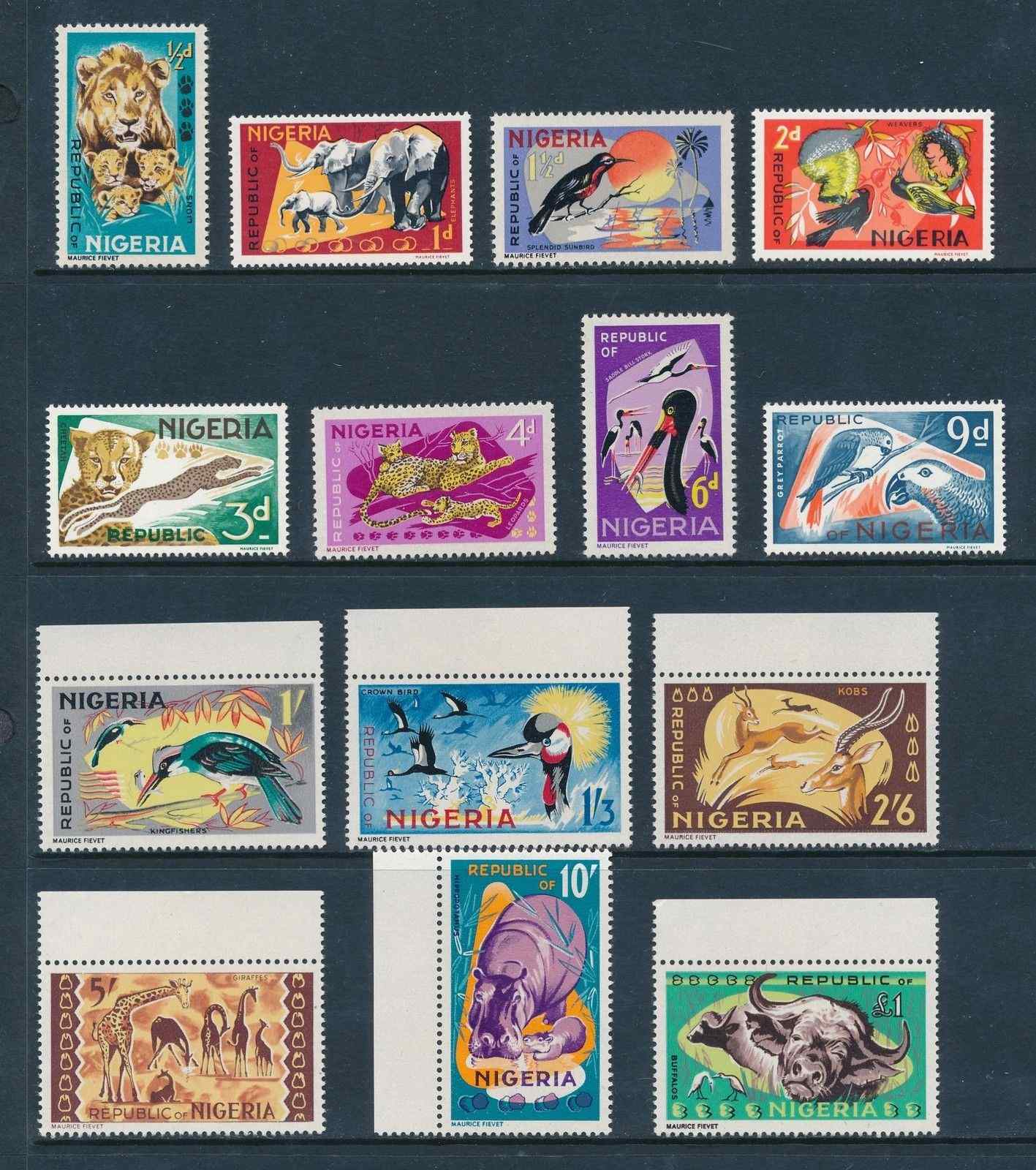
Scott and Gibbons both list a shade variety for the 2d value from this set, the 1971 reprinting with white numeral instead of yellow, 187a and 231 respectively. Gibbons also lists a shade for the 5/- (183a) however those of you who are familiar with this set will know that some values such as the 3d Leopard and 4d Cheetah exist in a broad range of shades.
Our focus now turns to the 4d value which depicts Cheetahs. There are several varieties of this denomination which are easily identified.
Scott 189/Gibbons 177 (Image also applies to Scott 189a which is perf 12.5 x 12):
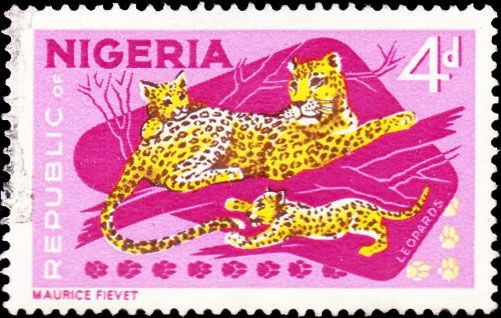
Next is Scott 189b/Gibbons 232 with designer's imprint at bottom right. Scott notes that the "4" is 5mm wide in this printing, however 189b is easily identified based on the Designer's imprint now moved to the lower right margin.
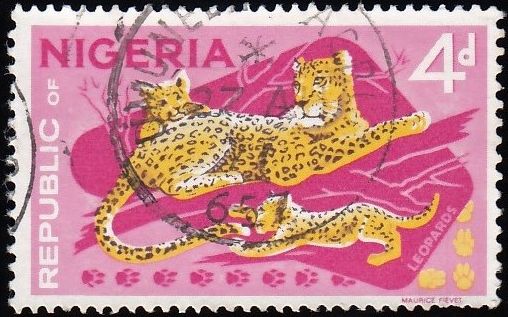
From 1969-72, Nigeria reissued 10 of the original 14 values with redrawn designs and lower-margin imprints. This is the basic 4d stamp one is likely to find from the redrawn set. Note the designer's name is located at lower right, while the printer's imprint has been added at lower left:
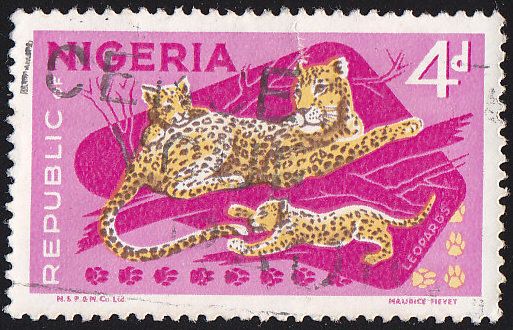
Despite footnoting printing variations for the 2d and 3d for the 1969-72 issues (Scott 259 & 260), Scott does not list any varieties for the 4d stamp, Scott 261. Gibbons lists the redrawn 4d as 224 but lists a variety as well, Gibbons 224a. Gibbons describes 224a simply as "Smaller imprint," and in the footnotes states:
"No. 224 has the left-hand imprint 6 mm long and the right-hand 5.5 mm. On No. 224a the imprints are 5.5 mm and 4.5 mm respectively. The width of the design is also 0.5 mm smaller."
Thus, if one is to find SG 224a, one must discern 3 differences in the design that each measure 0.5 to 1 mm. This can't be done without a glass, and likely can't be done without measuring. Imagine sitting at a bourse dealer's table with a known copy of the common printing and sorting through their redrawn 4d's looking for the scarce variety. Not an ideal situation and frankly, not likely to yield success except with extreme persistence. Why is this the case?
This printing is RARE. Gibbons currently prices 224a MNH at GBP 90, and does not price used at all. That said, I have searched for this variety for years, and have only ever found 3 definite copies, all USED! Two were found in a large accumulation I bought on
ebay, however, both copies had significantly damaged perfs due to too-close clipping. The third copy I discovered on Delcampe in 2017, only because I had come up with a way to identify SG 224a without measuring. I have never found a mint copy of this stamp although I very much want one.
How can the rare printing be differentiated without measuring? Below, I present a side-by-side image of Nigeria SG 224 and 224a. Hopefully some differences will jump out at you:
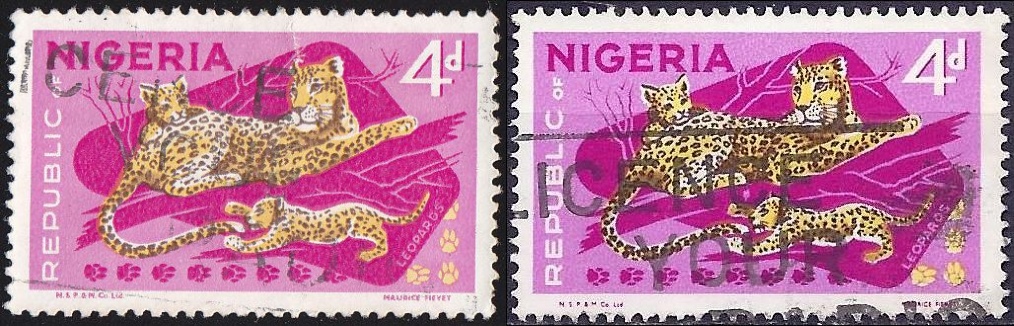
The distinguishing element I use to identify the 2 different imprints is not the font size difference, although the right-hand stamp clearly has a smaller font. Instead, the 3 used copies I have found all have the imprints centered in the middle of the bottom margin, vertically. The common printing has the imprint closely tucked under the paw-prints.
Here is a closer-up comparison. Note the space between the paw prints and the lettering- much wider in the rare printing at left. It is also notable that the "M" in the rare imprint is raised relative to the other letters, and is much shorter in height.
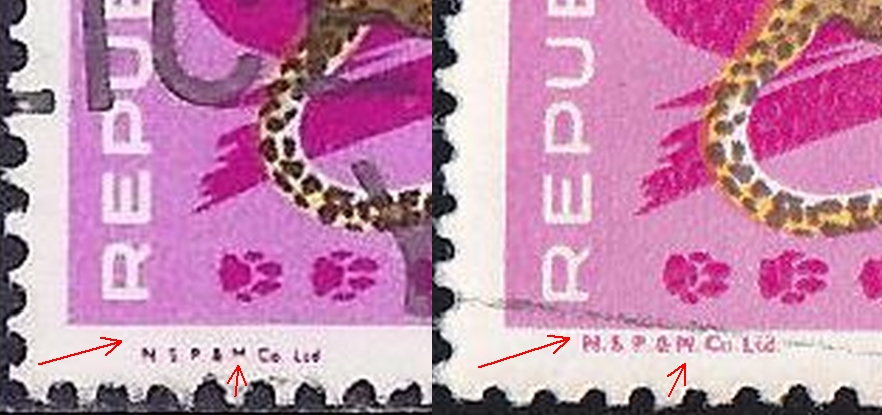
There is obviously a dramatic difference in shades between the stamps, however I don't have enough info to be sure if this difference is consistent and thus an additional landmark to help separate these 2 printings. Likewise, I cannot say for sure that the rare printing is always centered in the middle of the bottom margin vertically. What I can say for sure is that this stamp is quite rare, especially mint, and that I would like very much to locate a MNH copy.
You may not care, but the stamps ARE rare!





 Posted 07/29/2017 11:53 pm