| Author |
 Replies: 11 / Views: 2,312 Replies: 11 / Views: 2,312 |
|
|
Pillar Of The Community
United States
572 Posts |
|
|
My postcards arrived in this envelope the other day. I'm not familiar with the type of perforations on the 2 left hand stamps--the spaces centered on all 4 edges. What would you call them? And why that arrangement? 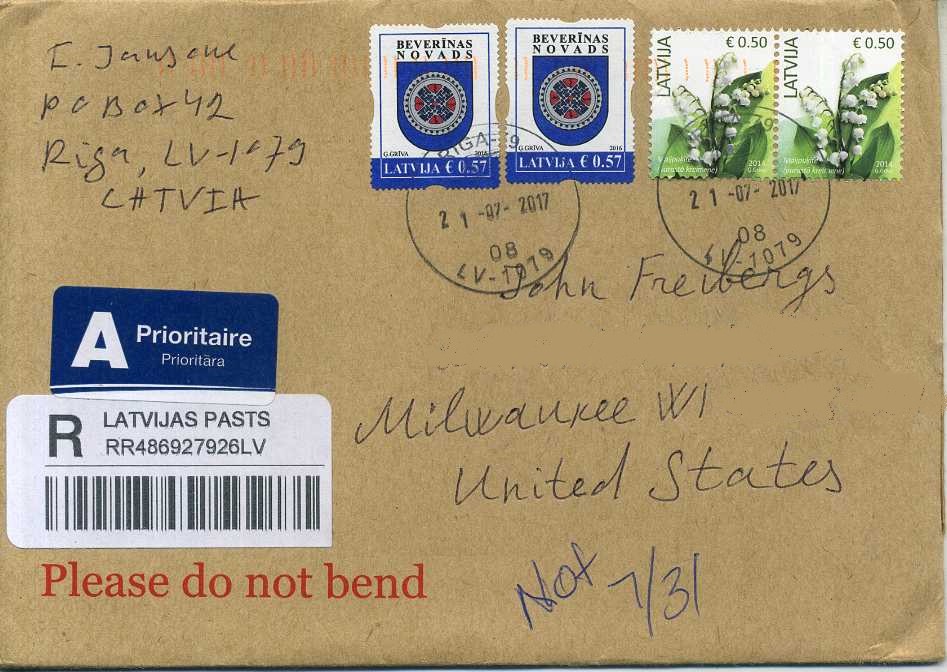 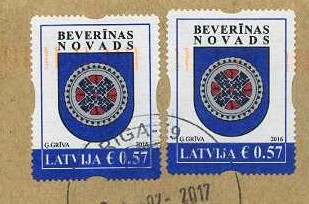 |
|
Send note to Staff
|
| Edited by John Freibergs - 08/03/2017 7:44 pm |
|
|
|
|
Pillar Of The Community
France, Metropolitan
3753 Posts |
|
|
Pillar Of The Community
United States
572 Posts |
|
|
Thanks. I edited those out before posting. Sorry. However reading the article in the link just now, there's no mention of the perforation variety. So that question still remains. And then something that came to mind, how would you even count the perforations if you wanted to describe the stamp? |
Send note to Staff 
|
|
|
Pillar Of The Community
United States
8956 Posts |
|
|
John, I do not know about Latvian stamps, but in England some of the Machins have had these elliptical perforations since 1993. The are also called "syncopated" perforations. See http://adminware.ca , although I can find no reasoning behind these. Peter |
|
Send note to Staff
|
|
|
Pillar Of The Community
United States
572 Posts |
|
|
Are they meant for some sort of device? Are the stamps supposed to be easier to separate? And how do you count the perfs? Just what's on either side of the ellipse? I really haven't paid much attention to modern Latvian stamps, but this is the first time I've seen something like that on an envelope coming my way. |
|
Send note to Staff
|
|
|
Valued Member
United States
42 Posts |
|
|
perf12, the zip code and street address have been obscured on purpose--they are still there. |
|
Send note to Staff
|
|
|
Pillar Of The Community
United States
1497 Posts |
|
|
The syncopations in the die cuts (there are not really perforations) are meant to be a security measure to make the stamps harder to counterfeit.
You measure the "perforation" gauge normally, while ignoring the ellipses. As an example, in a stamp catalog, it might be described as "die cut 15 syncopated" with a note describing the number and locations of the ellipses.
Hope this helps somewhat.
Robert |
|
Send note to Staff
|
|
|
Pillar Of The Community
United States
572 Posts |
|
|
Thanks Trainwreck and everyone. I saw a little bit about the Machins and the security part of it. I guess someone figured if 2 sides are good, all 4 sides are even better. I don't see a big market in counterfeit modern Latvian stamps, but then again who knows. |
|
Send note to Staff
|
|
|
Pillar Of The Community
United States
8574 Posts |
|
|
The word "syncopated" is a term used from the music business . It was used first in the United States, the British used a different term . It was used to describe early Netherlands perforations from the 1920's or 1930's ,I don't have a catalog here .But over the last 15 years "syncopated" has now become a philatelic term accepted by everyone who speaks English . |
|
Send note to Staff
|
|
|
Valued Member
United Kingdom
314 Posts |
|
|
Trainwreck, you say "they are not really perforations", but in my opinion they are because:
1) They still comprise a metal perforating pin, but that pin is simply not round.
2) They are punched out of the sheets, just like round pins are, and at the same time.
3) They are set into the perforating comb alongside the round pins where needed.
4) They have a corresponding shaped hole in the base plate for the pin to enter when perforating.
Incidentally, non-round pins are VERY expensive for the printer (or forger!) to purchase and are not an "off the shelf" item. An odd-shaped pin, say a Maltese Cross or a star, can cost 200 euros PER PIN. This is why they are seen as a security feature, as a sheet of 10 stamps would use 27 of the special pins if employed once on all four sides of each stamp. That's 5,400 euros-worth of pins. (Or 15 pins costing 3,000 euros if only used on the vertical sides) GLENN
|
|
Send note to Staff
|
|
|
Pillar Of The Community
United States
1497 Posts |
|
|
In the case of the two Latvia stamps, they are self-adhesive stamps. The Scott catalog describes them as "Serpentine Die Cut 20x16 Syncopated". Die cutting is not perforating. No paper is being removed to create holes for ease of separation. The stamp paper is cut, without cutting through the backing paper. This allows the user to peel the stamp off the backing paper.
The other two Latvia stamps, depicting the flower, are perforated.
Robert |
|
Send note to Staff
|
| Edited by Trainwreck - 08/05/2017 08:58 am |
|
|
Valued Member
United Kingdom
314 Posts |
|
|
Trainwreck, Oops! For some reason I was sure these were not self-adhesive stamps. I am therefore totally wrong with my comments. GLENN |
|
Send note to Staff
|
|
| |
Replies: 11 / Views: 2,312 |
|




 Posted 08/03/2017 5:21 pm


