This letter is addressed to Mary Whitehead at Mr Watts, Crayford Kent, and is written by Robert Wilson of Chislehurst Kent. It was written and posted on 11 May, 1840 only 6 days after the introduction of the 1d black adhesive stamp — the famous 'Penny Black'— but although it was prepaid, it does not have the stamp on it, only the '1' manuscript mark.
So now to the letter which is written under duress, by a man who is not happy about it. There is no punctuation, and the spelling is somewhat individual.
It would be a lot easier to read if it was punctuated, but I cannot be sure that the punctuation would be in the right place. However to make it easier to read I have split it into short paragraphs.
I have transcribed it as he wrote it, but put in brackets the current spelling of the word. It is dated Chislehurst May 11 /40 and when he began the letter he appears to be confused as he wrote
'Dear Sister' [then scratched out sister] and replaced it with ' Friend'
As you so wish'd me to write a few lines to you I will now try and see what I can do but railly [really] I don't ardly [hardly][know omitted?] what to write about but howsoever here begins I was at your Dear parents yesterday and spend the day with my Martha I got there about 8 oclock in the morning and started away about the same time this morning they are all very well excepting your dear Mother and she had the headache a little but it was better before I come away this morning but if I understand I think Martha is coming to see you this week I think she said But I wont be sure so don't you tell her that I wrote to you there's a dear because I should not like them to no [know] it because they will laugh
but I understand my dear that you are a going to live [leave] Crayford, well I wold [would] not stop were [where] there is so much to [do omitted?] on the Sabbath Day for that is a day that wee [we] all ought to have and I hope wee shall be able to have and I hope that wee all see the month up that day and I hope Mary that the few months you have been there it as [has] been for your good instead of your hurt for if wee always have the prestidge [prestige] of the Sabbath praps [perhaps] we shoud not no [know] the worth of it so much as if wee only had it sometimes and if you recollect wee reed [read] in that blessed notion of truth every thing shall work together for good to them that believe well my dear friend I hope wee are brought to believe in our blessed savour [saviour] for he saith he that believeth shall be saved he don't say they may be saved but he says they shall be saved O my dear it is a blessed thing to be brought to no [know] and believe in crist [Christ] our only savour [saviour] who alone can save us from all our sins and clense [cleanse] us from all unwriteousness [unrighteousness]
well my dear Friend I must now conclude but I hope you will burne [burn] this unsensible scrible as soon as you have read it but it is ardly [hardly] worth reading for I am such a poor ignorant creature I don't no [know] nothing nor cant do anything but may wee put our trust our whole trust in Crist and he will bring us to no [know] him and how to serve and if wee serve him he will surely guide us in the right rode [road] which leadith to ever lasting happiness
well my dear I must now conclude hoping that you will burne this, excuse what you see amiss in it and be sure not to tell them that I wrote I raily [really] am ashamed to send it only I have not time to write another
I remain your truly affectionate friend
Robt Wilson Chislehurst Kent.
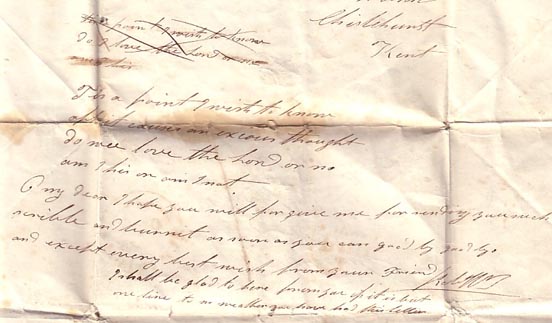
He adds a little verse for her - I think 'excess' should be 'anxious'
T'is a point I wish to know
Oft it causes an excess thought
Do wee love the Lord or no
Am I his or am I not
O my dear I hope you will forgive me for sending you such scrible and burn it as soon as you can good by good bye
And except [accept] every best wish from your Friend Robt W
He then finishes with this short plea
"I shall be glad to here [hear] from you if it is but one line to no [know] weather [whether] you have had this letter"
Luckily, it must have meant more to Mary Whitehead than Robert thought it would, as she did not burn it.
You have to feel for the poor feller don't you?





 Posted 08/12/2017 7:24 pm


