| Author |
 Replies: 12 / Views: 3,027 Replies: 12 / Views: 3,027 |
|
|
Pillar Of The Community
United States
1497 Posts |
|
|
These stamps are the Japan 1924-1933 Imperial Crest new die issues. 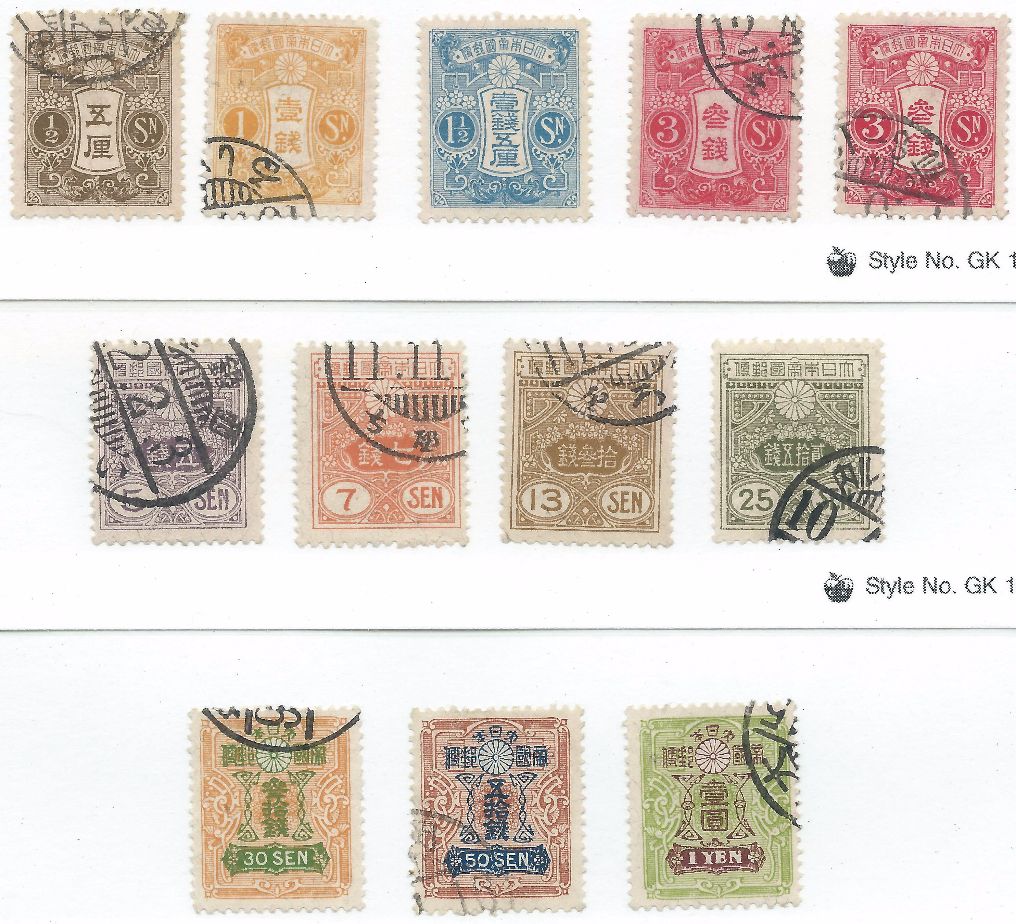 The Scott classic specialized catalog states the new die issues come printed by flat plate (18 1/2 x 22 mm) or rotary press (18 1/2 x 22 1/2 mm). Were any of the values printed by both methods? I have only a limited number of duplicates, and found no values printed by both methods. 1/2s brown - flat plate 1s orange - flat plate 1 1/2s blue - rotary press 3s rose - rotary press 5s violet - flat plate 7s red orange - flat plate 13s bister brown - flat plate 25s olive green - flat plate 30s orange & green - rotary press 50s yellow brown & dark blue - rotary press 1y yellow green & maroon - rotary press I'm creating a Steiner-like custom album page for them and want to differentiate the printing methods, if needed. Thanks, Robert |
|
Send note to Staff
|
|
|
|
|
Pillar Of The Community
1151 Posts |
|
|
@TRAINWRECK, I'm not sure I understand your question, the Scott Catalog would indicate if any were printed by both methods.
Stampmaster |
Send note to Staff 
|
|
|
Bedrock Of The Community
Australia
38679 Posts |
|
|
Hi Robert,
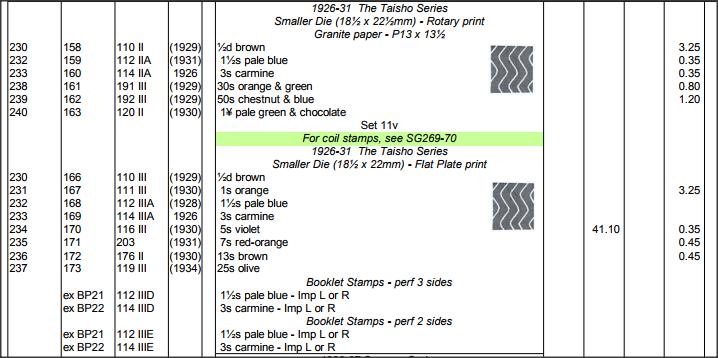
Stanley Gibbons, If I am reading it correctly, would suggest all stamps in the set
(11 stamps) came in either, giving you 22 stamps.
Granite Paper , Wmk wavy lines.
Perf 13 x 13½
My Yamamato catalogue isolates all the printings and issues, but fails to mention flat plate or rotary issues of 1924-1931
This whole set (of similar design) looks very tricky
Just a cursory glance gives a total set count all varieties around 84 stamps?
I'll have to do some intensive reading.
|
|
Send note to Staff
|
|
|
Pillar Of The Community
United States
1497 Posts |
|
|
Quote:
the Scott Catalog would indicate if any were printed by both methods The Scott heading for this issue says both printing methods were used--for all the stamps in question, or were some only rotary and some only flat plate? That's my question. The Scott heading does not make that clear to me. Here's the Scott listing. 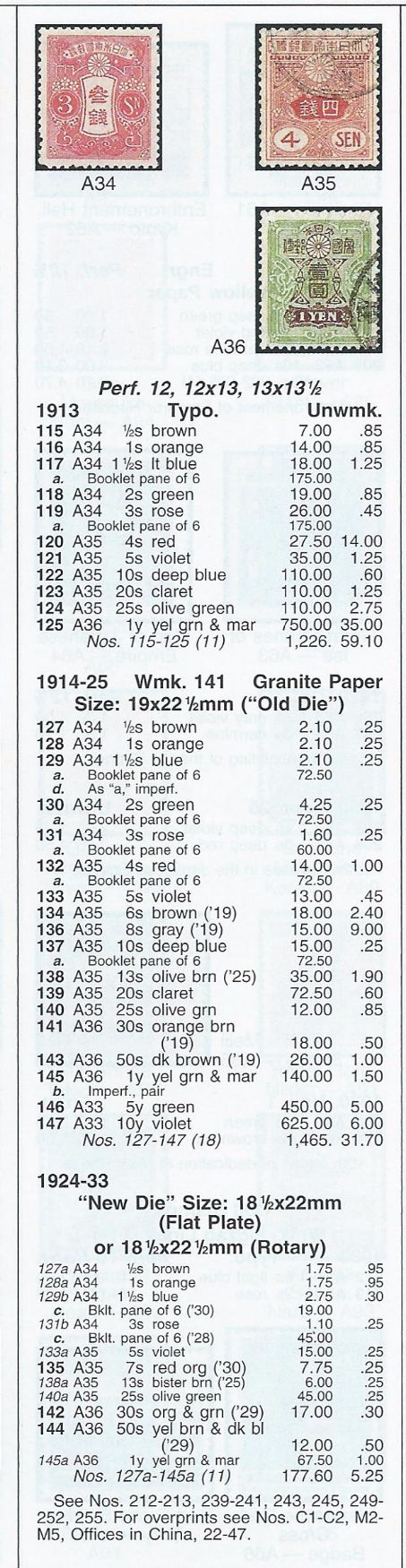 Thanks, Robert |
|
Send note to Staff
|
|
|
Pillar Of The Community
France, Metropolitan
3756 Posts |
|
|
Pillar Of The Community
United States
8599 Posts |
|
|
It says flat OR rotary , not flat AND rotary .Seems clear to me . I will check mine .
|
|
Send note to Staff
|
|
|
Bedrock Of The Community
Australia
38679 Posts |
|
|
Pillar Of The Community
United States
1497 Posts |
|
|
Ah, that's what I needed. At least some of them were printed by both methods.
Thanks rod222.
Robert |
|
Send note to Staff
|
|
|
Bedrock Of The Community
Australia
38679 Posts |
|
|
That was a toughie Robert.
I am glad I have saved all my "duplicates", I was unaware they were so varied.
|
|
Send note to Staff
|
|
|
Pillar Of The Community
Norway
1661 Posts |
|
|
Rod - that list from Sutherland is an excellent resource for Japan! I am collecting perforation varieties, and the listing from Sutherland is far more detailed than Michel or Scott, perfect for my use.  Thanks for sharing |
|
Send note to Staff
|
|
|
Pillar Of The Community
United States
898 Posts |
|
|
If you can put your hands on what's called the "JSCA" (or "Nissen", as it's often referred to in Japanese), that will spell out for you all printing types, paper types, color variations, and (usually, if I'm recalling correctly), perforation types.
I have a newer edition around, but have the 2001 edition within reach, and at that time just this series (called the "Tazawa" series in Japanese) took up 35 pages. I think they have expanded and better organized the information in later editions. (The JSCA itself has now expanded to 3 volumes. You'd want volume 1 for anything up through the end of WW2 -- again, if I'm recalling correctly.)
All that said, I've found that recent editions are hard to come by, even when I try to order from Japan. They don't update every volume every year, and, when they do, it seems to sell out quickly.) However, even an older volume (I don't think I'd go much earlier than 2000, but that's just me), can provide a lot of helpful information I'm unaware of from any other source.
It can also be difficult to use, as it is primarily in Japanese, although they've gotten better about adding useful English bits along the way. I (used to) read some Japanese, so I have some reference materials to help me with difficult readings, and so I can't say how hard it would be to use for someone without some language skills. But I think non-Japanese-reading people do! (I do think it's fair to say that it's more difficult to use than the more user-friendly but simplified Sakura catalog.)
I'm afraid I'm really slammed on time right now and for the next several weeks, so I apologize for just replying off the top of my head and not supplying some supporting research for my comments. But I hope this might be a little helpful for now.
Good luck with this! It's a fascinating area! (And one I hope to dig deeply into when/if I retire!)
-- Dave |
|
Send note to Staff
|
|
|
|
Valued Member
Japan
350 Posts |
|
|
Hi all, The Tazawa series could be categorized into six groups, depending on the paper, watermark, die and size. With the aid of Japan Specialized Stamp Catalogue (mentioned by Dave), I made a chart for the classification rules and a table for the basic Tazawa stamp issues. 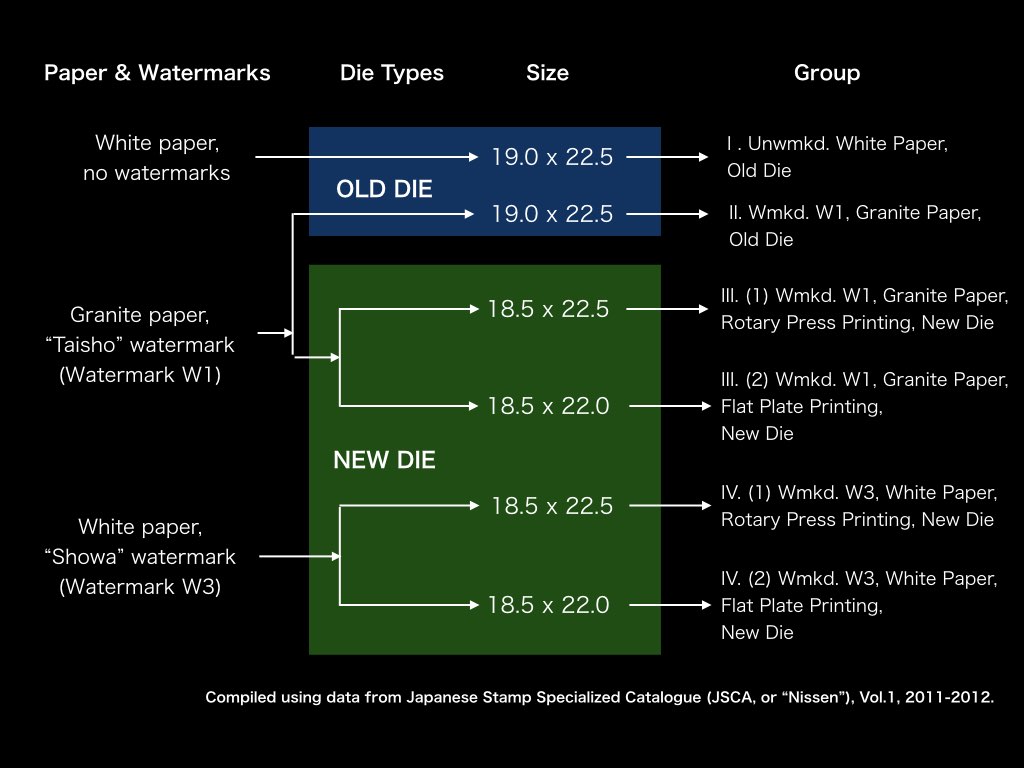 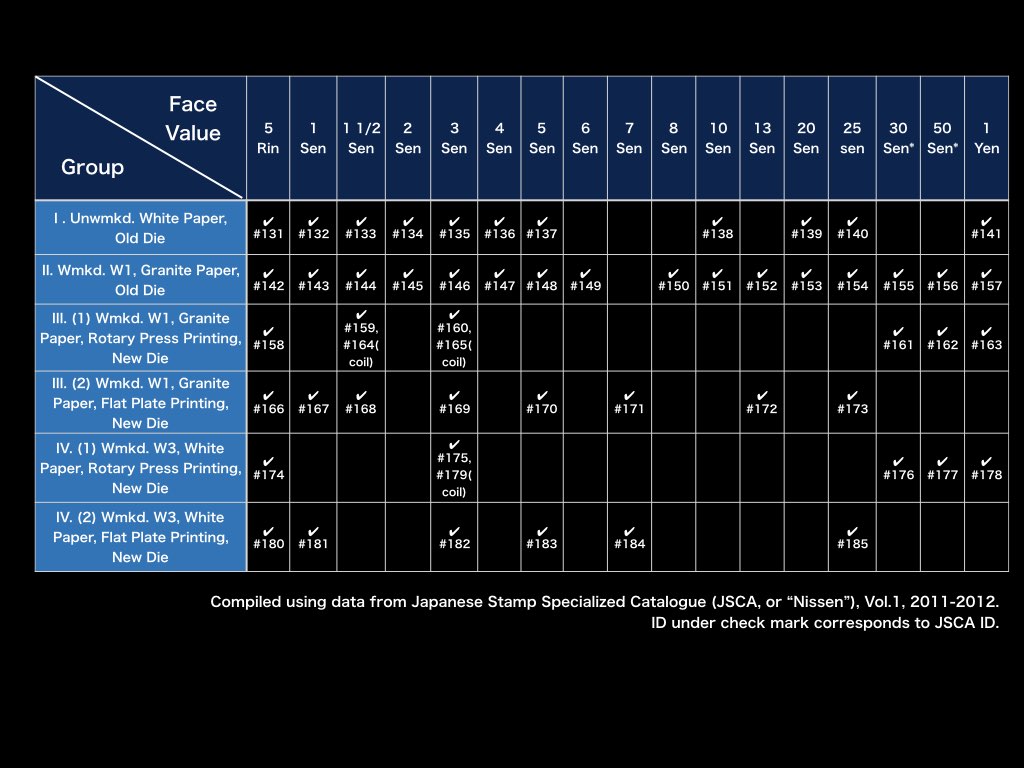 I hope this will clarify the rotary/flat question raised by Robert as well as the rather complicated (well, at least for me :-)) classification of the Tazawa stamps. - Hironobu |
|
Send note to Staff
|
| Edited by unechan - 10/09/2017 01:16 am |
|
|
Pillar Of The Community
United States
1497 Posts |
|
|
Those charts are excellent. I'm going to have to rework my album pages for this issue, but that's no problem!
Thank you.
Robert |
|
Send note to Staff
|
|
| |
Replies: 12 / Views: 3,027 |
|



 Posted 09/16/2017 10:27 pm