Stamp Community Family of Web Sites
Thousands of stamps, consistently graded, competitively priced and hundreds of in-depth blog posts to read


Stamp Community Forum
 
Username:
Password:
Save Password
Forgot your Password?

This page may contain links that result in small commissions to keep this free site up and running.

Welcome Guest! Registering and/or logging in will remove the anchor (bottom) ads. It's Free!

Narcotic Stamp Registration Numbers

Previous Page | Next Page    
 
To participate in the forum you must log in or register.
Author Previous TopicReplies: 32 / Views: 4,717Next Topic
Page: of 3
Bedrock Of The Community
United States
10611 Posts
Posted 09/28/2017   11:06 pm  Show Profile Bookmark this reply Add revcollector to your friends list  Get a Link to this Reply
Different plants in the same district? Wholesaler as well as manufacturer? We might need to know more about the corporate setup to know.
Send note to Staff  Go to Top of Page
Rest in Peace
United States
1738 Posts
Posted 09/28/2017   11:18 pm  Show Profile Bookmark this reply Add James Drummond to your friends list  Get a Link to this Reply
Why didn't more of these old coots write down some of this stuff at the time, so that we could Google it in 2017?

Well I guess they weren't old in 1919, but now they are.

Jim
Send note to Staff  Go to Top of Page
Pillar Of The Community
United States
867 Posts
Posted 09/28/2017   11:53 pm  Show Profile Bookmark this reply Add revenuermd to your friends list  Get a Link to this Reply
I think that there is sufficient evidence that the location is what gets the registration number. Thus the Mallinckrodt that Jim shows is a wholesale dealer at a specific location, but the Importer Manufacturer STS for Mallinckrodt at the same St. Louis address has the same registration number! That suggests that FY1920 annual report contains some duplication. Mallinckrodt is at least double counted in that report. So is McKesson & Robbins, who had at least three registration numbers in New York Second District (Lower Manhattan). Therefor we should not expect registration numbers as high as 239,000 in 1920.

I also have a Parke, Davis facility in Atlanta that has a registration number of 2454 as a wholesaler.

The highest registration number for which I have an example is for a practitioner (circa 14,000) presumably a newly minted physician much later. So practitioners also had registration numbers intermixed with manufacturers, wholesalers, retailers, and laboratories.

I think the jury is still out on Lilly having a registration number of 113,363. Only when a different location or address is found is a different registration number required and given. Given that practitioners were assigned registration numbers, why do we not see registration numbers on the special the special tax stamps above 15,000?

I think I will stay with my earlier assumption that Lilly also had at least three registration numbers for various locations, namely 4, 113, and 363.
Send note to Staff  Go to Top of Page
Ron Lesher
Edited by revenuermd - 09/29/2017 06:29 am
Rest in Peace
United States
1738 Posts
Posted 09/29/2017   11:47 am  Show Profile Bookmark this reply Add James Drummond to your friends list  Get a Link to this Reply
Ron,

Not to belabor this point, but the Harrison Narcotics Act of 1914 described the assignment of registration numbers to individuals, not to locations:


Quote:
An Act To provide for the registration of, with collectors of internal revenue, and to impose a special tax on all persons who produce, import, manufacture, compound, deal in, dispense, sell, distribute, or give away opium or coca leaves, their salts, derivatives, or preparations, and for other purposes


Further in the act is this phrase:


Quote:
place or places where such business is to be carried on


So I would take that to mean that just one number was assigned to each person or entity, per class, even if that entity was located in multiple locations.

In the later amendment (the Revenue Act of 1918), there is this entry:


Quote:
Class 1—$24.00 Per Annum.
Importers, manufacturers, producers and compounders.
NOTE :—Persons in Class 1 who have paid special tax for that class are not required to pay additional special tax under Class 2 or 3 when selling or producing only their own products in original stamped packages. If, however, they sell products not of their own manufacture, additional special tax, under Class 2 or Class 3, or both, as the case may be, will have to be paid.


So this is where the multiple registration numbers come from. One number for an importer, and another special tax/registration number if that importer manufactured products "not of their own manufacture."

For those that want to read century-old legal text, the act can be found here:

https://www.erowid.org/psychoactive...cs_act.shtml

Jim
Send note to Staff  Go to Top of Page
Edited by James Drummond - 09/29/2017 12:11 pm
Pillar Of The Community
United States
867 Posts
Posted 09/29/2017   12:28 pm  Show Profile Bookmark this reply Add revenuermd to your friends list  Get a Link to this Reply
Jim,

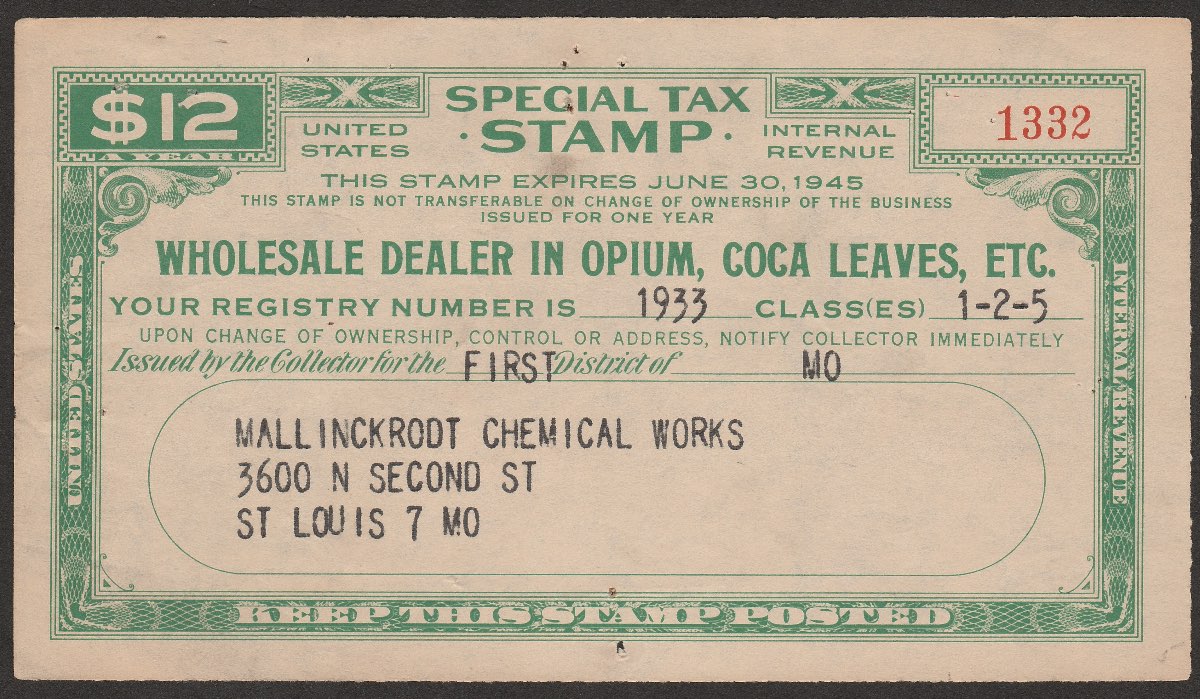
To belabor the point here, I have both a Wholesale Dealer STS from Mallinckrodt with registration number 1933 and a Importer, Manufacturer STS from Mallimckrodt with registration number 1933. That does not match with your reading of the law.
Send note to Staff  Go to Top of Page
Ron Lesher
Rest in Peace
United States
1738 Posts
Posted 09/29/2017   12:46 pm  Show Profile Bookmark this reply Add James Drummond to your friends list  Get a Link to this Reply
Ron,


Quote:
That does not match with your reading of the law


Then how would you interpret it?

Jim
Send note to Staff  Go to Top of Page
Pillar Of The Community
United States
867 Posts
Posted 09/29/2017   1:06 pm  Show Profile Bookmark this reply Add revenuermd to your friends list  Get a Link to this Reply


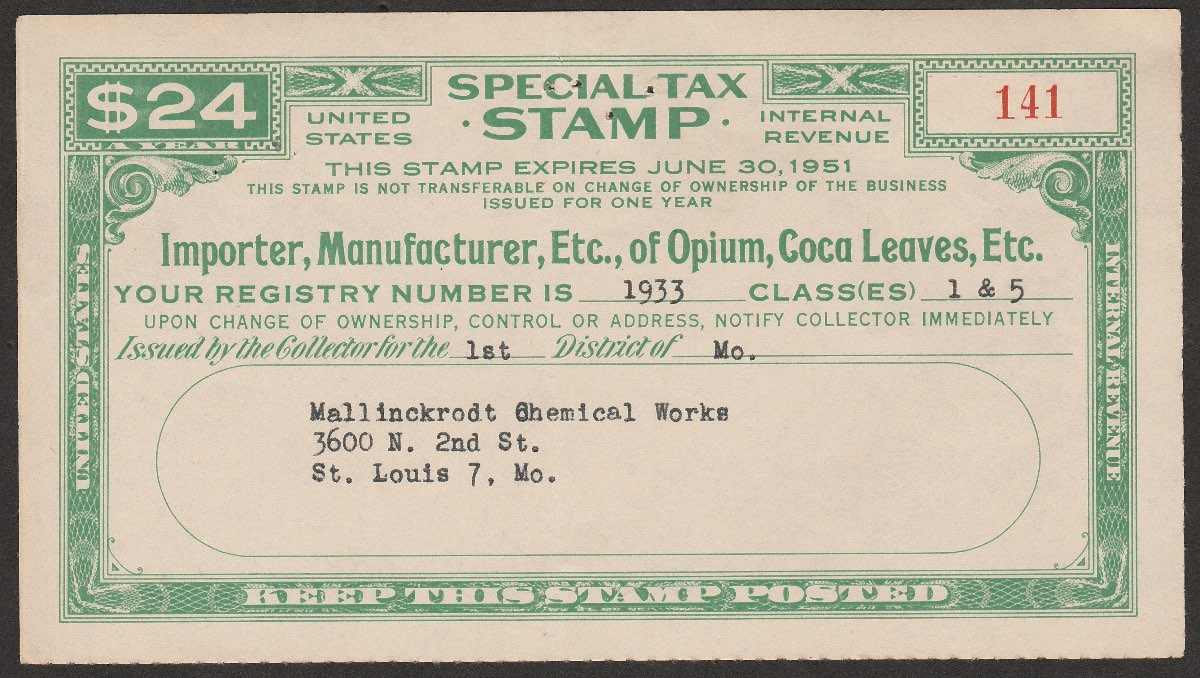
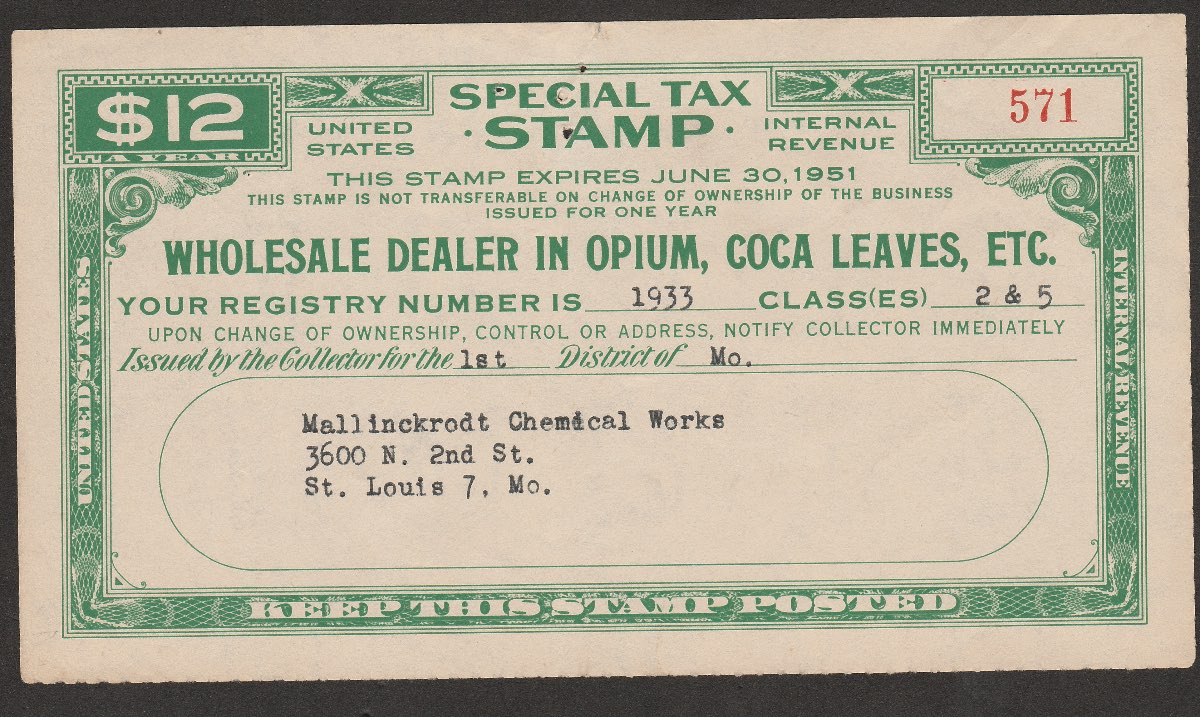
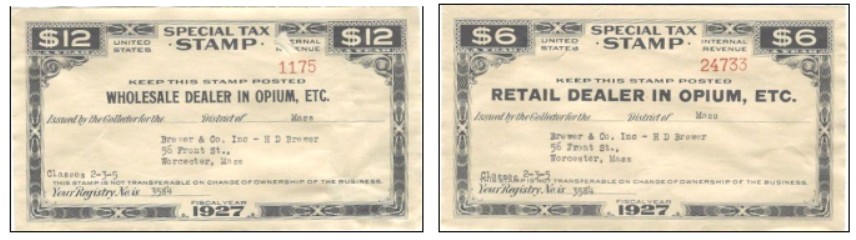
So here are two special tax stamps for fiscal year 1951, both from Mallinckrodt, same address. One is for wholesaler and the other for Importer, Manufacturer. Both have the same registration number. So just because they are acting as a wholesaler of someone else's manufactured product doesn't cause them to get a different registration number.

Wouldn't this be reported as separate statistics in the 1920 table? So the table might not reflect the number of separate registrants.
Send note to Staff  Go to Top of Page
Ron Lesher
Rest in Peace
United States
1738 Posts
Posted 09/29/2017   1:23 pm  Show Profile Bookmark this reply Add James Drummond to your friends list  Get a Link to this Reply
Ahh!

I understand now.

I was under the impression all along that your special tax stamps were dated the same year!

I interpret your early (1945) wholesale tax stamp class to have simply changed to a different class around 1951, when they no doubt started to import as well as wholesale.

The registration number was simply reissued.

Or something along those lines.

So, I hold by my earlier interpretation of the law.

Jim
Send note to Staff  Go to Top of Page
Pillar Of The Community
United States
867 Posts
Posted 09/29/2017   6:02 pm  Show Profile Bookmark this reply Add revenuermd to your friends list  Get a Link to this Reply
I scanned the wrong Wholesale Dealer STS. I do have a 1951 Wholesale STS for Fiscal Year 1951 for Mallickrodt. Will try to get it scanned later and post it.
Send note to Staff  Go to Top of Page
Ron Lesher
Rest in Peace
United States
1738 Posts
Posted 09/29/2017   7:09 pm  Show Profile Bookmark this reply Add James Drummond to your friends list  Get a Link to this Reply
No need to do so.

It makes no sense for a manufacturer to need multiple special tax stamps (i.e. be in several classes), except for the text shown in the "Class 1" quote, above. And if that was the case, they would have two different registration numbers.

It does make sense though that, in 1951, this manufacturer changed its class from wholesaler to importer, and the registration number was simply re-used.

Unless someone can show any other example of a manufacturer holding more than one special tax stamp with the same registration number on each stamp, for a given year.

Jim
Send note to Staff  Go to Top of Page
Pillar Of The Community
United States
867 Posts
Posted 09/29/2017   8:35 pm  Show Profile Bookmark this reply Add revenuermd to your friends list  Get a Link to this Reply


So here is the Fiscal Year 1951 Mallinckrodt Wholesale Dealer STS that I meant to post earlier. so we can see the Mallinckrodt had both a Manufacturer and Wholesale Dealer with the same registration number, 1933.
Send note to Staff  Go to Top of Page
Ron Lesher
Pillar Of The Community
United States
867 Posts
Posted 09/29/2017   8:38 pm  Show Profile Bookmark this reply Add revenuermd to your friends list  Get a Link to this Reply
Jim - Enjoy explaining the two special tax stamps with the same registration number for fiscal year 1951.
Send note to Staff  Go to Top of Page
Ron Lesher
Rest in Peace
United States
1738 Posts
Posted 03/14/2018   10:46 pm  Show Profile Bookmark this reply Add James Drummond to your friends list  Get a Link to this Reply

Quote:
I think that there is sufficient evidence that the location is what gets the registration number.


Ron is right.

I apologize for thinking differently.

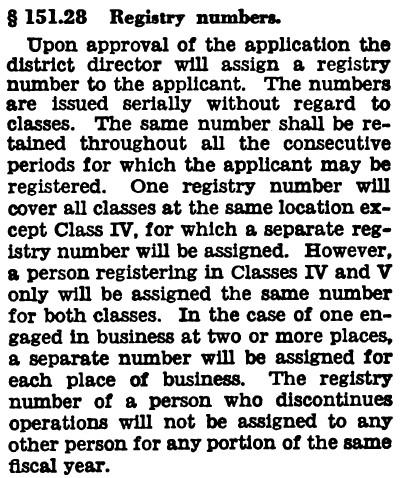
I found the tiny piece of proof that I needed to explain why different registration numbers are on the same company's cancels, and also to explain why the same registration number appears on different special tax stamps, from the same company at the same address.

Of which, another example pair is shown below.

Now I have to figure out where the very high registration numbers are coming from.

Jim

Source: Title 26 – Chapter I – Internal Revenue Service, Department of the Treasury, Revised as of January 1, 1961, section 151.28


Send note to Staff  Go to Top of Page
Pillar Of The Community
United States
867 Posts
Posted 03/15/2018   05:39 am  Show Profile Bookmark this reply Add revenuermd to your friends list  Get a Link to this Reply
Jim,

If the 1961 quote in your last post reflects past practice going back to 1914 and 1919, i.e., the district collector assigned the numbers, then a range of numbers was probably assigned to each collector. In 1934, for example, there were, if I recall correctly 64 districts. In fact, about 1917 there was a consolidation of the different Kentucky districts into one. So in 1914, when there were more districts, the number of districts was substantially greater. That is probably why we get such a large range of registration numbers. And, of course, a lot of numbers that never got assigned. The highest registration number seen does not equate with the total number of registrants.
Send note to Staff  Go to Top of Page
Ron Lesher
Rest in Peace
United States
1738 Posts
Posted 03/15/2018   5:26 pm  Show Profile Bookmark this reply Add James Drummond to your friends list  Get a Link to this Reply

Quote:
range of numbers was probably assigned to each collector


Ron (and anyone else that's interested),

I have found contemporaneous proof that the numbers weren't assigned to each internal revenue district in ranges.*
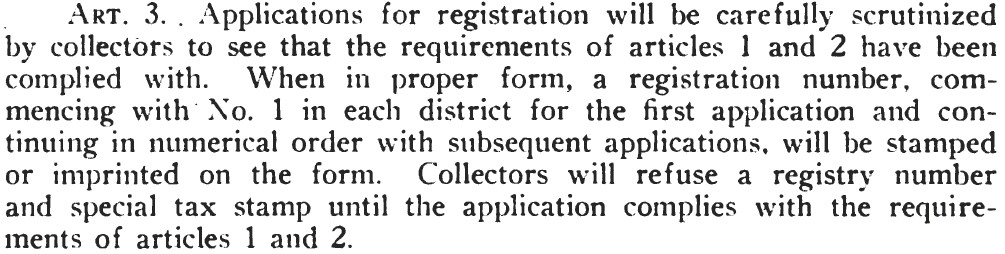


Based on this, it looks like there were potentially up to 64 registration number 1's in the country in 1919, 64 number 2's, and so on.

Also, based on the previous clip that I posted, registration numbers were reused after a time.

So, the numbers were not uniquely assigned to just one company permanently, really.

I believe that the most logical conclusion then is that certain companies, in an effort to become or remain exclusive or uniquely identifiable, requested and then received registration numbers that no one else could ever possibly receive in the normal course of assignment.

Remember that the narcotic stamps, with their cancellations, were regularly seen by the consumer.

These firms with high numbers, such as The Upjohn Company (11,576), the Eli Lilly Company (113,363), and Parke, Davis and Company (149,834), must have thought that it was worthwhile to obtain a number that was exclusive to themselves.

Surely there was some competition, even back in 1919 with drug manufacturers.
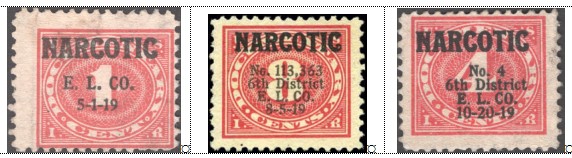


I can understand now that perhaps the Eli Lilly Company was assigned registration number 4 at first. But then they saw the same number on a competitors' product, and when they opened another factory in Indianapolis, Indiana, they requested a number that no one else would ever use, 113,363. Of course they continued to use their number 4. As a very large user of the narcotic stamps, surely they had some "pull" at the local internal revenue office.



Since the applications were filed alphabetically, the numbers themselves weren't critical, as long as they weren't used twice in the same district.

Since the registration numbers were not unique, it explains these two stamps, which have puzzled me for some time.
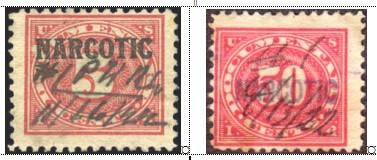


The one on the left is cancelled with "#1" and with "PWR Co," The Powers – Weightman – Rosengarten Company, which was based in Philadelphia, Pennsylvania. The one on the right also has "#1" and has the "narcotic" handstamp that was used in Pennsylvania.
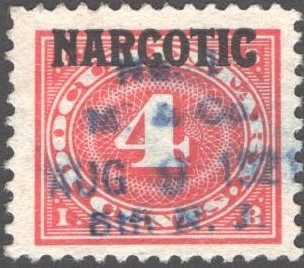


But Merck and Company also used registration number 1. However they were located in New Jersey.

Jim

*Source: Federal Rules and Regulations, John A. Lapp, B. F. Bowen and Company, Indianapolis, Indiana, 1918, Article 3, page 434.


Send note to Staff  Go to Top of Page
Page: of 3 Previous TopicReplies: 32 / Views: 4,717Next Topic  
Previous Page | Next Page
 
To participate in the forum you must log in or register.

Go to Top of Page

Disclaimer: While a tremendous amount of effort goes into ensuring the accuracy of the information contained in this site, Stamp Community assumes no liability for errors. Copyright 2005 - 2026 Stamp Community Family - All rights reserved worldwide. Use of any images or content on this website without prior written permission of Stamp Community or the original lender is strictly prohibited.
Privacy Policy / Terms of Use    Advertise Here
Stamp Community Forum © 2007 - 2026 Stamp Community Forums
It took 0.26 seconds to lick this stamp. Powered By: Snitz Forums 2000 Version 3.4.05