| Author |
 Replies: 14 / Views: 3,018 Replies: 14 / Views: 3,018 |
|
|
Valued Member
United States
485 Posts |
|
|
Hello! Is there an 11× 10 1/4 perf in this stamp? Does not line up with 10 on gauge. Am I missing something here? Thanks in advance for your help! 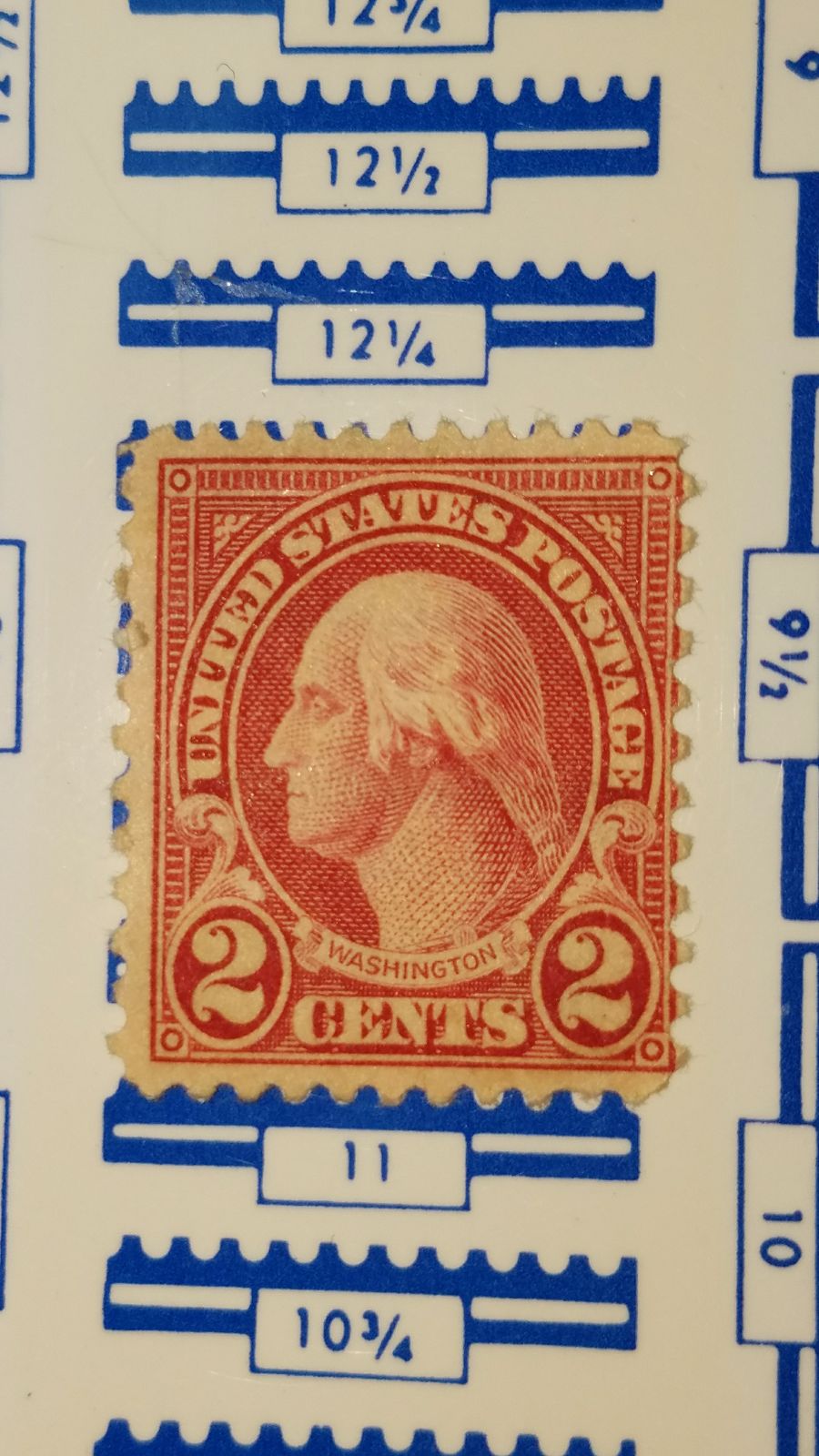 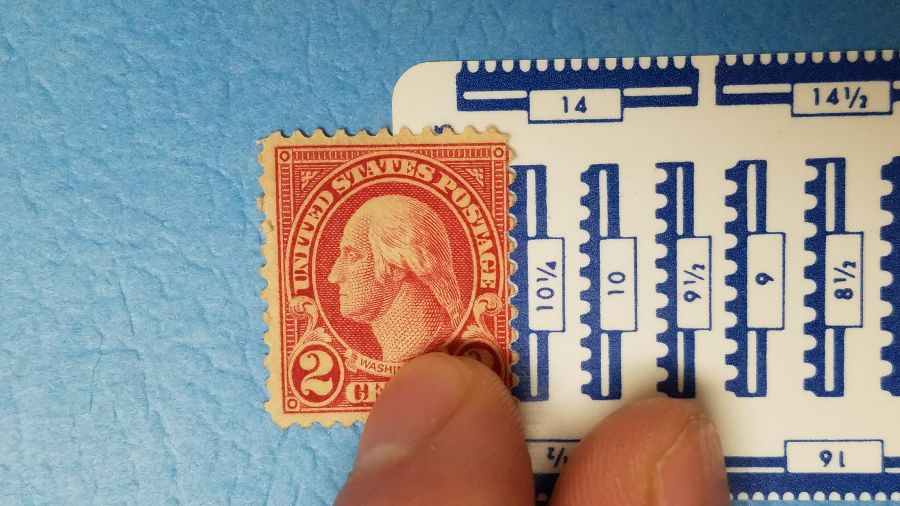 |
|
Send note to Staff
|
|
|
|
|
Pillar Of The Community
United States
1179 Posts |
|
|
Water. Paper is a wood pulp product that is produced and delivered with a % of water left in the paper after curing at the time of printing. In the Rotary Printing process, additional water is added during laying down of color-on-paper to assist ink adhesion. During the print process, the paper is absorbing more moisture while it is moving on the press, under tension and between the pressure of print cylinders and print platens, with a more moisture absorbed when in gum application. After the "squeezing", "pulling" and "perfing" the printed stamp paper has a chance to cure a second time and with that you have "shrinkage." 11× 10 1/2 perf becomes a 11× 10 1/4 perf. |
Send note to Staff 
|
| Edited by Hal - 10/17/2017 10:15 pm |
|
|
Valued Member
United States
485 Posts |
|
|
Thank you for the very educating and informing response. So it should be a 579? |
|
Send note to Staff
|
|
|
Pillar Of The Community
United States
1179 Posts |
|
|
Valued Member
United States
485 Posts |
|
|
Pillar Of The Community
United States
1497 Posts |
|
|
Quote:
you have "shrinkage." 11× 10 1/2 perf becomes a 11× 10 1/4 perf. Not trying to stir the waters here, but shrinkage would increase the perforation gauge, would it not? As the paper shrinks, more perforation holes could be placed in a 2 centimeter distance, thereby increasing the perforation gauge. Robert |
|
Send note to Staff
|
| Edited by Trainwreck - 10/18/2017 10:10 am |
|
|
Rest in Peace
Canada
5701 Posts |
|
|
Trainwreck, you are correct. Besides, if you look closely, the 10 1/4 does not line up perfectly on the gauge. It looks like to me it would fit gauge 10 better or somewhere between. |
|
Send note to Staff
|
|
|
|
Pillar Of The Community
United States
1497 Posts |
|
|
Whenever I have a question about the perforations I am measuring with a gauge, I return to the basics. I count the number of holes in a measured distance, and calculate the perforation gauge from there.
(Number of holes / measured distance in mm) x 20 = perforation gauge
You need a device that can measure to tenths of a millimeter to get accurate results.
Robert |
|
Send note to Staff
|
|
|
Pillar Of The Community
3865 Posts |
|
|
Maybe the gauge is off because the perforation 11 side should actually be 11 1/4 which unfortunately Scott doesn't note it as such. They confuse many with their 11 x 10 1/2 when the actual closer better reading would be 11 1/4 (11.25) x 10 1/2 (10.50). |
|
Send note to Staff
|
| Edited by jogil - 10/18/2017 4:33 pm |
|
|
Pillar Of The Community
United States
1179 Posts |
|
|
Thanks TRAINWRECK. Minor correction to my statement, but the problem still come down to moisture/water and paper distortion. Distortion during Rotary Offset Printing (See Diagram) may not only be "shrinkage" it may be from paper "over-tensioning" (stretching) or "paper-sqeezing" (flattening) from too much pressure between blanket cylinder and Impression cylinder which distorts the final product. 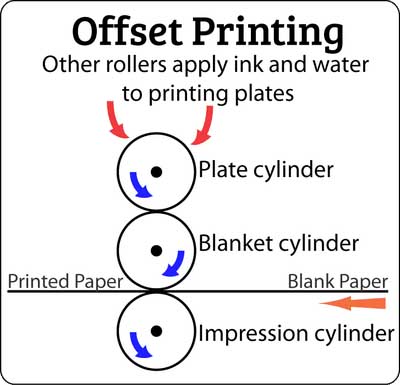 Anyone who collects the 1922 Definitive Issue has done some double-takes checking a stamp on their perf gauge. I know I have. One other thing, I also suggest using a rigid metal or acetate/plastic perf gauge; they are more accurate. Hope that helps and again, sorry for any confusion. Best, Hal |
|
Send note to Staff
|
| Edited by Hal - 10/18/2017 9:42 pm |
|
|
Pillar Of The Community
3865 Posts |
|
|
U.S. Scott 634 (11 1/4 x 10 1/2) stamps were printed by Stickney rotary press intaglio wet printing. |
|
Send note to Staff
|
| Edited by jogil - 10/19/2017 02:44 am |
|
|
Pillar Of The Community
United States
1414 Posts |
|
|
Quote:
After the "squeezing", "pulling" and "perfing" the printed stamp paper has a chance to cure a second time and with that you have "shrinkage." 11× 10 1/2 perf becomes a 11× 10 1/4 perf. Not true. The paper must dry enough to safely apply gum before the stamps can be perforated. Once the stamp is gummed, the dimensions are reasonably stable. Also, rotary press stamps shrink less than flat plate stamps and the shrinkage, if any would be in the horizontal direction for sheet stamps, not in the vertical directions, a second reason why the assertion above is not true. Readings from generic perforation gauges instead of a Kiusalas Specialist gauge are often misinterpreted. Go back and read the definition of what perforation gauges are intended to do. A perforation gauge is not a measuring device. It is a gauge to see how many perforations, to the nearest half fits between a pair of parallel lines two centimeters apart. It is easy to calculate that a two "perf 10" stamps can have up to 5% differences in perforation spacing before moving into the perf 9 1/2 or 10 1/2 bucket. It is better to use another stamp with known characteristics to compare instead of measuring. To check rotary press stamps, find a stamp like a 7 cent Presidential that exists only as perf 11 x 10 1/2 and compare with the stamp being investigated. |
|
Send note to Staff
|
| Edited by cfrphoto - 10/25/2017 12:34 am |
|
|
Pillar Of The Community
United States
1179 Posts |
|
|
cfrphoto I'm not going to get into a verbal with you about paper. I have a web printing background. Actually, Rotary paper can contain more water than sheet fed paper! I have rejected carloads (train box cars) of rolls of paper for having too high of a % of water content. |
|
Send note to Staff
|
|
|
Pillar Of The Community
United States
1414 Posts |
|
|
Hal, You are missing the point. The Stickney rotary presses used a wet printing process. While less moisture may have been added in later years, the paper had to be dried before gumming and perforating. Stamps produced by the replacement Huck-Cottrell presses were referred to as "dry printings". See https://goscf.com/t/48496 |
|
Send note to Staff
|
| Edited by cfrphoto - 10/25/2017 11:55 am |
|
|
Pillar Of The Community
United States
1179 Posts |
|
|
cfrphoto- I'm not missing the point. You have no idea of the mechanics of paper, presses in the time before humidity-controlled pressrooms, bindery operations and uncoated (or coated) paper moisture absorption, especially in high-humidity areas like the D.C.-metro area. Please don't argue with someone that does have web press experience and understands both "wet" and "dry" print processes. Hal Quote:
...While less moisture may have been added in later years… This comment tells me you need a deeper understanding in paper manufacturing, production and the rotary web print process of the era being discussed. |
|
Send note to Staff
|
| Edited by Hal - 10/25/2017 6:13 pm |
|
| |
Replies: 14 / Views: 3,018 |
|



 Posted 10/17/2017 9:33 pm


