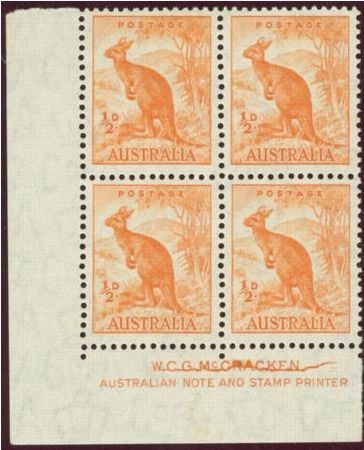
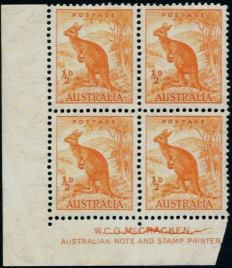
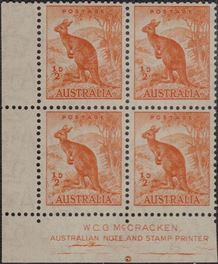
In the 2015 ACSC it mentions on page 6/43 note 5, that nos. 178zc and zca are of Plate 1, sheet F, and consist of a series of crystalline cracks immediately below the imprint. In the second state, the cracks extend the full length of the second line of the imprint as seen below.
One example has been seen showing a very early state of the crack, without perforation pip below.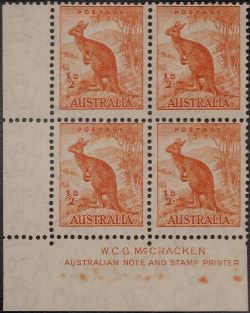
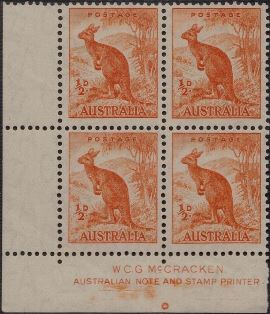
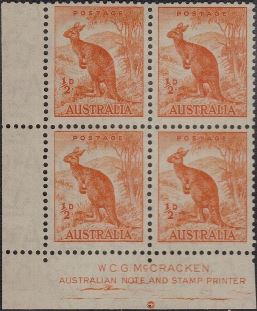
As one can see, all three stamps are uniform. The block of 4 without the pip is the exact stamp referred to by ACSC. Only a few weeks ago, after a specialist dealer bought some of the Arthur Gray collection, it turned out that Gray too had a strip of 4, 1949 roos with exactly the same markings. Arthur Gray listed his as
McCracken Imprint strip of 4 showing burnishing marks below imprint due to the Ash imprint substitution.The block of 4 the specialist and I thought to be the rare missing very early plate crack may now be burnishing marks instead.
Yet the stamp I have shown above still fits ACSC's description of the rare block of 4, and my invoice of that block of 4 states that it is the missing rare very early plate crack.
Gray's strip of 4 showing what he refers to as burnishing marks has created a conundrum, is the first stamp a burnishing or is it the missing very early state of plate crack?
The block of 4 has been send away for a more detailed analysis to see if Gray was correct about his analysis of his block of 4.
If mine is the missing cracked plate then it cannot be unique, as Gray also had the same, not as prominent but nonetheless the same.
Or we both have burnishings and the rare very early cracked plate is still missing (if it ever existed) and I will try and have it hunted down for my collection.
But then, Gray was known to be an expert in Australian pre-decimals, including plate cracks.
All my stamps are in ACSC order up until 2001, from 2002 to the present date they are in SG order. If one has the recent KGVI ACSC and then look at the stamps I have displayed (The Coronation Robes & Coat-of-Arms sets I have posted earlier is a good example of being in ACSC order).
Everything I have posted based on information in relation to the very early state of plate crack and the early and late state of plate crack is from the 2015 ACSC and from Specialists of pre-decimal stamps.
To the best of my knowledge my posting of the stamps and the information that I have supplied with these stamps are accurate, and as I have said, the block of 4 which has now become a conundrum has been sent to specialists for a proper analysis as to whether it is the rare plate crack or a burnishing just prior to the very early plate cracking.
Rob





 Posted 11/13/2017 03:39 am