| Author |
 Replies: 39 / Views: 4,970 Replies: 39 / Views: 4,970 |
|
Valued Member
New Zealand
5 Posts |
|
|
|
|
Pillar Of The Community
United States
2230 Posts |
|
|
Hello, fireflynz,
They are all either Scott #11 or #11A. If they have one outer frame line on each side with no inner frame lines, they are #11. If they have one outer frame line on each side and one inner frame line on one or both sides, they are #11A.
Can you show larger scans of the stamps only, or describe what you see for each stamp regarding the frame lines? |
Send note to Staff 
|
|
|
Pillar Of The Community
United States
1337 Posts |
|
|
I would like to get some input on this group of three that I have as well. Is there any way to differentiate between #10 and #11 besides color? 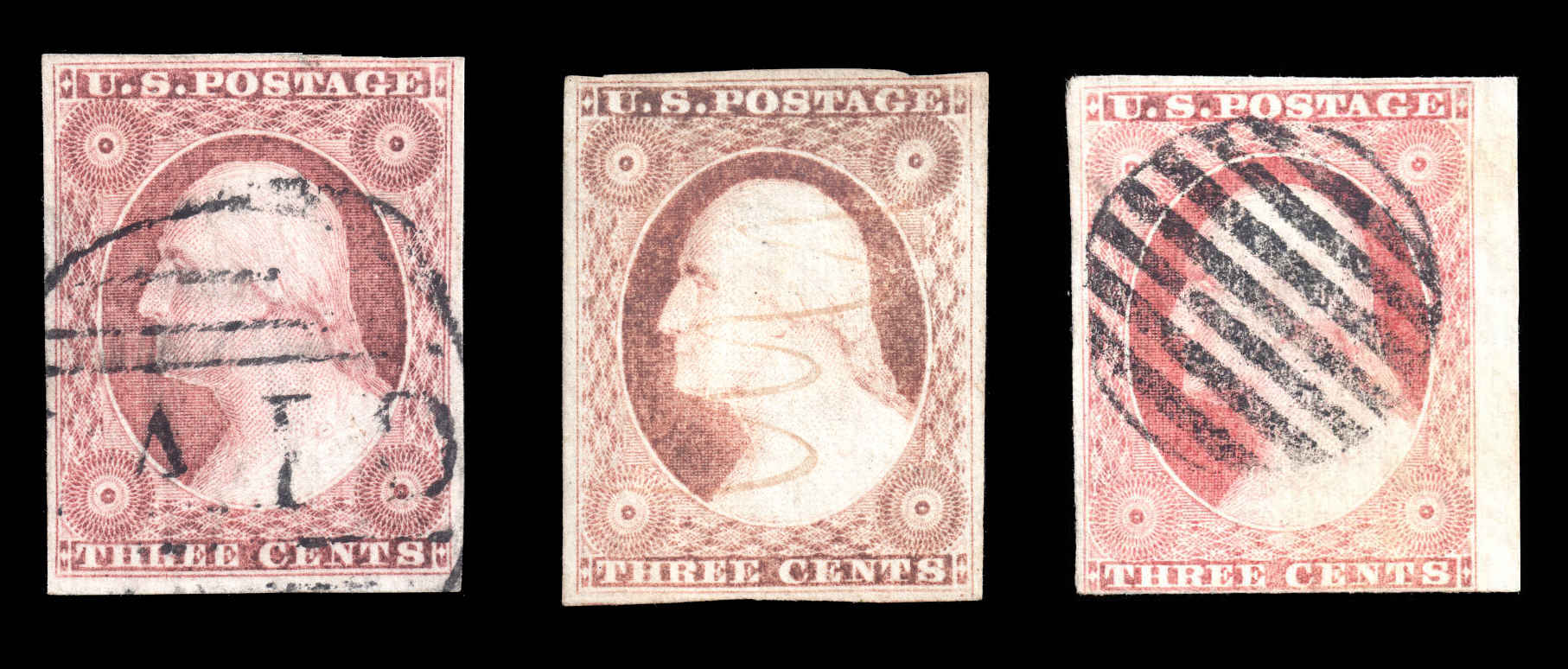 |
|
Send note to Staff
|
|
|
Pillar Of The Community
United States
2230 Posts |
|
|
jaxom100, Yes. The surest way to confirm a #10/10A is by plating the stamp to a position on one of the plates that were known to produce the orange brown stamps. However, #10/10A have a very distinctive, rich color, that falls in a narrow range of shades. Another way to help identify #10s is the ink quality. #10/10A stamps typically have a rich ink texture that looks rusty. None of the stamps in your image are #10/10A. The middle stamp is oxidized (darkened/discolored). None of the three appear to have any orange in them. The #10/10A orange brown ink doesn't get oxidized/discolored to this extent. Here is an annotated color set that shows an orange brown #10A at top left with seven #11/11A colors:  |
|
Send note to Staff
|
|
|
Pillar Of The Community
United States
2555 Posts |
|
|
It is remarkable how many times you will run into a nice '52 brownish carmine specimen used in Mobile in February of '52. |
|
Send note to Staff
|
|
|
Pillar Of The Community
United States
2230 Posts |
|
|
I never noticed, but this one certainly fits since the plate isn't worn. |
|
Send note to Staff
|
|
|
Pillar Of The Community
United States
1337 Posts |
|
|
My images seem to match none of the colors shown there. I also noticed that the center stamp has the outside line extending past the bottom line in the lower right corner only. Could this be because it was a bottom row stamp? I would guess that the on one in the center is a type I and the outside ones are type II. The inside border is sharper on the left stamp than the right one. Where wuold someone get the information to plate these stamps and how would they start? I do not think a slight color variation should have resulted in a different Scott number with no design difference. There should have just been sub letters for the colors. |
|
Send note to Staff
|
|
|
Valued Member
97 Posts |
|
|
Classic Coins, I'd e-mail you, but don't have enough posts yet:
That color reference image is the best of many I've seen on the Internet. Most of the others just don't show the colors well. I think it helps that yours is high resolution.
Can you do it again the same way? If you can, maybe if you decide to add a few more colors, may I suggest you choose a different OB stamp? The current one looks like a late printing, more red and less orange than most and the large Boston cancel is a bit disconcerting. I don't doubt that it is a 10A, but it just doesn't scream orange brown to me.
I took a few courses in college dealing with color theory and materials used in painting and printmaking, but I've never been good at differentiating the colors of this stamp. Your image is the most helpful one I've seen so keep up the good work. |
|
Send note to Staff
|
|
|
Pillar Of The Community
United States
2555 Posts |
|
|
Pillar Of The Community
United States
2948 Posts |
|
|
Quote:
My images seem to match none of the colors shown there. Matching colors from two different sources on two different monitors is difficult. Your images look washed out a bit by the light source. With that in mind here's what I see. Your stamp on the left is in the Claret "family". Family is a term I use because most of the specific colors listed for these stamps have prefixes/suffixes like, deep, pale, brownish, yellowish etc. So these form the family of Claret or the family of Carmine etc. That's just me though.Your center stamp, as Gary mentioned is oxidized, that along with the scan, makes it even more difficult to identify the color. The right hand stamp, again I say to my eyes, looks likely to be in the Carmine family. These are the guesses of a beginner/novice. |
|
Send note to Staff
|
|
|
Pillar Of The Community
United States
2230 Posts |
|
|
Quote:
I also noticed that the center stamp has the outside line extending past the bottom line in the lower right corner only. Could this be because it was a bottom row stamp? jaxom100, Your stamp with the right frame line extending past the bottom line is no indication of where on the plate the stamp was printed from. The frame lines were hand-cut into the plate after the rest of the design was transferred to the plate from the transfer roll. At many random positions, the engraver simply cut too far while trying to make the corners meet up. You are correct about the stamp in the center being a type I and the outside ones being type II. The below links will get you started on plating this issue, and identifying colors. The orange brown stamp on the colors page (third link) is the same one in my color set above: http://www.uspcs.org/stamps-covers/...2%a2-plates/https://www.uspcs.org/stamps-covers...amp-plating/https://www.uspcs.org/stamps-covers...-11-and-11a/ |
|
Send note to Staff
|
|
|
Pillar Of The Community
United States
2230 Posts |
|
|
ttreen, I appreciate your kind feedback. I sent you an email about 30 minutes ago.
The #10A in my image is 16R5e. My scanner has a tendency to add a little red, and I need to make a slight adjustment. I may try this with the original scan tonight.
Gary |
|
Send note to Staff
|
| Edited by Classic Coins - 11/27/2017 8:01 pm |
|
|
Pillar Of The Community
United States
1337 Posts |
|
|
When it was mentioned that the center stamp was brown because of oxidation, I decided to try to remove the oxidation with hydrogen peroxide as I had read online to try. Here is the results: 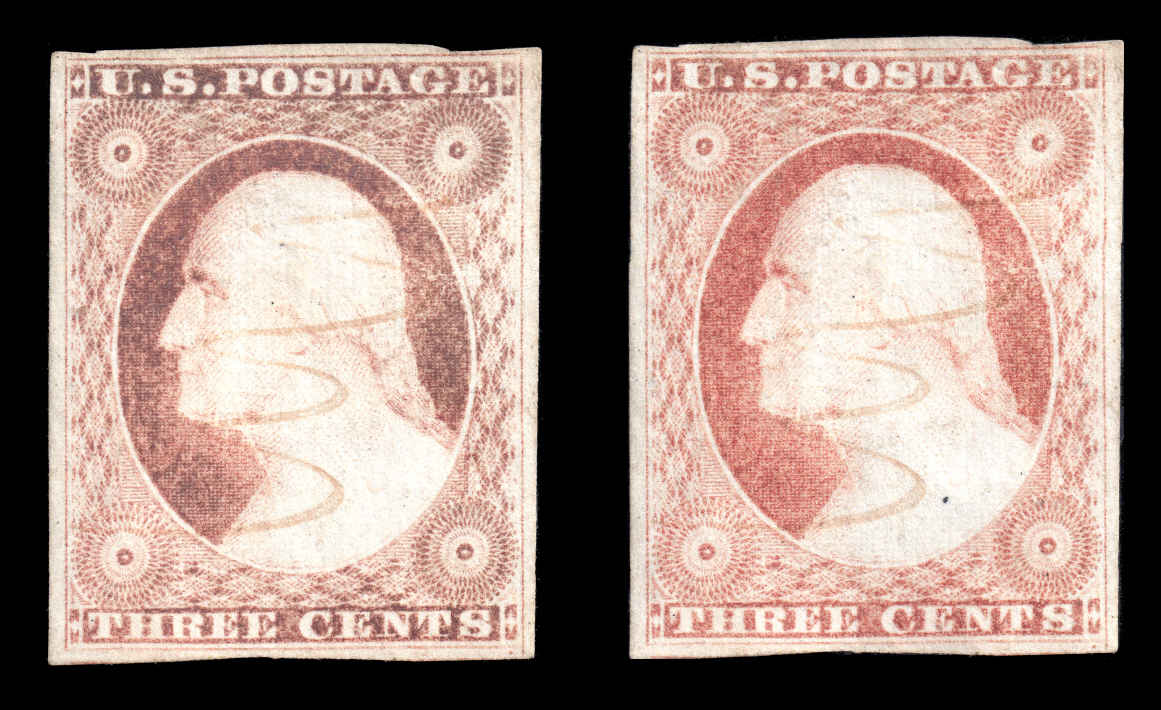 |
|
Send note to Staff
|
|
|
Pillar Of The Community
United States
2230 Posts |
|
|
jaxom100, thanks for showing your results. This looks like an improvement, and about what I'd expect. I've used peroxide on numerous oxidized 3-cent imperforates, but I've never seen it completely remove the darkness. |
|
Send note to Staff
|
|
|
Pillar Of The Community
United States
1337 Posts |
|
|
I left in it for about 3 minutes instead of one as recommended. It made a big difference.
Classic Coins, thank you for those links. If I am not mistaken, this stamp that was just cleaned the oxidation from is plate 53R1E. If that stamp has the one line in lower left triangle recut and has no inner lines. That only left me one choice for plate and position. Is this correct? Would that make the stamp a #10?
53R1e
Relief A
Variety #2 No Inner Lines.
Variety #16 One Vertical Line Recut in Lower Left Triangle.
|
|
Send note to Staff
|
| Edited by jaxom100 - 11/27/2017 9:44 pm |
|
|
Pillar Of The Community
United States
2948 Posts |
|
|
Replies: 39 / Views: 4,970 |
|



 Posted 11/25/2017 8:33 pm