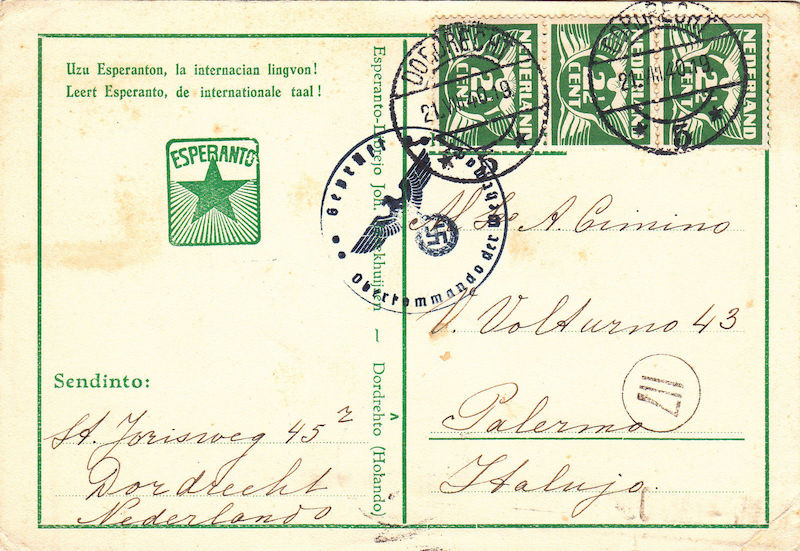
This is one of my favorite pieces from my collection. It's a postcard mailed on 21 August 1940 from Dordrecht to Palermo. Since the Netherlands had surrendered to Germany on 15 May, this postcard had to pass through the German censors, hence the Wehrmacht censor stamp. I haven't been able to find anything about the "117" stamp on it, though, whether it's a routing number, the individual censor's number, or what; if someone with a better knowledge of WWII censored mail (or at least a better reference library!) could enlighten me, I'd appreciate it.
What's most interesting about this postcard (to me, at least) is that it was written in Esperanto and was unmistakably promoting the use of that language during the Nazi occupation. Although Esperanto organizations had already been banned in Germany four years earlier (Hitler regarded Esperanto as a tool of the international Jewish conspiracy), the Nazis didn't immediately crack down on the use of Esperanto in the occupied countries. I haven't been able to find out precisely when the use of Esperanto was banned in correspondence between the Netherlands (an occupied country) and Italy (an Axis power), though I have read that it was banned in correspondence between the Netherlands and
Belgium in November 1940. All Esperanto organizations in the Netherlands were dissolved by decree on 20 March 1941.
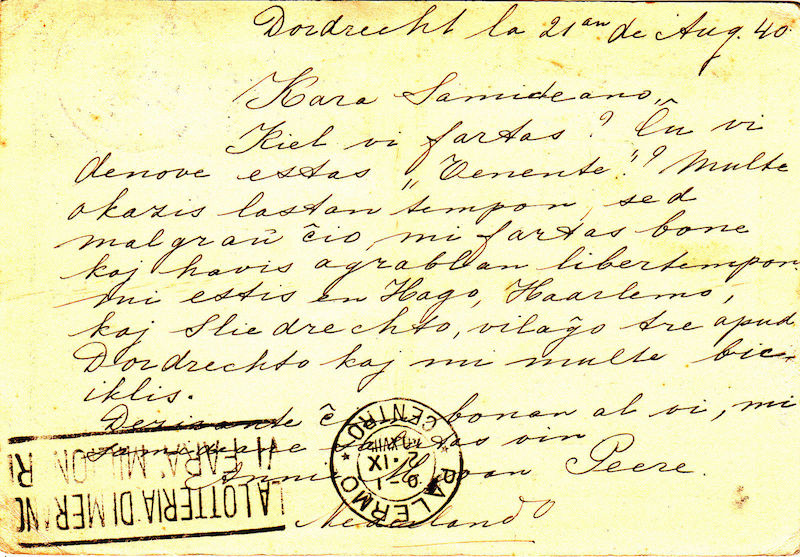
The text reads:
Dordrecht, 21 Aug. [19]40.
Dear Samideano [Fellow Esperantist],
How are you doing? Are you "Venente" [Italian for "coming"] again? Much has happened recently, but in spite of everything, I am doing well and have had a pleasant vacation. I was in the Hague, Haarlem, and Sliedrecht, a village very close to Dordrecht, and I did a lot of bicycling.
Desiring all the best for you, I salute you as a fellow Esperantist,
Annie M. van Peere.
Netherlands.
"Much has happened recently" — what a masterpiece of understatement!
I suppose that Sinjorino van Peere wrote in Esperanto to correspond with Sinjoro Cimino simply because it was their only common language, but why would she use a postcard blatantly
promoting this language that had the disfavor of the occupying power? Was she making a bold statement, or was she simply ignorant of the Nazis' stance on Esperanto? Either way, I hope she didn't have to pay the price for it.





 Posted 11/28/2017 10:57 pm


