| Author |
 Replies: 12 / Views: 4,711 Replies: 12 / Views: 4,711 |
|
|
Pillar Of The Community
Canada
1449 Posts |
|
|
Presently working on my WWII stamp collection, Part 3 "Axis Powers". Did the Hungary War stamps of this section and starting inventory on Bulgaria WWII stamps. Compared to other Countries, excluding Hungary and others.....they do not have much value....they are "penny stamps" Here is a Feb 28, 1944 set, Sc # 434-438. Only the last one is worth a little more....still under 50 cents - but nice stamps, MNH-VF  |
|
Send note to Staff
|
| Edited by Renden - 12/05/2017 11:31 am |
|
|
|
|
Pillar Of The Community
United States
572 Posts |
|
|
As with anything collectible the demand is what drives the price. Apparently the lack of demand for that corner of Europe keeps the price low. Scarcity affects price too, but it's usually demand that wins out. |
Send note to Staff 
|
|
|
Pillar Of The Community
Canada
1449 Posts |
|
|
Thanks for the observation (and opinion)John - I also believe som countries have "flooded" the market, affecting the scarcity etc |
|
Send note to Staff
|
|
|
Pillar Of The Community
Netherlands
799 Posts |
|
|
Part of the problem with WW II stamps, is the fact that a lot of them were bought with Black Market money. Soon after the war a lot of black market dealers lost out when governments declared the stamps no longer valid or declared them worthless. This material flooded the market, most of the time unused. This is also the reason why used stamps of that period often have a simular or higher value than unused stamps.(something you rarely see in other time periods). |
|
Send note to Staff
|
|
|
Pillar Of The Community
Norway
1661 Posts |
|
|
I think another reason for lack of market for the Bulgarian stamps is that they also flooded the market in terms of number of different stamps issued in the 70's and 80's, and the worst part was maybe that many of those stamps seems to have been very hastily made...same goes for Romania and Hungary, whilst example given Poland, Chzekoslovakia and Russia made some more effort in their stamp production, but that is naturally depending on personal preference by the collectors. At least on the auctions I've attended it seems many agree, extensive collections for the 3 mentioned countries often sell ridiculously cheap, compared with what someone once paid for those stamps.
|
|
Send note to Staff
|
|
|
Pillar Of The Community
Canada
1449 Posts |
|
|
Thanks Johan and Blaamand - do agree and this explains what I also have noticed...mint German stamps WWII are frequent in this collection and unused ones are often worth more,as said. They are part of history... |
|
Send note to Staff
|
|
|
Pillar Of The Community
Canada
1324 Posts |
|
|
We need to also refer to the CTO - Cancelled To Order issue. This is the appalling practice of printing stamps never intended to be used for postage but rather to sell in kilo loads to dealers to stuff world sales lots. Watch for the perfect corner cancel - usually a dead give away - because the panes were cancelled intact. CTOs are essentially worthless. |
|
Send note to Staff
|
|
|
Pillar Of The Community
United States
8572 Posts |
|
|
A lot of countries don't have good control at the printing office and also at the post offices so a lot of nice stamps go out the back door . They end up at the bigger stamp dealers in far away cities in Germany or places like Paris OR London . |
|
Send note to Staff
|
|
|
Pillar Of The Community
1363 Posts |
|
|
Let me offer a perhaps somewhat odd defense of these countries' stamp issuing policies.
Romania, Bulgaria, and Hungary operated local stamp collecting groups as a way to occupy their citizens. These clubs wften were pretty big deals in countries where consumer spending was very small and the chance to travel was limited, and living conditions often pretty bad. Keeping citizens busy with "happy" hobbies was, apparently, one approach to keeping the lid on social unrest. When you do this sort of thing, it helps to have a lot of easily available stamps for people to collect, and these have to be local stamps since the populace cannot afford most foreign stamps. I own a number of collections put together by someone in East Germany who spent an enormous amount of time mounting and writing up their collection of what were, essentially, ordinary and uninteresting DDR stamps of little value. What else do you do with your time in a totalitarian dictatorship?
A second factor for the issuance of so many cheap stamps was that these countries needed foreign currency to buy things with. One way to do that would have been through foreign trade, but the West did not trade much with Eastern Bloc countries, so that was of little benefit. Another source of dollars and pounds might have been tourism, but who went to Bulgaria during the Cold War? I spent some time in Czechoslovakia and it was pretty bleak, hardly a tourist haven, and there were very few foreigners there at the time. And it was one of the more open countries during that era. One solution to producing this needed income was issuing large amounts of stamps which is what they did. This was also done by a number of Latin American and African nations (Mali comes to mind) in order to bring in foreign income because of a lack of foreign trade and tourism dollars. North Korea and some other countries still do this today.
Keeping the public busy and creating some foreign income are not bad ideas, but of course they resulted in an enormous number of cheap stamps being issued which keeps their prices down. I somewhat disagree with the "hastily made" claim as I find some of these stamps (certainly not all of them) fairly attractive stamps. Poorly made or poorly designed stamps, to me anyway, would be North Korean stamps or the stamps of any number of other countries (Pakistan, Afghanistan, and others). These Eastern European countries often had decent stamp designers and created stamps that were actually fairly attractive. A lot of them were purposely made as topicals (birds, fish, animals, and so on) to sell them to the packet trade. So they are fairly pretty stamps. But, I agree that they certainly were not at the quality level of Swedish, Swiss, or Japanese stamps, that's for sure. I have collections from all these countries, partly because they are so inexpensive but also because I just kind of like the strangeness of Eastern European history. But, I also I like the look of a lot of the stamps, as well. The best stamp designers in Eastern Europe were, in my opinion, from Czechoslovakia. Just to show that good design vs. bad design can have little impact on stamp values, Czech stamps are still fairly inexpensive. |
|
Send note to Staff
|
| Edited by DrewM - 12/23/2017 12:03 am |
|
|
Pillar Of The Community
1448 Posts |
|
|
Pillar Of The Community
United States
1565 Posts |
|
|
I agree with Drew. One of my specialty areas is Poland, and I belong to the Polonus Polish Philatelic Society. Earlier this year, I obtained, via auction, a collection of postally used Polish issues through about 1965-66. Lots of empty spaces after 1960, but the post-war issues through 1960 are fairly comprehensive. That sort of collection took some effort. I have modest collections of Czechoslovakia, Romania, and Bulgaria.
As a tourist plug, for those who are travelers, visit Bulgaria before it gets "discovered" by American tourists. I was there briefly in 2014 and found it to be a nice little country with lots of cultural stuff; good hiking in national parks, including Mount Musala, the high point of the Balkans; and generally friendly people. A good friend visited Bulgaria this year and also liked the beach towns; I think she was in Varna. |
|
Send note to Staff
|
|
|
Pillar Of The Community
Canada
1449 Posts |
|
|
Thanks Drew for your interesting contribution to this thread and I do agree with you also - |
|
Send note to Staff
|
|
|
Valued Member
Bulgaria
287 Posts |
|
|
Wow, I see very skilled analysts here. Been directly into these areas for years, I can confirm that almost all of the above reflections are absolute truth. Just want to warn you: bear in mind that all these processes are not finished at all. Furthermore, I'd like to make hint here that, actually, east and west of Europe and America were not opponents. This was only the official version for the masses. And, in terms of philately, this reflected almost all European countries, not only eastern ones. I think, the French and West German stamps from the second half of 20th century are even cheaper than the mentioned above.  They just have a better public image because of the powerful propaganda. All I dream is to unite all the people that love the Philately so that to resist the negative political processes. Yes, everybody likes the so called classic, that's easy but: Let's rehabilitate all the philatelic stuff produced after WWII. There are many many great materials which should be preserved by the collectors for the next generations.Have a look, please: 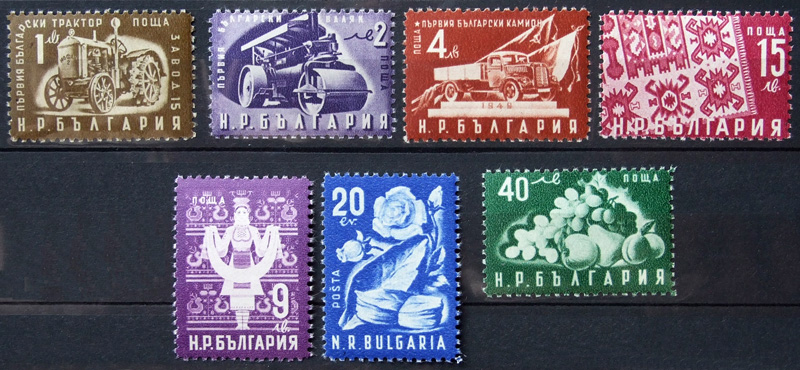 |
|
Send note to Staff
|
| Edited by MrPhilaRooms - 09/11/2018 06:32 am |
|
| |
Replies: 12 / Views: 4,711 |
|




 Posted 12/05/2017 11:30 am


