| Author |
 Replies: 42 / Views: 12,959 Replies: 42 / Views: 12,959 |
|
Valued Member
United States
35 Posts |
|
|
|
|
Moderator

United States
5107 Posts |
|
|
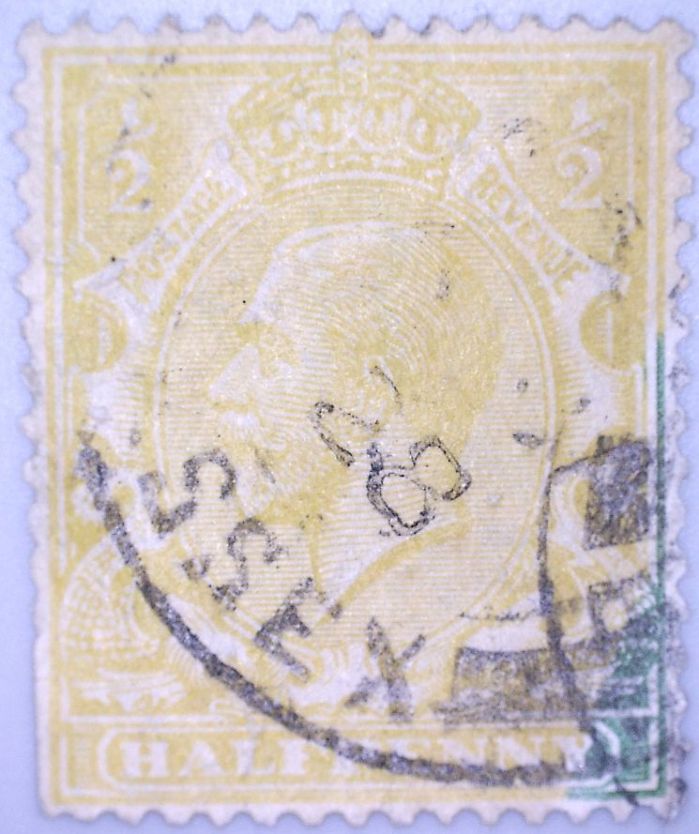
Probably environmental fading (left in the sun too long), or other fading (soaked in warm water for too long). Since I see a small bit of the correct color in the lower right hand corner, it was probably exposed to the sun and the small bit was underneath another stamp or cover.
This is a Great Britain stamp.
I wouldn't plan my retirement party yet. |
Send note to Staff 
|
|
|
Valued Member
United States
35 Posts |
|
|
I would go for this but the cancel is over top of the yellow and the green |
|
Send note to Staff
|
|
|
Moderator
United States
5107 Posts |
|
|
The cancel did not fade as much in the sun. The green ink faded much more, and that is what you are seeing. Sorry, but this actually means the stamp is an oddity, with no extra value.
You can see many other questions on this issue, and answers, including many examples, using the Search function. |
|
Send note to Staff
|
|
|
Pillar Of The Community
United States
3224 Posts |
|
|
As it should be. But the cancel is made of a more fade-resistant and solvent-resistant ink to try to prevent cleaning off cancels. It doesn't necessarily completely protect what is underneath it. This issue and earlier Great Britain are susceptible to fading, commonly the green ink used. This stamp is just an extreme example of that. A key that it is not an error is that the green color is not completely missing. |
|
Send note to Staff
|
|
|
Valued Member
United States
35 Posts |
|
|
Reason I'm asking these questions is, I received this collection from the late Mendel L.Peterson. They have never been exposed to light I am the first one to touch these in over 30 years out of the box. Mendel was the Head Curator for the Smithsonian Institute so I am afraid im going to have to dismiss the sun or environment theory guys |
|
Send note to Staff
|
|
|
Valued Member
United States
35 Posts |
|
|
Also under high magnification digital microscope their is no residue of any green even in the fibers. Does this help more?  |
|
Send note to Staff
|
| Edited by MrQuestion - 12/06/2017 7:30 pm |
|
|
Pillar Of The Community
USA
646 Posts |
|
|
Quote:
They have never been exposed to light I am the first one to touch these in over 30 years out of the box. postmark dated 1928. that leaves almost 60 years of possible exposure. Quote:
so I am afraid im going to have to dismiss the sun or environment theory Quote:
no residue of any green even in the fibers possibly chemical reaction (maybe bleached?) |
|
Send note to Staff
|
|
|
Pillar Of The Community
United Kingdom
3220 Posts |
|
|
Mr Question,
I'm afraid you are grasping at straws. The stamp has clearly changed colour through the action of sunlight and/or chemicals.
It doesn't matter if it has spent thirty years in a box away from sunlight. It had many decades to suffer this damage before going into the box.
|
|
Send note to Staff
|
Nigel |
|
|
Valued Member
United States
35 Posts |
|
|
Maybe! wouldn't that have effected possibly the others inside the envelope that were touching it for those many years? What does the ink look like to you gents and how it just abruptly ends? |
|
Send note to Staff
|
|
|
Moderator

United States
12330 Posts |
|
|
Pillar Of The Community
United Kingdom
3220 Posts |
|
|
Mr Question, I have suggestion for you:
Why not take another damaged KGV halfpenny blue-green stamp still with its original colour (that you don't mind damaging further), place it in bright direct sunshine (preferably with one corner covered securely), and wait to see how long it takes for the colour to change?
|
|
Send note to Staff
|
Nigel |
|
|
Pillar Of The Community
United States
6668 Posts |
|
|
The printing process alone should put to rest anything other than light exposure or chemical reaction. I'm sure if this were some type of freak stamp then surely the head curator for the Smithsonian would have some type of provenance for something this scarce or rare.
Pigments and dyes fade because light absorption and exposure to the air can slowly break down the chemicals that give them color. Generally the higher wavelength the absorbed light, the more likely it is to cause a pigment breakdown. This is because the energy of each photon in light is proportional to the wavelength (Energy of a photon = Planck's constant times wavelength). Blue dyes reflect higher visible wavelengths (not absorb) so are therefore likely to have a minor fade resistance advantage over red and green dyes. |
|
Send note to Staff
|
|
|
Moderator
United States
5107 Posts |
|
|
Pillar Of The Community
United States
7104 Posts |
|
|
"Other stamps in the envelope" lets me infer that Mr. Peterson had no particular love for that stamp. I concur with the environmental-damage opinions above.
But the bigger question is, what did you receive from Mr. Peterson that he clearly valued? That could be interesting to see. I hope you have more to show. |
|
Send note to Staff
|
|
|
Pillar Of The Community
674 Posts |
|
|
Well the fact that this came from the Smithsonian curator certainly makes this interesting, but that does not mean he was a serious stamp collector. Based on what's been described so far, it sounds like this may have been his childhood collection - that he never returned to??
So my questions - for Mr. Question! - are:
How did you come to acquire this collection?
What are your plans for it?
Is there anything sorted/presented properly in albums/pages etc? Please post pictures of other items of interest! |
|
Send note to Staff
|
|
|
Replies: 42 / Views: 12,959 |
|




 Posted 12/06/2017 6:27 pm