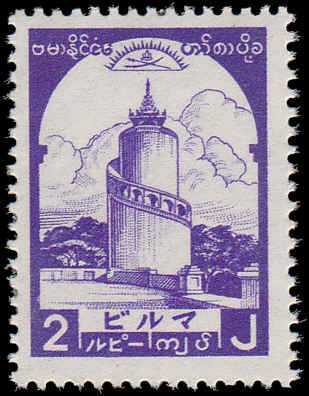
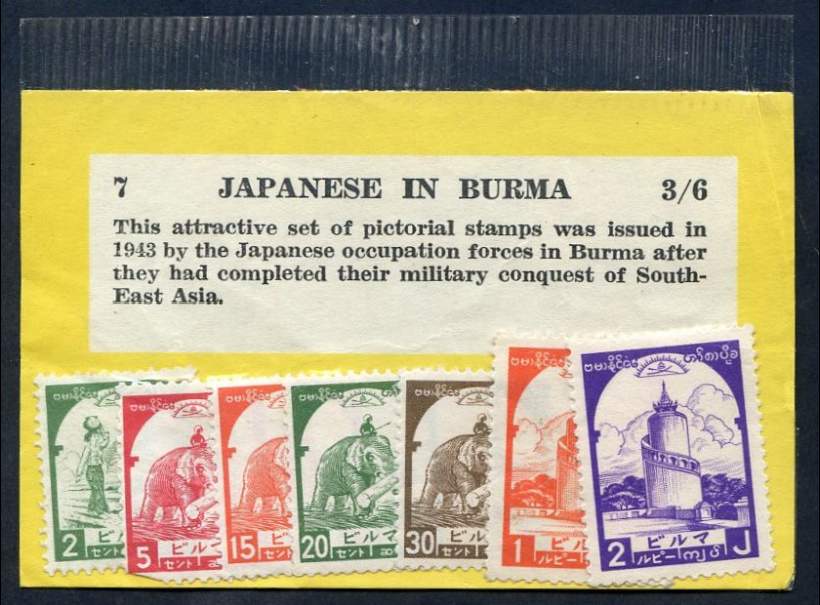
Quote:
Renden, those three Kanji characters in the white box are a sign that it is a Japanese Occupation stamp
Small correction: Those are katakana characters, not kanji.
Japanese writing normally utilizes three types of characters:
1. Kanji - ideographic characters of Chinese origin, generally used for the roots of nouns, verbs, adjectives, and adverbs. A given kanji represents a meaning or a group of related meanings, but may have different pronunciations (native Japanese or based on Chinese), depending on context. The kanji for "tree", for example, can be pronounced as
ki, ko, boku, or
moku.
2. Hiragana - cursive-looking syllabic characters used mainly for grammatical endings and function words (conjunctions, postpositions, particles).
3. Katakana - more block-like syllabic characters used mainly where we might use italics, such as for emphasis or foreign words. Both hiragana and katakana represent sounds, not meanings. In this case, the katakana spell out "
bi-ru-ma" (Burma). The katakana below them to the left spell out "
ru-pi-[vowel lengthener]" (rupee); those on the lower denominations "
se-n-to" (cent).
Anything written in kanji can alternatively be written in hiragana or katakana, though this is normally done only in special circumstances, such as to make a text easier for younger readers.





 Posted 12/16/2017 2:34 pm