| Author |
 Replies: 13 / Views: 2,010 Replies: 13 / Views: 2,010 |
|
|
Valued Member
United States
262 Posts |
|
|
Thought I would use the many experts (and general all around smart brains) to help me figure out the origin of these stamps. I acquired these recently in a group of Czech Legion Post stamps. While I didn't buy the lot specifically for these stamps, I thought they were interesting nonetheless.  First of all, a quick background. According to Scott, the base stamp had three printings. This is from the third printing in the 1920s. They were printed in Prague, primarily for sale on the philatelic market. This printing is easy to spot because of the heavy carmine inking at the top of the center oval. Therefore the first deduction -- Of course they were philatelicaly produced. In the next few posts, I will zoom in on some interesting aspects of these stamps, and maybe we can together can deduce the who, what, where, when and how these stamps were produced. Of course, if there is someone who has seen these before and actually, knows this information. You can let us know the answer, and potentially spoil the fun. Michael |
|
Send note to Staff
|
| Edited by DCStamps - 02/18/2018 4:43 pm |
|
|
|
|
Valued Member
United States
262 Posts |
|
|
One observation of the stamps, is that the face of some of them have been damaged. Scraped? smeared? I don't know what would cause the marks. Here are a couple of close ups.  |
Send note to Staff 
|
|
|
Pillar Of The Community
1448 Posts |
|
|
Michael - the 2017 Scott 1840-1040 catalogue states that all three printings received the subsequent overprintings.. So aren't these a variation of Czech Legion Post Scott 9-14, or is that spoiling the fun? ;-) |
|
Send note to Staff
|
|
|
|
Valued Member
United States
262 Posts |
|
|
Valued Member
United States
262 Posts |
|
|
Sorry, I guess I wasn't very clear. This set has inverted surcharges, and I am trying to deduce as much as possible about them. They seemed to be inked differently with a much lighter ink. Here is a comparison of the 35k stamps (normal vs inverted)  Just trying to find out as much as possible about the inverted overprints. The back of the stamps also have a couple of expert / collector marks, which I will show later. |
|
Send note to Staff
|
|
|
Pillar Of The Community
United States
3295 Posts |
|
|
They look like set-offs. Un-overprinted stamp sheet laid on top of freshly over printed sheet. They are inverted and reversed. |
|
Send note to Staff
|
|
|
Valued Member
United States
262 Posts |
|
|
Humm I don't see that they are reversed. Wanted to be sure I was correct, so I rotated all of them by 180 degrees and compared them to the normal. I see that this also gives us a chance to compare the actual overprints side by side. They seem similar, but the inverts are so messy, it is hard to be sure.  |
|
Send note to Staff
|
|
|
Pillar Of The Community
United States
8956 Posts |
|
|
DC stamps, rotating them by 180 degrees will not do the trick. Just flip them over and see - they will be reversed!
Peter |
|
Send note to Staff
|
|
|
Valued Member
United States
262 Posts |
|
|
Peter, I like your idea that it might be a transfer, the light inking would make perfect sense.
However, I must be dyslexic, as I still can't see it.
To make it an inverse and an invert, one would need to flip it and rotate it.
When I physically do this with the stamps, it just doesn't give me the image.
Michael
|
|
Send note to Staff
|
|
|
Pillar Of The Community
United States
3224 Posts |
|
|
The two overprint colors are from different typefaces. The character widths are clearly different, both in overall width and line width. If both color versions were not blown up to slightly different sizes, then the characters are a different size as well. Compare the areas noted below: 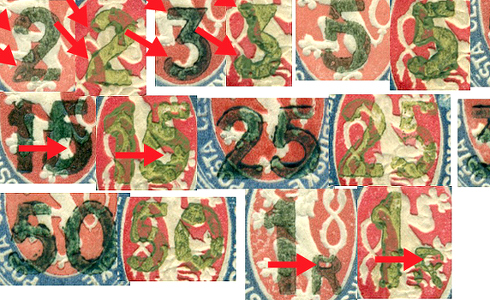 |
|
Send note to Staff
|
| Edited by hy-brasil - 02/18/2018 11:16 pm |
|
|
Valued Member
United States
262 Posts |
|
|
Thanks, I see the differences, and there are so many things wrong with these. surcharges. There is one more observation I have to add to the puzzle (although it could be entirely irrevelent) On the back of every stamp are two collectors marks. One is is the stamp of Lešetický-Ustredna, a prominent Expert committee in Prague during the era, and the other is quite unrecognizable, I have tried to blow up the best of the bunch. These could be counterfeit marks, they could have been applied before the surcharge was applied, or they could be real for the entire stamp. My guess is the middle one, although I wonder why you need an expert mark for a stamp run what was primarily printed for the stamp market. 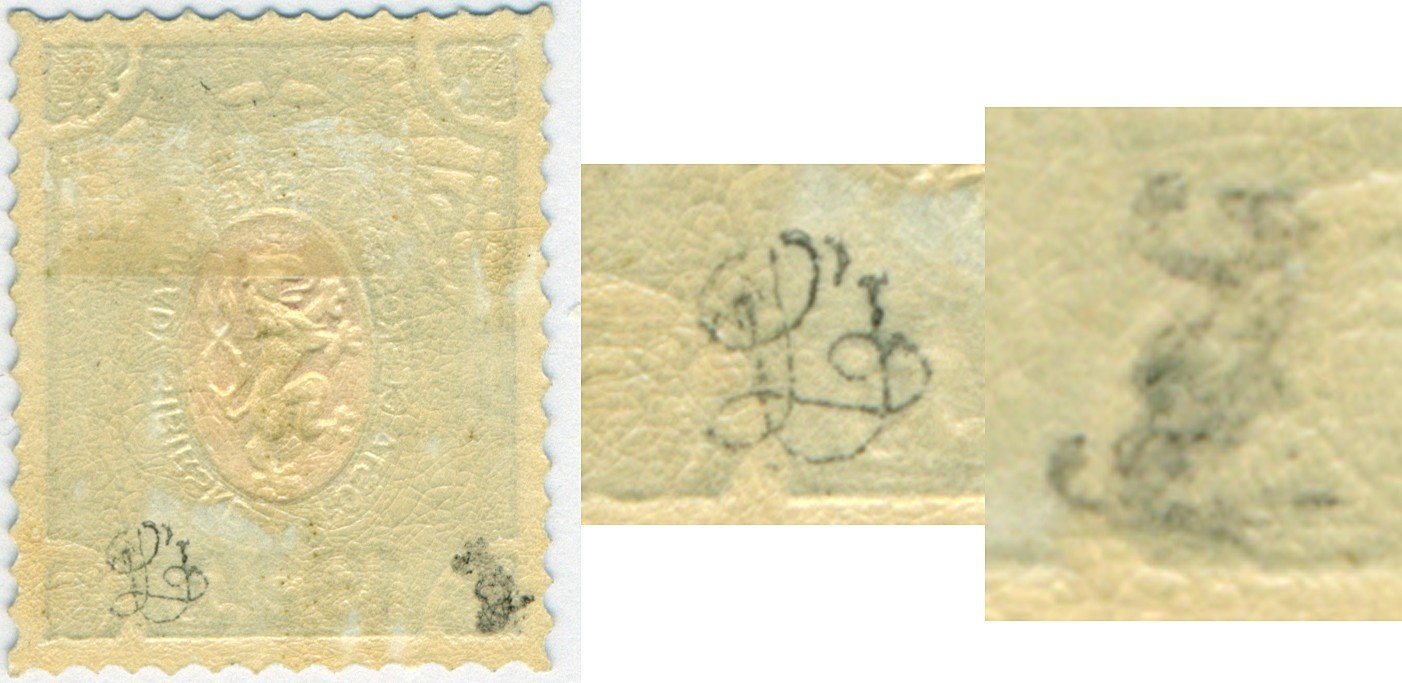 |
|
Send note to Staff
|
|
|
Valued Member
Canada
24 Posts |
|
|
For the sake of comparation, here's my set, they are all signed by Jan Mrnák (sometimes forged). 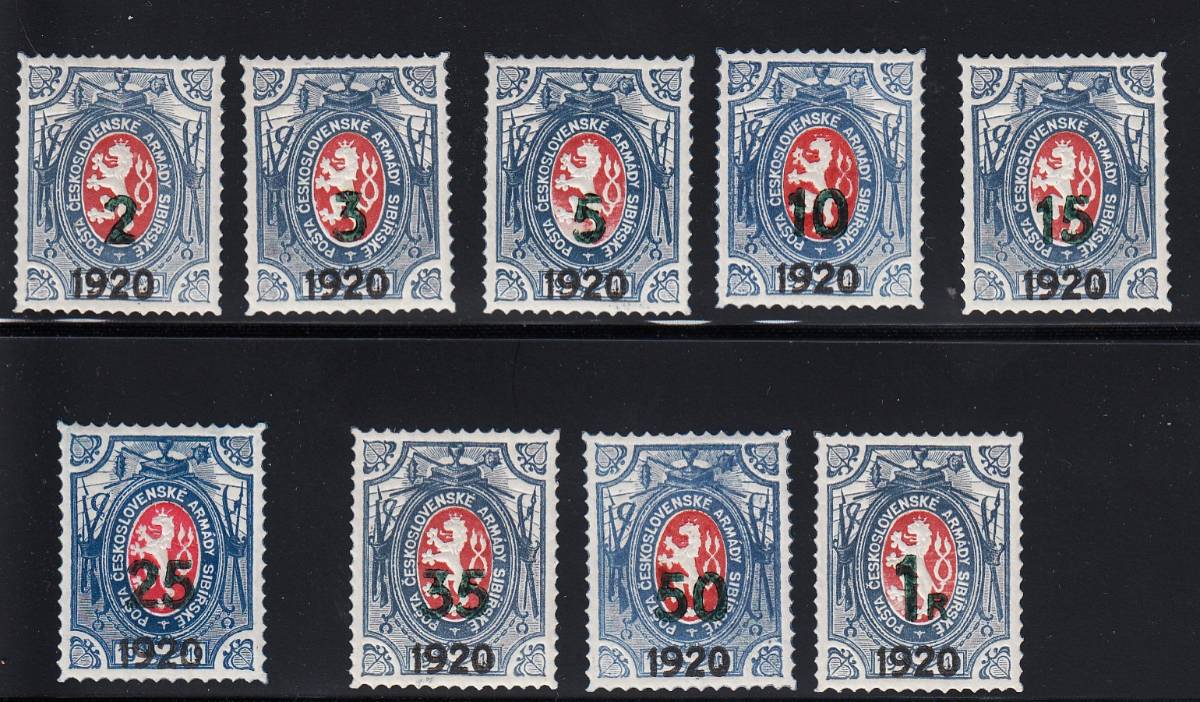 |
|
Send note to Staff
|
|
|
Pillar Of The Community
United States
8601 Posts |
|
|
Valued Member
Canada
24 Posts |
|
| |
Replies: 13 / Views: 2,010 |
|




 Posted 02/18/2018 4:40 pm


