| Author |
 Replies: 71 / Views: 13,259 Replies: 71 / Views: 13,259 |
|
|
|
Valued Member
Belarus
75 Posts |
|
|
Moderator

United States
12330 Posts |
|
|
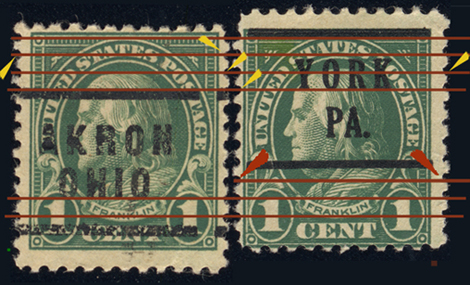
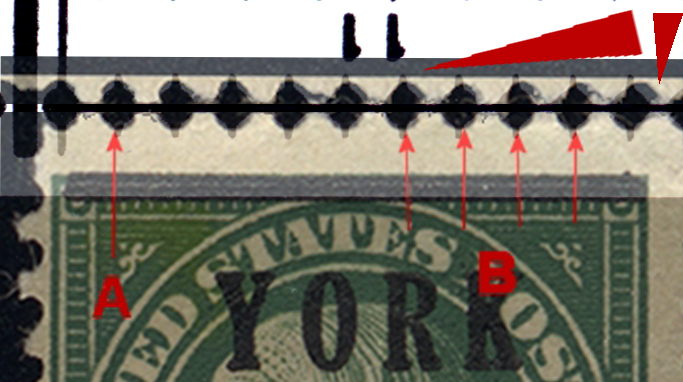
Sigh, here we go again. The York PA stamp is NOT 11 x 11. If you want to use software, then use the Srail method. ( https://srailstamps.com/ ) Srail method takes one side of the perfs and compares it to the other sides like this (left side perfs digitally copied next to other three sides) 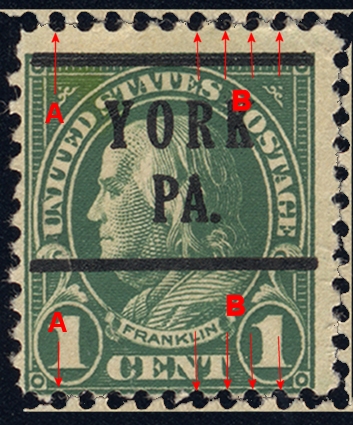 As you can plainly see, the perfs (marked as 'A') line up, but as you move to the other end of the stamp the perfs do NOT line (marked as 'B'). You do not have sheet waste stamps. But let's assume someone here posted that you might have a sheet waste stamp. What would you do? You would have to spend money and get it certified. It appears that you think you have one of these very rare stamps. Please send it in for a certification and report back to us the results. Don |
Send note to Staff 
|
|
|
Valued Member
United Kingdom
299 Posts |
|
|
Don, is it normal the length of the fibers left after tearing this stamp off the sheet, please? |
|
Send note to Staff
|
|
|
Moderator
United States
12330 Posts |
|
|
The fibers do not strike me as unusual. valera_foto is too concerned with the stamp dimensions when he should be looking closely at perforations and printing type.
Always start with the assumption that you have the most common stamps.
If you start with the assumption that you have a rare stamp, you get caught up in trying to prove it with dimensions and miss the obvious things like offset ink on the back of flat plate stamps, perforations, etc.
I am baffled on how many threads we have where people do this.
Don
|
|
Send note to Staff
|
|
|
Valued Member
Belarus
75 Posts |
|
|
Thank you very much for discussing the topic. I tried to provide material to the maximum, for professionals to Express their opinion for some elements,such as size,perforation, and more... If that is not shown sorry.... As was able, I'm not a high-level specialist, Reading the forum threads at the expense of Scott 552. Decided to show mine,because the dimensions are different. If that the I missed,write I will try show.Thanks for the chat..... |
|
Send note to Staff
|
|
|
Pillar Of The Community
1375 Posts |
|
|
As said already, you need to use a perforation gauge, then decide if you really have any perf 11 without setoff on the back (=possible rotary), then search for a perf 11 WITH very clear setoff on the back (=flat), then compare these two stamps concerning the size. All measurements you showed above do not lead to get an identification of this stamp. |
|
Send note to Staff
|
|
|
Valued Member
Belarus
75 Posts |
|
|
Pillar Of The Community
1375 Posts |
|
|
Pillar Of The Community
United States
1946 Posts |
|
|
Quote:
But why are there such fine lines in this brand…
That happens...? I'm sorry. I am not able to recognize what you mean by "brand" in this sentence. Are you perhaps referring to the quality of "impression"? If so, then the die cutting has little to do with it. But I'm not sure of what you mean, so I don't want to guess. Some of you guys seem able to follow what is being asked here. Can you help me? |
|
Send note to Staff
|
|
|
Valued Member
Belarus
75 Posts |
|
|
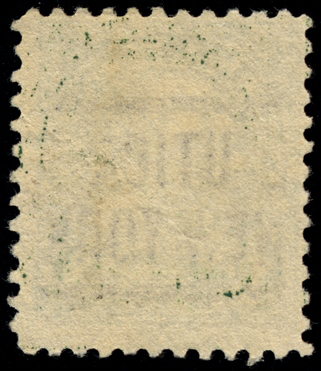
View did a scan of the reverse side ( YORK PA.) there are color spots as well as lines ...... 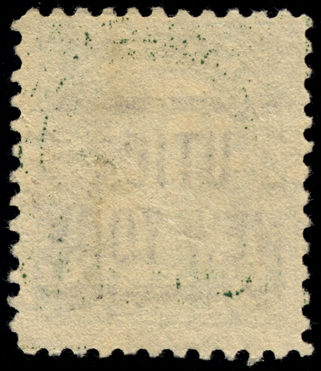 |
|
Send note to Staff
|
|
|
Valued Member
Belarus
75 Posts |
|
|
51studebaker writes that you should always start with the assumption that you have the most common brands.I agree.... I'm not saying anything and not prove,and analyze and listen to Your opinions,but sometimes recheck, to hurry in these cases is unnecessary..... Thanks to everyone who helps me, and expresses his opinion...... If we talk about perforation,then we need to return to (BUFFALO N. Y. ) where perforation 10 does not work.Can who knows why so. To use a perforation gauge,can advise which is correct that would show for sure.....? 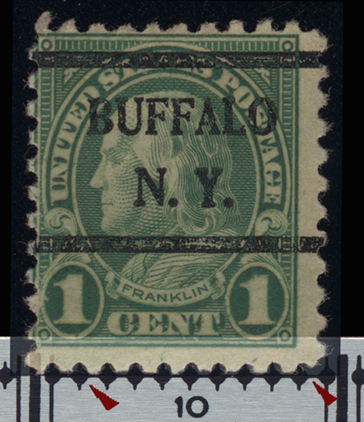 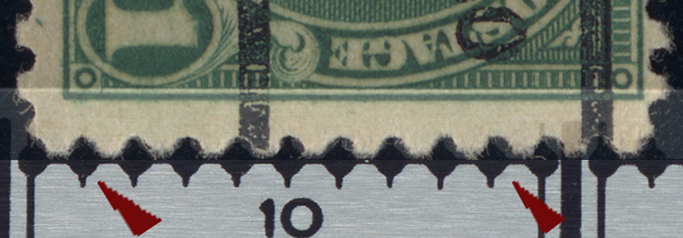 |
|
Send note to Staff
|
|
|
Pillar Of The Community
United States
1430 Posts |
|
|
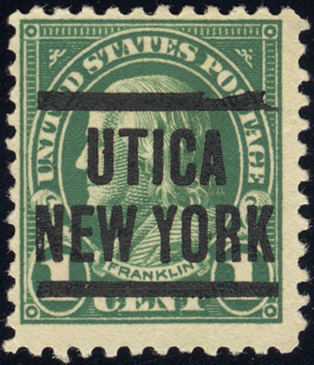
Quote:The York PA stamp is NOT 11 x 11. If you want to use software, then use the Srail method. ( https://srailstamps.com/ ) Srail method takes one side of the perfs and compares it to the other sides like this (left side perfs digitally copied next to other three sides) Okay, if it's not 11 x 11, then what is it? The vertical perfs do appear to be slightly out of sync with the horizontal perfs, but even 11 x 10½ would be noticeably further out of sync, as this image of a #632 shows:  Let's assume that one of the sides of the York PA stamp is really perf 10.9 or 10.95 according to somebody's super-high-tech electronic perforation gauge. Is that going to make a difference? Is it going to be listed as a different stamp in Scott? Not as far as I can tell. I'm not arguing that the York PA stamp is a valuable rarity or anything. 11 x 11 usually means that it's just a garden variety #552, of course. |
|
Send note to Staff
|
|
|
Pillar Of The Community
1375 Posts |
|
|
you need an US specialty perforation gauge to get exact results, like Kiusalas', or the US Multigauge.
about the York PA: yes, the perforation does look strange, and it's neither perf 11 not perf 10.5 to me. I am not a perforation expert, so some others may express their opinion if they are fake or what they are.
the setoff on the back of a stamp is seen if the stamp is flat printing, so no rotary (594/596). |
|
Send note to Staff
|
|
|
Moderator
United States
12330 Posts |
|
|
erilaz,
The point was to try to move the original poster towards properly gauging the perforations, color, and printing type and away from trying to measure the stamp design. We are offering opinions on images, not stamps. We do not have the stamp in hand. This thread, like the other 20+ threads on 594/596, try to justify an identification based solely upon dicey stamp design dimensions.
Don |
|
Send note to Staff
|
|
|
Valued Member
Belarus
75 Posts |
|
|
Replies: 71 / Views: 13,259 |
|



 Posted 03/01/2018 07:05 am