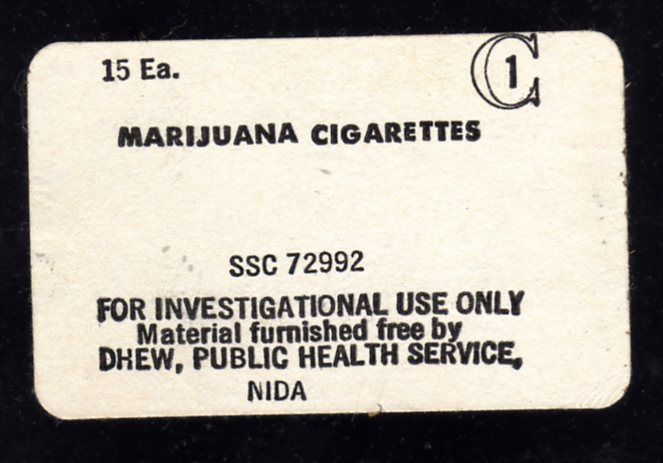
NIDA is still part of the NIH, information on government Marijuana, the farm in Mississippi and applications for reaserch can be found on there website.
Under the 1961 international Single Convention on Narcotic Drugs (amended in 1972), cannabis
is designated a Schedule I substance, and participating countries are required to restrict
production, manufacture, possession, and distribution of marijuana except for medical and
scientific purposes. The Drug Enforcement Administration (DEA) regulates the cultivation of
marijuana for research purposes through licensing requirements and establishment of annual
aggregate production quotas under the authority of the 1970 Controlled Substances Act (CSA),
which implements the Single Convention.
Marijuana for use in research can be obtained through the NIDA Drug Supply Program. All
applicants must fulfill the following criteria:
For non-NIH funded human research projects:
1. Demonstrate scientific validity and ethical soundness through review by the FDA's IND
process. Research protocols will undergo a scientific review which assures the safety and
rights of subjects and the scientific quality of the clinical investigations, and assesses the
likelihood that investigations will yield data capable of meeting the statutory standards for
drug marketing approval; and
2. Possess a DEA registration for marijuana, a Schedule I controlled substance under the CSA.
For NIH-funded projects:
4
1. Demonstrate scientific validity and ethical soundness through the NIH grant review process
which consists of three steps: (1) the NIH peer review system, which assesses the scientific
and technical merit of all grant applications; (2) the National Advisory Council of the
funding institute, comprising eminent scientists as well as public members; and (3) the
funding institute's Director, who makes the final funding decision on the merit of an
application, based on peer review, public health significance, and institute priorities. To find
studies approved through the NIH review process go to:
http://projectreporter.nih.gov/reporter.cfm;
2. Have an active-status IND application on file with the FDA (for human research only),
which has been evaluated by FDA and found safe to proceed. For additional information go
to:
http://www.fda.gov/Drugs/Developmen...lopedandApproved/ApprovalApplications/InvestigationalNewDrugINDApplication/default.htm; and
3. Possess a DEA registration for marijuana, a Schedule I controlled substance under the
CSA.
Once the above steps have been completed, investigators should contact the NIDA Drug Supply
Program to place an order for marijuana with specific characteristics with regard to
concentrations of delta-9-tetrahydro-cannabinol (THC), cannabidiol (CBD), and other
cannabinoids. The program official will verify that the application is complete (with all the
above-mentioned steps fulfilled), and forward the order on to the contractor responsible for
shipping the marijuana. While not required in all cases, it is recommended that researchers
contact the NIDA Drug Supply Program early in the planning of a study to obtain information on
5
specific strains of marijuana available so that this information can be included in the protocol
and IND (
http://www.drugabuse.gov/researcher...ly-program).DATED: June 17, 2015.
Karen B. DeSalvo, MD, MPH, MSc,
Acting Assistant Secretary for Health.





 Posted 03/25/2018 8:58 pm