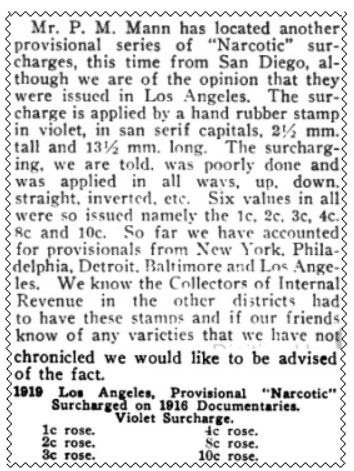
Well, I did mention "attributed."
In my book I propose the source of the internal revenue office but I also mention that no identifiable cancelled examples have yet been seen. So, yes, the overprint may be fake.
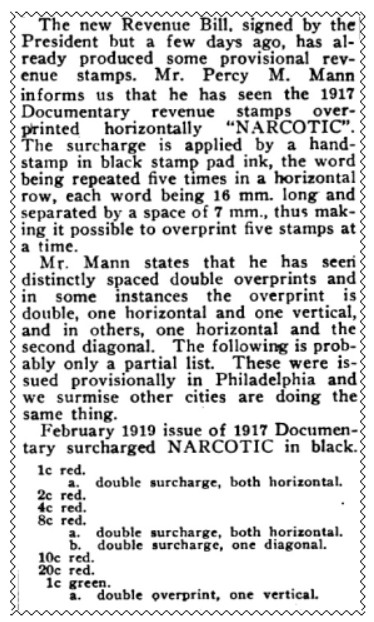
Ward was merely reporting what Percy Mann had shown him.
Mr. Mann was also apparently the first to find the Philadelphia overprinted stamps, in March, 1919.
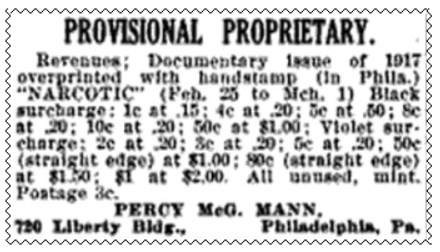
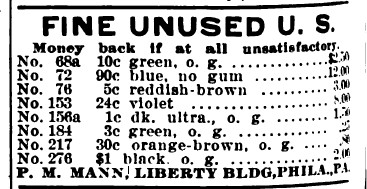
Apparently Mr. Mann obtained more than a few of the stamps, as he was attempting to sell them in May, 1919, a mere 60 days after they were issued, for a considerable mark up (as dealers are known to do).
Now, if Mr. Mann had reported more and more narcotic overprint varieties, then it sure seems that not all of them should be genuine, unless he was a particularly well-connected and enthusiastic stamp dealer/collector, who was also quite lucky.
But, so far at least, he only "found" the Philadelphia and the Los Angeles overprints.
Ultimately, one can look at it positively in that Mann was an honest dealer/collector that specialized in these stamps at the time, and was able to track down stamps that most other collectors were either unable to acquire or simply didn't know about; or he was a bit of a rogue and fabricated the Los Angeles overprints (and possibly several others) for financial gain.
He was definitely at least a part-time stamp dealer.
Despite the lack of confirming cancelled examples of the L. A. overprint, I lean towards them being genuine, rather than not.
What would be the point of their creation, if they weren't being sold for a profit, at the time?
I haven't found
any later advertisements from Mann for the L. A. overprinted stamps, and he only ran the ad for the Philadelphia copies
once, in a 1919 philatelic newspaper.
Can you show the alleged Baltimore 3 cent overprint variety? Not sure if I've seen it yet.
Jim





 Posted 03/30/2018 10:16 pm