Stamp Community Family of Web Sites
Thousands of stamps, consistently graded, competitively priced and hundreds of in-depth blog posts to read


Stamp Community Forum
 
Username:
Password:
Save Password
Forgot your Password?

This page may contain links that result in small commissions to keep this free site up and running.

Welcome Guest! Registering and/or logging in will remove the anchor (bottom) ads. It's Free!

New South Wales Parcel Post 1886-1900

Next Page    
 
To participate in the forum you must log in or register.
Author Previous TopicReplies: 17 / Views: 2,910Next Topic
Page: of 2
Pillar Of The Community
Australia
3282 Posts
Posted 04/04/2018   01:17 am  Show Profile Bookmark this topic Add Bobby De La Rue to your friends list Get a Link to this Message
A Parcel Post was established between New South wales and the United Kingdom under a Treasury Warrant dated 10 June 1886.

At this time the Sydney Parcels Office was located at George Street but in October 1893 it was relocated to Castlereagh Street. Parcels could still be lodged at the GPO however. In 1893, the Parcel Post Offices were open until 6pm on weekdays and 1pm on Saturdays.

Rates to the United Kingdom


Intracolonial Rates


Intercolonial Rates


Rates to New Zealand


British Empire and Foreign Destinations
By the time a Parcel Post was established with the United Kingdom, various British Colonies and foreign countries had already made arrangements for a Parcel Post with the United Kingdom.

British colonial destinations had rates based on a lower weight limit of one pound, compared to two pounds for New South Wales. European destinations, as well as Canada and the British Post Office in Constantinople, had a charge based on a lower weight limit of three pounds, with the exception of Belgium where a flat rate of 1/8 was charged for parcels up to a maximum weight of seven pounds. The lower weight limit for Egypt was two pounds.

Rates for parcels were first mentioned in the October 1886 quarterly edition of the New South Wales Postal Guide. The rate for the first pound was based on the minimum 2/- charge to the United Kingdom plus the rate per pound to the destination as per the Treasury Warrant between the United Kingdom and the destination. The maximum weight for British Colonies (as well as the British Post Office at Constantinople) was 11 pounds; for European destinations seven pounds.

For parcels addressed to British Colonies exceeding two pounds, the per pound rate was one shilling plus the additional pound rate as per the Treasury Warrant. By 1887 parcels sent to Austro-Hungary, Denmark, Germany, Heligoland and Switzerland could be sent via Hamburg or Cologne, the latter being a little more expensive.

It is worth noting that the Treasury Warrant rates to Sweden and Austro-Hungary were rounded up to the nearest penny as New South Wales did not have a half-penny stamp until January 1891.

With the "Postage Acts Amendment Act, 1893" New South Wales established it's own rates for Parcel Post and the Treasury Warrant in effect between New South Wales and the United Kingdom was annulled from 1 January 1894. The postage rates however remained unaltered.


The table below shows the parcel rates as originally advertised in the New South Wales Postal Guide, October 1886. The 10lb rate for Constantinople appears to be an error.
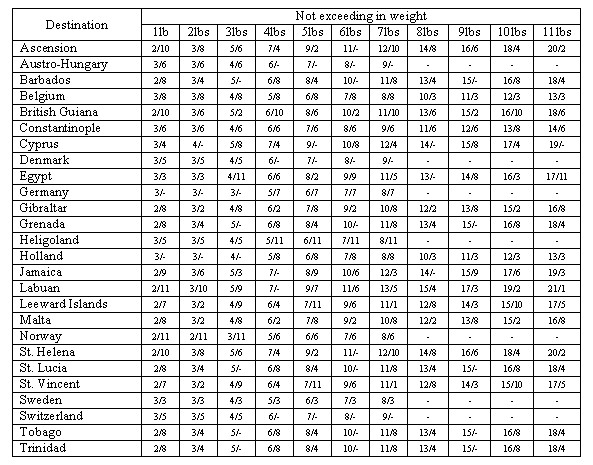


For Canada, parcels to Nova Scotia, New Brunswick, Prince Edward Island and Quebec were charged at 3/3 for the first lb, up to 2lbs 4/6 and up to 3lbs 6/9. For Ontario the charges were 3/6 for the first lb, up to 2lbs 5/- and up to 3lbs 7/6. For Manitoba and the North-West Territories the charges were 3/8 for the first lb, up to 2lbs 5/4 and up to 3lbs 8/-. For British Columbia and Vancouver's Island the charges were 3/11 for the first lb, up to 2lbs 5/10 and up to 3lbs 8/9.

With the exception of Canada, parcels could have a maximum length of 3'6" and a maximum length and girth combined of 6'. For Canada the limits were a maximum length of 2' and a maximum girth of 1'.

By 1887 the service had been extended to the following British colonies: Bahamas (3/4 to 2lbs, then 1/8 per lb), British Honduras (2/8 to 1lb, 3/4 to 2lb, then 1/8 per lb), Natal (4/8 to 2lbs. then 2/4 per lb) and Zanzibar (3/- to 1lb, 4/- to 2lb, then 2/- per lb). The maximum weight for Natal was 7lbs while for the others it was 11lb.

The service was extended to certain other British colonies as follows: Dominica, Montserrat, Nevis, St. Kitts and Virgin Islands in 1888; Cape Town in 1889; Bermuda, Falkland Islands and Turks Islands in 1890 and Bechuanaland, Transvaal and Mauritius in 1892. A direct service with Hong Kong, Gibraltar and Egypt had been established by 1891 and was extended to India and Ceylon the following year.

The October 1894 New South Wales Postal Guide listed parcel rates to almost every British colony and foreign country. A direct service with Canada was established in 1895 and with the Cape of Good Hope in 1900.

Additional Services
In 1886 a certificate of posting could be obtained for 4d. In 1888 this charge was reduced to 2d and by 1894 it was 3d. By 1894 inland parcels could be registered at a charge of 3d and a receipt of delivery could be obtained at a charge of 2½d.
Send note to Staff

Bedrock Of The Community
Australia
38679 Posts
Posted 04/04/2018   01:45 am  Show Profile Bookmark this reply Add rod222 to your friends list  Get a Link to this Reply

Nice work Sir !

Send note to Staff  Go to Top of Page
Pillar Of The Community
Australia
3282 Posts
Posted 04/04/2018   04:17 am  Show Profile Bookmark this reply Add Bobby De La Rue to your friends list  Get a Link to this Reply
Thanks Rod.

I'll be adding to this as I continue to write up my research.

I'm aware of Nibbs' manuscript "Newspapers, Books and Parcels in NSW" but I don't think anyone has done much study on just Parcel Post.
Send note to Staff  Go to Top of Page
Bedrock Of The Community
Australia
38679 Posts
Posted 04/04/2018   07:36 am  Show Profile Bookmark this reply Add rod222 to your friends list  Get a Link to this Reply

I've not seen anything on Parcel Rates in my travels, so your work is a Godsend.

Still getting my head around the prices.

Surely the heavier stuff would have been handled by freight forwarders.


Quote:
The 10lb rate for Constantinople appears to be an error.


Why you feel that ?

Send note to Staff  Go to Top of Page
Pillar Of The Community
Australia
3282 Posts
Posted 04/04/2018   5:43 pm  Show Profile Bookmark this reply Add Bobby De La Rue to your friends list  Get a Link to this Reply
Hi Rod,

I wrote the article about 4 years ago and always thought the 10lb rate for Constantinople should say 10/6, in keeping with the one shilling steps above 8lbs.

Since then the NSW Gazettes have been placed online. I should've checked that one and reworded my original text. I just checked and my suspicions were confirmed.

https://trove.nla.gov.au/newspaper/...l-decade=188

To maintain the structure of the table in the original MS word document I took a screenshot and used the image.

I agree with you about the heavier stuff. Normal shipping arrangements/bills of lading would surely apply? That's something I know very little about.
Send note to Staff  Go to Top of Page
Bedrock Of The Community
Australia
38679 Posts
Posted 04/04/2018   8:06 pm  Show Profile Bookmark this reply Add rod222 to your friends list  Get a Link to this Reply
Thanks Bobby.
You have done a cracking job. Very much appreciated.
Send note to Staff  Go to Top of Page
Pillar Of The Community
United States
3224 Posts
Posted 04/05/2018   01:55 am  Show Profile Bookmark this reply Add hy-brasil to your friends list  Get a Link to this Reply
Excellent. Helps justify to me the need and use for the 5/- and 10/- values.

Although -- St.Helena?? Wouldn't you just love to have a parcel front sent from NSW to there? Even just a receipt of mailing?
Send note to Staff  Go to Top of Page
Pillar Of The Community
United Kingdom
3211 Posts
Posted 04/05/2018   10:06 am  Show Profile Bookmark this reply Add nigelc to your friends list  Get a Link to this Reply
This is a fascinating thread. Thanks very much Bobby.

I was amused to see the typo of 6" for max. length and girth rather than 6'.

That would have severely limited the use of the service!


Send note to Staff  Go to Top of Page
Nigel
Pillar Of The Community
Australia
3282 Posts
Posted 04/05/2018   6:43 pm  Show Profile Bookmark this reply Add Bobby De La Rue to your friends list  Get a Link to this Reply
Thanks Rod for your kind words

Well spotted Nigel, thank you Proof reading your own work is always fraught with danger I've amended my word doc so this doesn't happen again down the track.
hy-brasil, yes I agree, NSW parcel pieces are not common to say the least so to have one to anywhere I would consider a good find. I only have one which I will write up and post soon.
Send note to Staff  Go to Top of Page
Edited by Bobby De La Rue - 04/05/2018 7:35 pm
Pillar Of The Community
Australia
3282 Posts
Posted 04/10/2018   02:29 am  Show Profile Bookmark this reply Add Bobby De La Rue to your friends list  Get a Link to this Reply
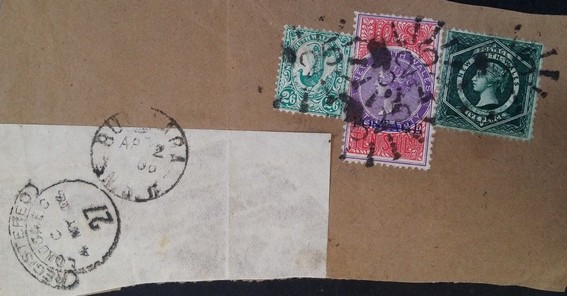
I picked up the piece below recently.


It has 12/11 in stamps and a London Registered handstamp. Registration at this time was 3d so we have postage of 12/8.

I have some information from Trove on parcel rates around 1906 but nothing got close to the total on the piece.

So, off to the State Library in Sydney for some answers! I looked up the quarterly Post Office Guide issued in April 1906 and here's what I found.

Letters: Maximum weight of 3lbs = 48oz. The postage rate to the UK was 2d per ½oz so a 3lb letter would cost 8 shillings.

Packets: Could not attract 12/8 in postage due to cost per 2oz and maximum weight limits.

Late Fee: 2½d

Parcel Acknowledgement of Delivery: 2½d (but only for insured parcels to the UK).

Parcel Certificate of Posting: 3d

Parcels that would attract close to the rate:
Bechuanaland Protectorate 6lbs = 12/4
Rhodesia (via London & Cape Town) 6lbs = 12/4
Rhodesia (via London & Beira) 11lbs 12/1

Parcels to UK:
All sea route 1/- for 1st lb, then 6d per lb, max. 11lbs (11lbs parcel would cost 6/-)
Via Brindisi or Naples 2/- for 1st lb, then 6d per lb, max. 11lbs (11lbs parcel would cost 7/-)

Insurance: Service not available to Bechuanaland Protectorate or Rhodesia. To the UK the maximum charge is 1/6 (6d for value to £10, 9d for value £10 to £20, 1/- for value £20 to £30, 1/3 for value £30 to £40, 1/6 for value £40 to £50).

Customs Duty: Addressed to UK 6d fee plus deposit of 1/- per 4 shillings (or part thereof) of the declared value of the parcel. The parcel must be lodged at an Official Post Office, which is also a Money Order Office. NB: service not available to Bechuanaland or Rhodesia. It was not clear if Customs Duty could be paid in postage stamps but I would think not.

Possibility 1: A 6lb Registered parcel to Rhodesia or Bechuanaland Protectorate via London and Cape Town with a Certificate of Posting = 12/10 so parcel was overpaid by 1d.

Possibility 2: An 11lb parcel to UK via Brindisi or Naples = 7 shillings, Late Fee, Ack. Del. + Cert. Post. = 8d, therefore 5 shillings still to be charged so only possibility is 6d Insurance + 6d Customs Duty Fee + 4/- Customs Duty Deposit.

Possibility 3: An 11lb parcel to UK by All Sea Route = 6 shillings, Late Fee, Ack. Del. + Cert. Post. = 8d, therefore 6 shillings still to be charged so only possibility is 6d Insurance + 6d Customs Duty Fee + 5/- Customs Duty Deposit.

Possibilities 2 and 3 are only possible if Burraga was an Official Post Office. The revenue would've needed to be £350 and Burraga's was only £169 in 1892. It's highly unlikely Burraga would've been an Official Post Office in 1906.
Send note to Staff  Go to Top of Page
Bedrock Of The Community
Australia
38679 Posts
Posted 04/10/2018   02:36 am  Show Profile Bookmark this reply Add rod222 to your friends list  Get a Link to this Reply

Quote:
Possibilities 2 and 3 are only possible if Burraga was an Official Post Office. The revenue would've needed to be £350 and Burraga's was only £169 in 1892. It's highly unlikely Burraga would've been an Official Post Office in 1906.


Great research there, Bobby.

I disagree, not from fact, just feeling.

wiki
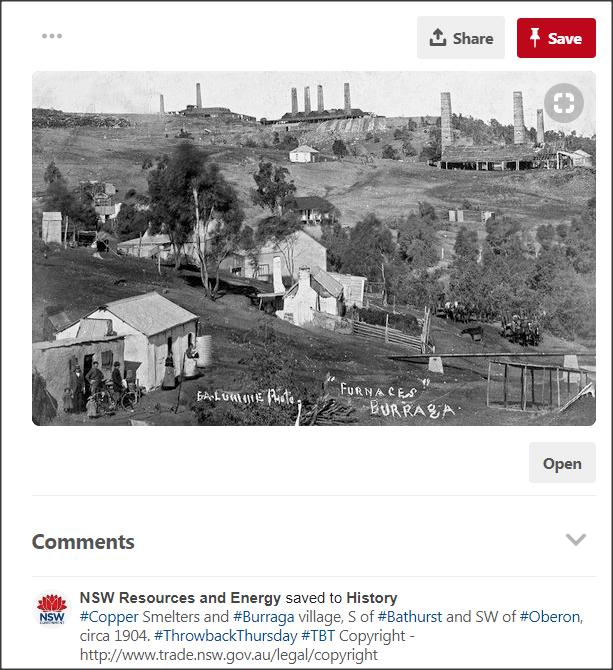
As there were no other industries to provide employment the fortunes of the village rose and fell in line with those of the associated Burraga copper mine. In 1883 it was stated that the mine employed about 200 men and that the population of Burruaga was about 500 persons including 60 children. The town had "the usual businesses" and a Post-Office and a Public School.

Mining continued from 1880. A fire in 1913 destroyed one of the locomotives. Mining was closed down in 1919 and a lot of material, including the other locomotive, was sold off in 1920. Mining continued on and off up until 1961. Studies around 2012 were being conducted looking for worthwhile lodes of copper and gold at the nearby Lucky Draw Gold Mine
Chapter and Verse..........
https://www.academia.edu/25705830/H...p_of_Burraga

Happy to stand corrected.

Burraga ? 1904

Send note to Staff  Go to Top of Page
Edited by rod222 - 04/10/2018 02:59 am
Pillar Of The Community
Australia
3282 Posts
Posted 04/10/2018   04:07 am  Show Profile Bookmark this reply Add Bobby De La Rue to your friends list  Get a Link to this Reply
Thanks Rod

A great photo/postcard - I will be visiting there at some stage in the next few months.

Burraga's population was 528 according to the 1891 census.

The PO guide made no distinction between Northern and Southern Rhodesia ie: the parcel rates were the same.

I want you to be right. I've done everything to convince myself that this parcel was addressed to the UK. This article would lend support to Burraga being an official PO. A proposed railway line from Bathurst: https://trove.nla.gov.au/newspaper/...earchLimits= The paragraph is halfway down the first column.

So would this. Acquisition of land for a PO in 1904: https://trove.nla.gov.au/newspaper/...|l-year=1904

The road to Burraga runs through Rockley. Here's an article from 1915 on the reduction of Rockley's PO from Official to Allowance: https://trove.nla.gov.au/newspaper/...earchLimits=. Rockley had a much smaller population than Burraga in 1891.

The one thing that Burraga and Northern Rhodesia have in common is copper. Is that a straw too narrow to clutch? Perhaps so!
Send note to Staff  Go to Top of Page
Edited by Bobby De La Rue - 04/10/2018 04:10 am
Bedrock Of The Community
Australia
38679 Posts
Posted 04/10/2018   05:12 am  Show Profile Bookmark this reply Add rod222 to your friends list  Get a Link to this Reply

Not sure if you have read the "chapter and verse" link I offered,
seems sometimes the mine had 1,000 employees.

I cannot see a mine as large as Lloyd's not having decent PO operations in 1906.

But yes, it's all speculation.

Send note to Staff  Go to Top of Page
Pillar Of The Community
Australia
3282 Posts
Posted 04/10/2018   05:28 am  Show Profile Bookmark this reply Add Bobby De La Rue to your friends list  Get a Link to this Reply
Yes I saw that, one week 1000 people have a job and the next week 16. Talk about unstable employment!

I had a good read of the introductory pages of Hopson & Tobin's 'N.S.W. & A.C.T. Post, Receiving, Telegraph & Telephone Offices' and they give the impression that Burraga would've been classed as an official post office before 1906.

Thanks Rod, your help is much appreciated - you help me think outside the box which I know I'm sometimes very poor at

I'll be posting some information on parcel contents restrictions in the near future. The odd raising of an eyebrow is virtually guaranteed
Send note to Staff  Go to Top of Page
Edited by Bobby De La Rue - 04/10/2018 06:26 am
Pillar Of The Community
Australia
3282 Posts
Posted 04/19/2018   12:40 am  Show Profile Bookmark this reply Add Bobby De La Rue to your friends list  Get a Link to this Reply
My research on the Parcel Post of New South Wales has taken me to the State Library in Sydney on a couple of occasions. Because of the impossibility of purchasing old Postal Guides (I can't recall seeing a 19th century issue for sale or auction), I photocopied the regulation and destination pages of the October 1888, October 1894 and April 1906 guides. In all three, the destination pages have notes on special prohibitions.

The common exclusions to overseas destinations were letters, live animals and dangerous articles. The 1888 issue also mentions perishable and contraband articles. The 1894 issue specifically mentions money (coin and notes), explosive or dangerous articles, gold bars or gold dust and articles of an offensive character.

Liquids and semi liquids were only accepted if they were securely packed so the contents could not escape and in vessels strong enough to withstand breakage in transit.

Customs declarations were required. I'm still looking for confirmation that any duty payable could or had to be paid in postage stamps.

From the 1888 issue, I've set out what I thought were some interesting prohibitions to various foreign destinations. I think most of these will be due to cultural, trade or quarantine restrictions. All spellings from the original guides have been retained.

Algeria - Ostrich feathers, foreign bronze coins

Austro-Hungary - Potatoes, foreign lottery tickets

Beyrout (British PO) - Firearms

Bulgaria - Candles, unmanufactured tobacco

Corsica - Secret or forbidden arms, playing cards, lace

Cyprus - Locust eggs

Denmark - Almanacs

Egypt - Arms, unless addressed to members of the British Army

Germany - Pork or bacon, books of a social democratic or socialistic tendency

Portugal - Salt

St. Helena - Books infringing British copyright, Cape Brandy

Spain - Breviaries, rosaries, reproductions of Spanish maps or plans

Tunis - Nitrate of soda, saltpetre, sulphur, china, imitations of Tunisian chechias

Many destinations prohibited 'parts of the vine'.
Send note to Staff  Go to Top of Page
Bedrock Of The Community
Australia
38679 Posts
Posted 04/19/2018   02:02 am  Show Profile Bookmark this reply Add rod222 to your friends list  Get a Link to this Reply
Nice work..well done Bobby.

Tunisian Chechias......
IBYu8gkPufM
Send note to Staff  Go to Top of Page
Page: of 2 Previous TopicReplies: 17 / Views: 2,910Next Topic  
Next Page
 
To participate in the forum you must log in or register.

Go to Top of Page

Disclaimer: While a tremendous amount of effort goes into ensuring the accuracy of the information contained in this site, Stamp Community assumes no liability for errors. Copyright 2005 - 2026 Stamp Community Family - All rights reserved worldwide. Use of any images or content on this website without prior written permission of Stamp Community or the original lender is strictly prohibited.
Privacy Policy / Terms of Use    Advertise Here
Stamp Community Forum © 2007 - 2026 Stamp Community Forums
It took 0.23 seconds to lick this stamp. Powered By: Snitz Forums 2000 Version 3.4.05



