| Author |
 Replies: 10 / Views: 3,267 Replies: 10 / Views: 3,267 |
|
|
Pillar Of The Community
3865 Posts |
|
|
I have found two different stamps with one narrow (left) and another wide (right). Both are on vertical wove paper and are wet printed. The narrower one appears to be scarcer. Plates 1 and 2 were flat plate printed with 100 stamp subjects each and plates 3 and 4 were rotary press printed with 200 stamp subjects each. This may account for such a difference. Also, Scott/Unitrade 97 were similarly printed. However, I don't think this is mentioned in any catalogue. 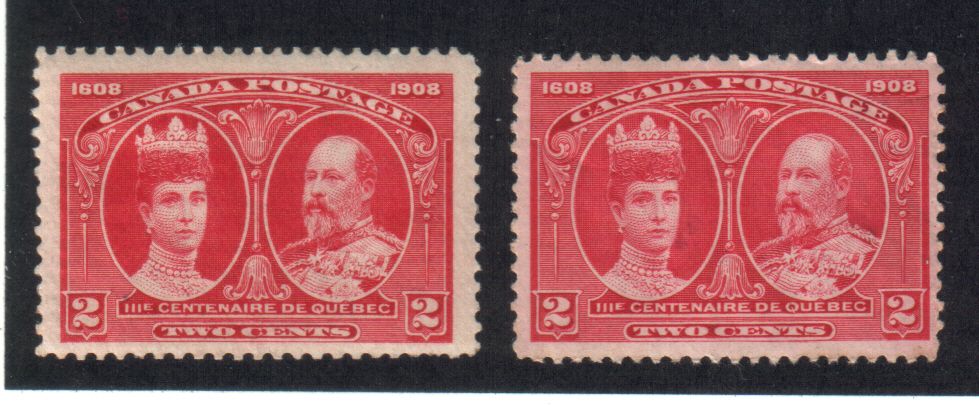 |
|
Send note to Staff
|
| Edited by jogil - 04/09/2018 10:06 pm |
|
|
|
|
Moderator

United States
5107 Posts |
|
|
Quote:
I have found two different stamps with one narrow (left) and another wide (right). When you say narrow and wide, are you referring to the perforations or the stamp design? I don't see anything mentioned in my 2014 Unitrade concerning scarcity and a difference in rotary press versus flat plate printing. |
Send note to Staff 
|
| Edited by Partime - 04/09/2018 10:28 pm |
|
|
Pillar Of The Community
3865 Posts |
|
|
Valued Member
Canada
123 Posts |
|
|
Hi Jogil,
If you could advise the design dimensions in mm, it might be easier to help out. |
|
Send note to Staff
|
|
|
Valued Member
Canada
123 Posts |
|
|
I did some quick checking as based on your photograph/scan, the design of the stamp on the right does appear to be wider. According to both Boggs and Holmes, the issue was printed over a three month period, the 15-cent value being the last issued to Postmasters on October 14, 1908. It was printed on a good quality white wove paper. The 2-Cent stamp, picturing King Edward VII and Queen Alexandra was, as you mentioned, printed over 4 plates. Boggs nor Holmes mentions anything about different printing methods though - which would be unusual due to the fact that these were commemoratives. |
|
Send note to Staff
|
|
|
Pillar Of The Community
3865 Posts |
|
|
The 200 large/400 small stamp subject printing plates were used for sheet-fed rotary (wet) printing presses by ABN starting in 1907 until around 1926.
The 100 large/200 small stamp subject printing plates were used for sheet-fed flat and rotary (wet) presses by ABN starting in 1897 with 1910 marking the last of these for rotary presses and 1913 marking the last of these for flat plate presses. |
|
Send note to Staff
|
| Edited by jogil - 04/10/2018 01:02 am |
|
|
Valued Member
Canada
123 Posts |
|
|
Hi Jogil,
Do you have a reference for the ABN details?
Not trying to put words in your mouth but are you then hypothesizing that the 2-Cent may have been printed on two different presses? Considering that the domestic and USA rate at the time was 2-Cents, and that they produced more of the 2-Cents than any other stamp in the series (35,100,000), it would make sense. But I have read that the rotary press at the ABN used plates that were not curved as much as other presses at the time, and therefore the distortion or stretch was not very significant. |
|
Send note to Staff
|
|
|
Pillar Of The Community
Canada
1416 Posts |
|
|
Actual plate blocks for different plates might be useful to confirm the differences. Time to look for them in inventories and auction catalogues..... |
|
Send note to Staff
|
|
|
Pillar Of The Community
3865 Posts |
|
|
The stretch may have been less noticeable on the Admirals because they were smaller stamps in horizontal size than these which may help more in showing a difference because of their double width size in comparison. 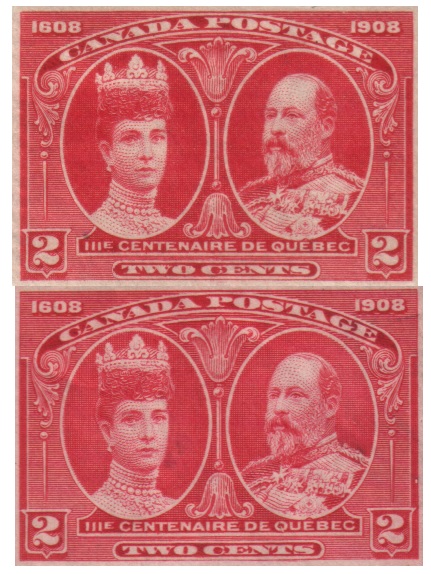 The Brigham auction was a source for these. It also looks like Montreal City Stamps and Saskatoon Stamp Centre have some plate blocks. Maybe they can send someone scans of them on one page together. |
|
Send note to Staff
|
| Edited by jogil - 04/10/2018 09:24 am |
|
|
Valued Member
Canada
123 Posts |
|
|
I can't wait to get home tonight so that I can check my used stock of these stamps and see if I can find an example. Super topic!! |
|
Send note to Staff
|
|
|
Pillar Of The Community
3865 Posts |
|
|
It could be that plates 1 and 2 are flat and plates 3 and 4 are rotary. It could be that plates 1 and 2 are also rotary or plate 1 is flat and plate 2 is rotary or plate 1 is rotary and plate 2 is flat. This is what is trying to be determined, if anything with regards to the different width sizes on this stamp. |
|
Send note to Staff
|
| Edited by jogil - 04/11/2018 2:27 pm |
|
| |
Replies: 10 / Views: 3,267 |
|




 Posted 04/09/2018 9:55 pm


