| Author |
 Replies: 10 / Views: 2,665 Replies: 10 / Views: 2,665 |
|
|
Valued Member
United States
24 Posts |
|
|
I've had this WF Line Pair M-NH for some time, and I've been a bit confused with it. It looks nice (which is alarming and I question it further), but I keep going from 388 to 353? Genuine? W/F's are a weak area for me. Would really appreciate any feedback on it. Thanks. 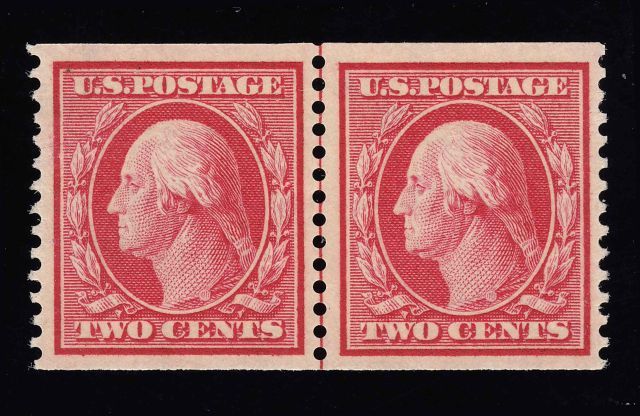 |
|
Send note to Staff
|
|
|
|
|
Moderator

United States
12330 Posts |
|
|
When the perf holes align on a flat plate coil, be highly suspect. While not impossible for them to line up, it would be a very rare occurrence. But you should wait for Clark to offer his opinion.
Don |
Send note to Staff 
|
|
|
Valued Member
United States
24 Posts |
|
|
Thanks Don,
My gut "too good to be true" feeling. I'll check out some RAS auction examples in the meantime. |
|
Send note to Staff
|
|
|
Moderator
United States
12330 Posts |
|
|
Pillar Of The Community
United States
1414 Posts |
|
|
The pair could be from an imperf coil or cut from an imperf sheet printed on an "A" plate with constant spacing of 2 ¾mm between designs. Plates used for perf 12 coil production had either 2mm spacing, or 3mm spacing on the 7 outer vertical rows and 2mm on the inner six vertical rows. Check the horizontal spacing between the stamps. The images from Siegel should also be helpful: https://siegelauctions.com/lot_grd....thin+ResultsThe top margin is crooked on the left and the bottom margin is ragged unlike the top margin. Clean, round perforations aligned between rows is a "tell" for Kiusalas fakes. |
|
Send note to Staff
|
| Edited by cfrphoto - 04/20/2018 12:09 pm |
|
|
Valued Member
United States
24 Posts |
|
|
Thanks, The links help a lot. It is odd with the top clean cut, but the bottom a bit ragged. Perfs being aligned, I'm inclined to think it is very likely spurious. I'll have to measure spacing this evening. Don's link to the WFFakes with the 353 shown reinforces suspicions.The Siegel images all seem to show a consistent lowering (of the center perfs) to make unevenness of the perf alignment as well. |
|
Send note to Staff
|
| Edited by DefCon22 - 04/20/2018 12:20 pm |
|
|
Pillar Of The Community
1375 Posts |
|
|
In European or German stamps, it is said that the perforation holes often have like "waves" / little "hills" at the border of the holes, because of the punch, in opposite to the fake perforation which is often made with cuts. Is that the case for US stamps as well, and for which period? |
|
Send note to Staff
|
|
|
Valued Member
United States
24 Posts |
|
|
Yes, I think so. Someone please correct if I'm wrong. I imagine it varies from different perf methods (line/rotary perf, etc.). I think you are talking about that little upward hill, kind of a "crescent lip" that occurs on what seems to be one side of the perforation? The way that some of the perforation devices would punch out the chads. Much like I notice when I use a three whole punch on paper at the office. One side of the hole has a "lip" to it. That is something I wonder if I should look for on this as well. As far as the periods on US stamps, I'm unsure. |
|
Send note to Staff
|
| Edited by DefCon22 - 04/20/2018 4:44 pm |
|
|
Pillar Of The Community
United States
3224 Posts |
|
|
Agree with DefCon22. I'm guessing that the perf pins on (at least) a rotary perforating wheel are extremely close to but not perfectly perpendicular to the stamp sheet, causing the "hills". It's not the best factor to use as sometimes it's very hard to spot. Also, there is a forger's technique of cleaning regumming from perf holes that produces those "hills", too.
From what I can tell from the scan (weasel words) the center perfs look too cleanly cut, as probably the other sides are. If they measure exactly on a specialist gauge/Kiusalas gauge, it could be a Kiusalas production which are very, very good but with holes too cleanly cut. Those can exist in strips of (like) 6, so you wouldn't immediately suspect forged coils. |
|
Send note to Staff
|
|
|
Pillar Of The Community
United States
1414 Posts |
|
|
Perforation pins on line perforators and bar perforators used for coils and the top and bottom perforations of rotary press sheet stamps cut the paper at a slight angle while pulling the paper between two cylinders, one with pins and the other with holes matching the pins. The resulting hole is slightly elongated in the direction of motion with a pressure ridge on the leading edge and pulled fibers on the trailing edge where the perforation pin leaves the paper at an angle. Flat plate sheet stamps are perforated in one direction and then the other direction. Holes are elongated in the direction of the row of perforations. This applies to flat plate coils.
Rotary press coils have pressure ridges, fibers and elongated holes in the direction of the coil. Rotary press sheet stamps combine both so that the perforation holes are elongated in the direction of the paper web, vertical for upright definitive stamps or horizontal format large commemoratives. More information is available by searching the United States Stamp Society "United States Specialist" for articles on perforations. |
|
Send note to Staff
|
| Edited by cfrphoto - 04/21/2018 01:14 am |
|
|
Valued Member
United States
24 Posts |
|
|
Pulled Kiusalas guage and it came to 12-66 perfs dead on. 3mm Vertical margin. Well, still pretty cool. I'll add it to my references next to the old "China Clay" LOL. |
|
Send note to Staff
|
|
| |
Replies: 10 / Views: 2,665 |
|




 Posted 04/20/2018 10:14 am


