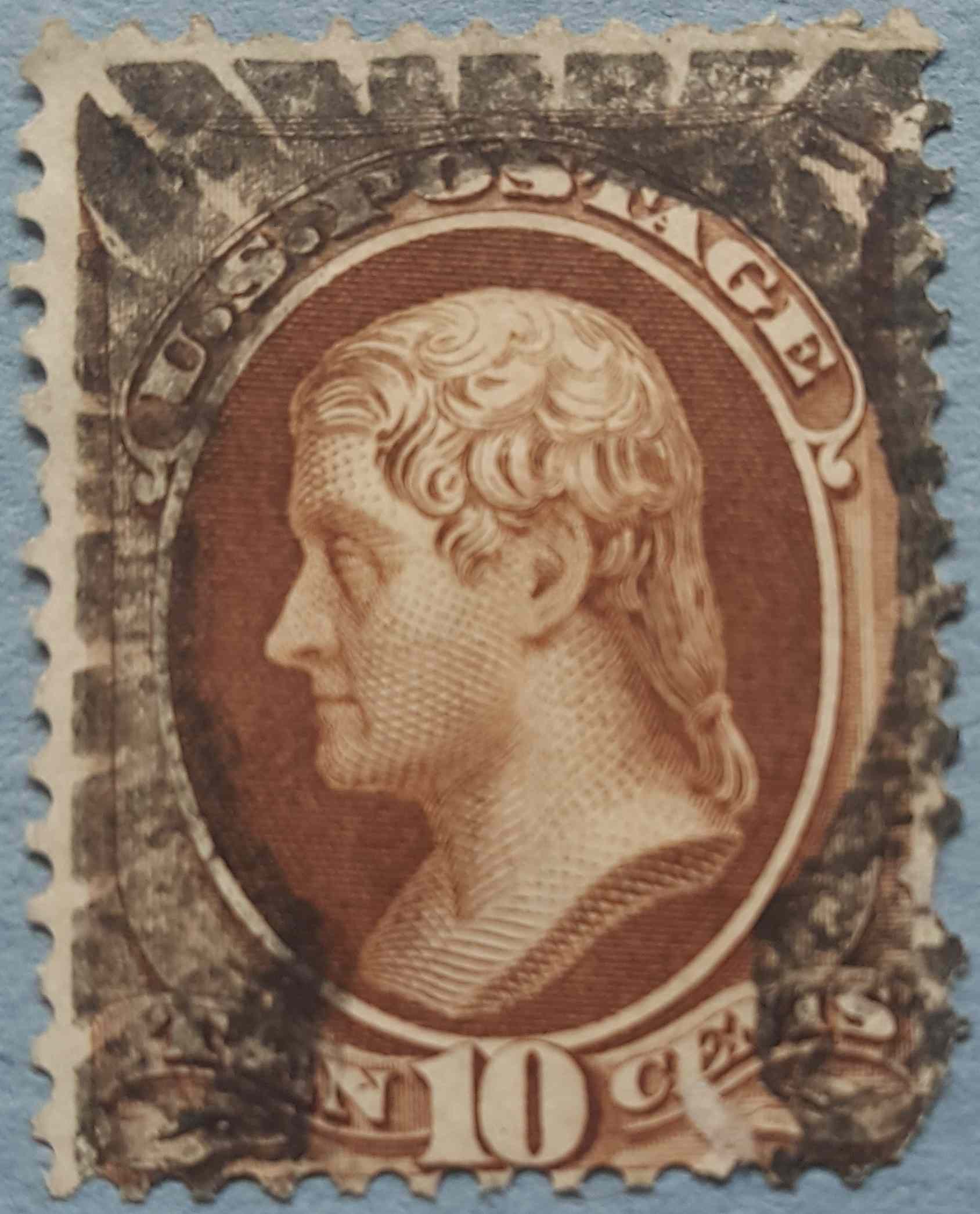
There were some problems with the initial posts in this thread which should get attention now that the sale of the following two stamps in the 2018 Rumsey "Westpex" auction is complete:
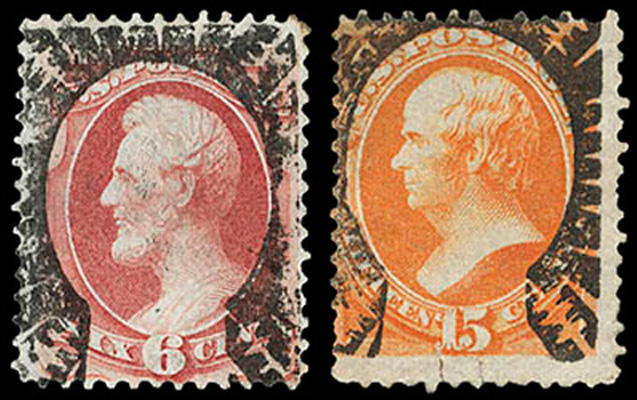
These were two examples of the same cancellation that appeared on a 10c in the OP, which was identified as a "collar" cancel in that post. The distinguishing details of a "collar" cancel were given in the second post, which emphasized that they are produced by a rubber cancelling device mass produced commercially and widely promoted and used in the 1880s. The case was made that cancels of this particular design did not catch on with postmasters or the general public of the day, and that:
Quote:
Except for one lone example found in an old-time collection, no others have been sighted. Nor is anything known of its origin, and no covers have ever surfaced. Philatelically this is called a dead-end. Scarcity is high, desirability is potentially very high, but unlikely this cancel will ever create a following of any kind.
The initial sentence in that quote is laid to rest by the appearance of the two examples that were just sold, illustrated here.
The story that was told in the first two posts here could hardly be further away from what is said about this cancellation type by the auction house, starting with its designation. In the description of lot 1439 this cancellation type is called a "Keyhole," presumably referring to the way it resembles the upper part of a lock opening for the use of an antique skeleton key in which a round center hole flares out and downward for the barrel and bit of the key to enter the lock. If we accept the notion of "collar" as given earlier, it is important to distinguish this cancellation from that type for several reasons.
First we must consider date of origin and use. Contrary to the quoted statement, the lot description observes "There is only one recorded cover bearing the Pottsville Pa. "Keyhole" cancel dated August 1st 1871 to Spain." The plausibility of that date is reinforced by the fact that the stamps are hard paper issues of the National Bank Note Co. If we accept the statement from the house, then we must consider what is known of the rubber stamp "collar" type.
James Cole in
Cancellations and Killers of the Banknote Era 1870-1894 devotes the first 18 pages to a chapter written by Richard Graham entitled, "Postmarks and Postmarking Devices of the Banknote Era." Graham discusses the advertising of cancellation devices in the
Postal Guides of the 1880s, and (p.9) observes that the first mention of devices in rubber is in a full page ad in the January 1880
Guide by a seller in Illinois. Prior to this, townmarks and killers for commercial sale were most commonly rendered in cork, wood, or metal. According to Graham, the material most commonly used for the killer portion of a cancellation, particularly with the advent of the duplex device in the mid-1870s, was cork.
From this we may understand that elaborate cancellations like these keyhole types in 1871 were not done on rubber but most probably on cork. There is no evidence whatsoever that these were commercially produced or available to postmasters generally. Without further evidence beyond the single known cover, we can only say that the postmaster in Pottsville, Pa. is alone in the use of this particular keyhole killer cancel. As for the existence and authenticity of the cover, I can only report that during the sale the auctioneer identified the owner of the cover as Mr. Bill Gross. Nothing was said about the kind of certification it has, but the fact of its mere existence was not challenged.
As for the "following" this cancel might have I can say this: I was happy to bid the initial $400 for the lot sold by Rumsey, despite the obvious faults in the stamps, and not surprised in the least that it sold for $725 (not to me). Bidding was rapid up to that point, when it probably dawned on everyone who we might be bidding against. In my opinion the uniqueness of the design of this keyhole marking, preserving the vignettes of portrait stamps, will make it an object of interest and importance alongside some of the great Chicago blues and elaborate fancy cancels of the early 1870s.





 Posted 04/26/2018 08:26 am