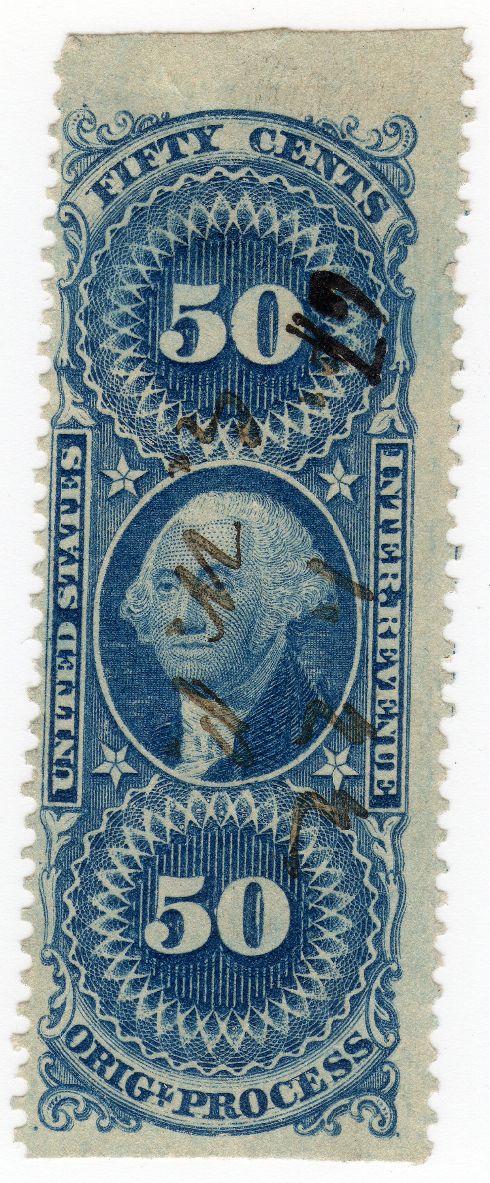
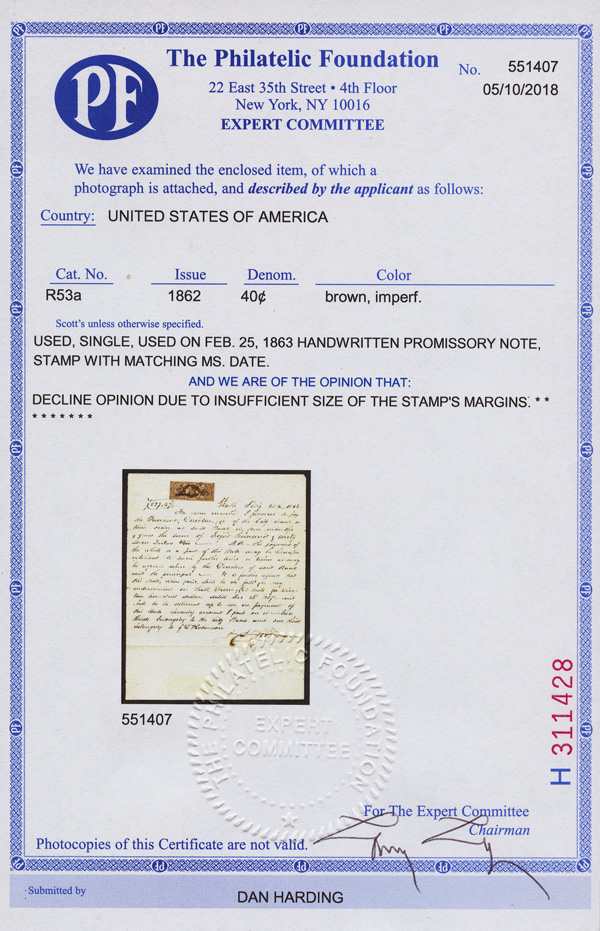
And actually the failure was exactly as expected. Let's start with that one.
See this thread:
https://goscf.com/t/28598It discusses a purported R53a that I felt would inevitably get a declined opinion as there's no way to know what it originally began life as. Since I was already sending in several items anyway, I figured why not? If nothing else, I wanted to see how consistent the PF's decisions are (see below).
So all that said, with the declined opinion confirmed, I'd like someone to explain how the (supposed) R80a from PF cert #496153 obtained a positive opinion? It suffers from the exact same issues as this item. The color shade of R80a is not relegated solely to imperforates; there are early perforated examples with this same shade.
http://pfsearch.org/pfsearch/pf_grd...lledfrom=lkp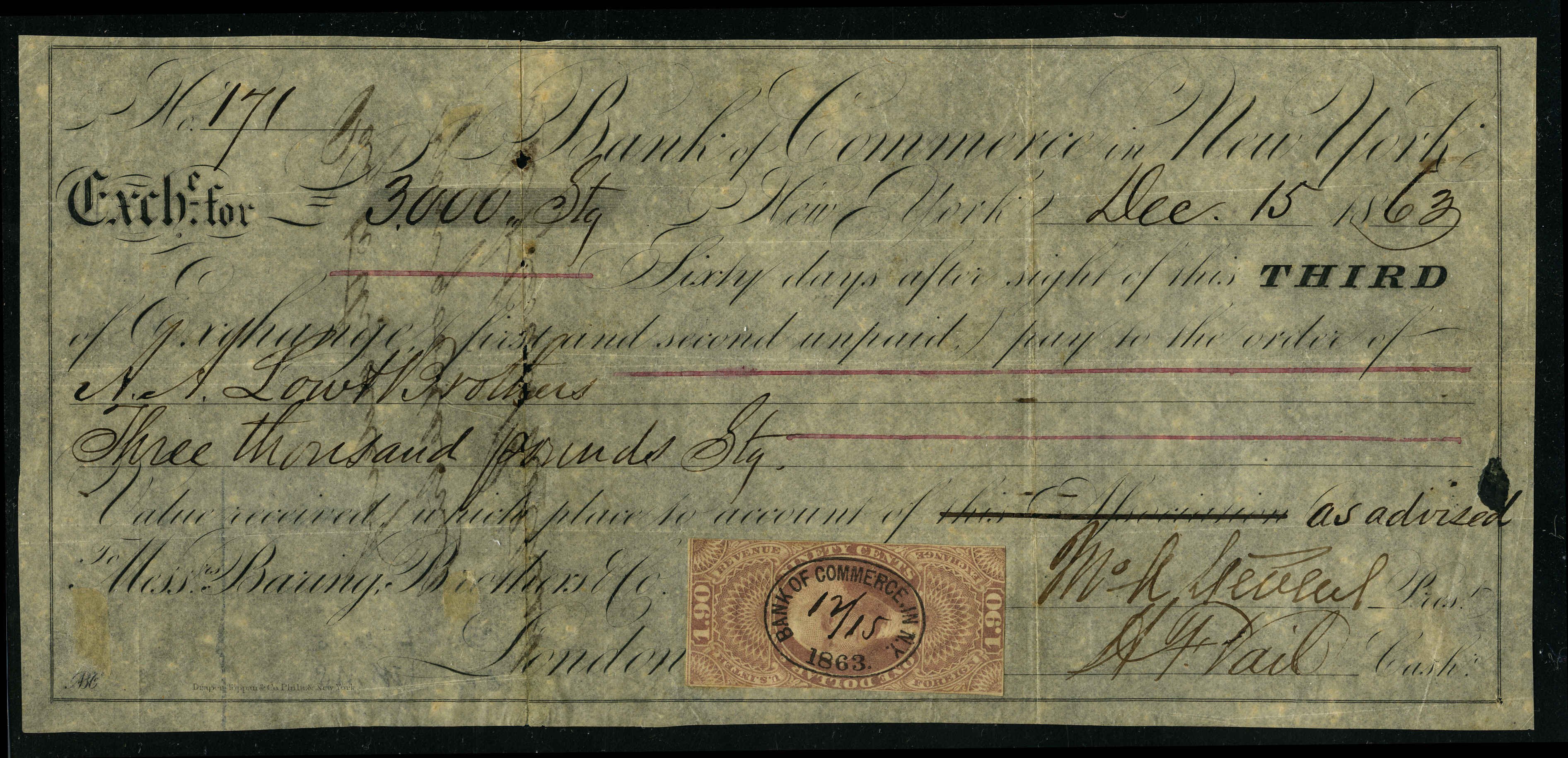
PF cert or not, I would never touch it. It should have received a declined opinion.
Now on to the successful results...
First we have a provisional IR overprint on Scott #273. It's not R157, but rather a smaller font. There are now 2 examples certified by the PF, so I think it's time for it to be listed in Scott.
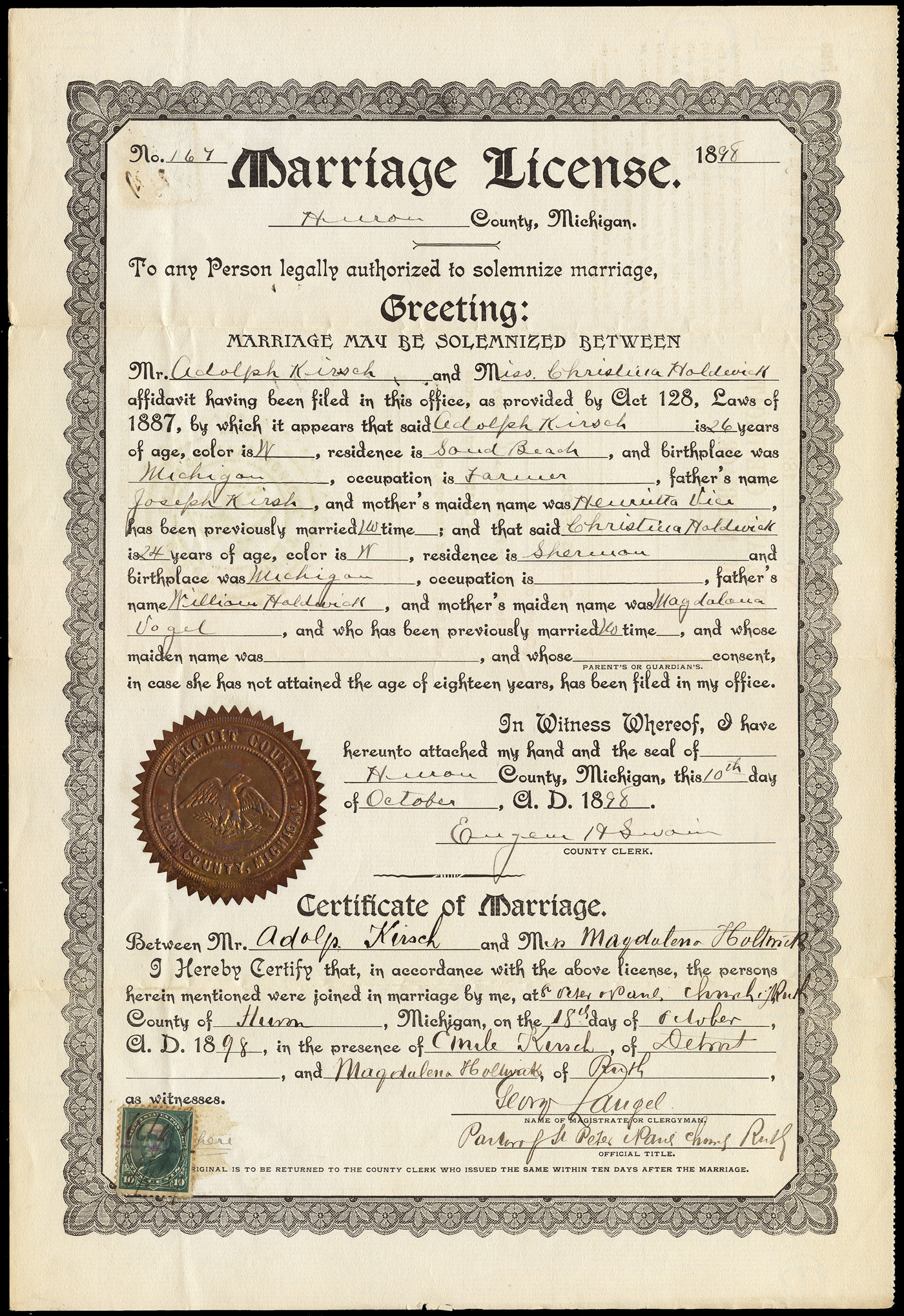

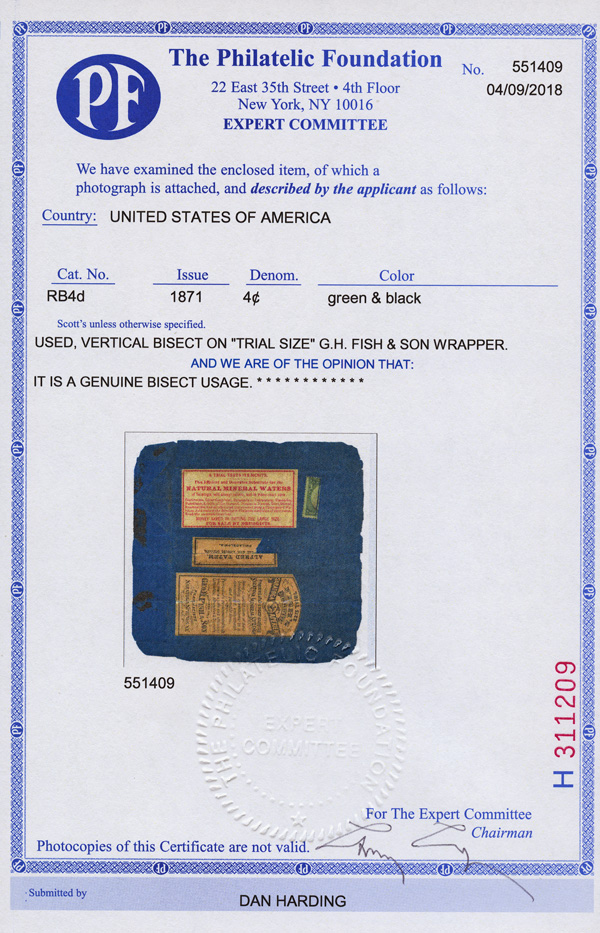
Next, a very scarce revenue bisect, RB4d, vertical half of the 4-cent 1st issue Proprietary stamp, on complete wrapper for a trial size of 'Fish's Saratoga Asperient' prepared by George H. Fish & Sons, Saratoga Springs, New York. The regular size would have been taxed at 4 cents, hence the 2-cent tax on the trial size.
This is the second example to be expertized by the PF, the first one belonging to Michael Rosenberg, Bart's brother, found 40+ years ago.

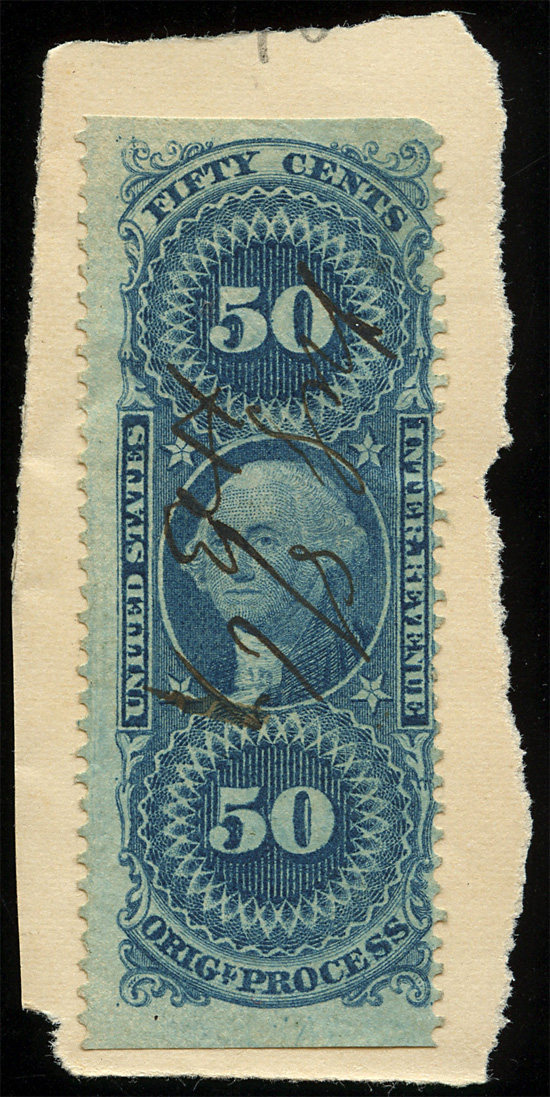
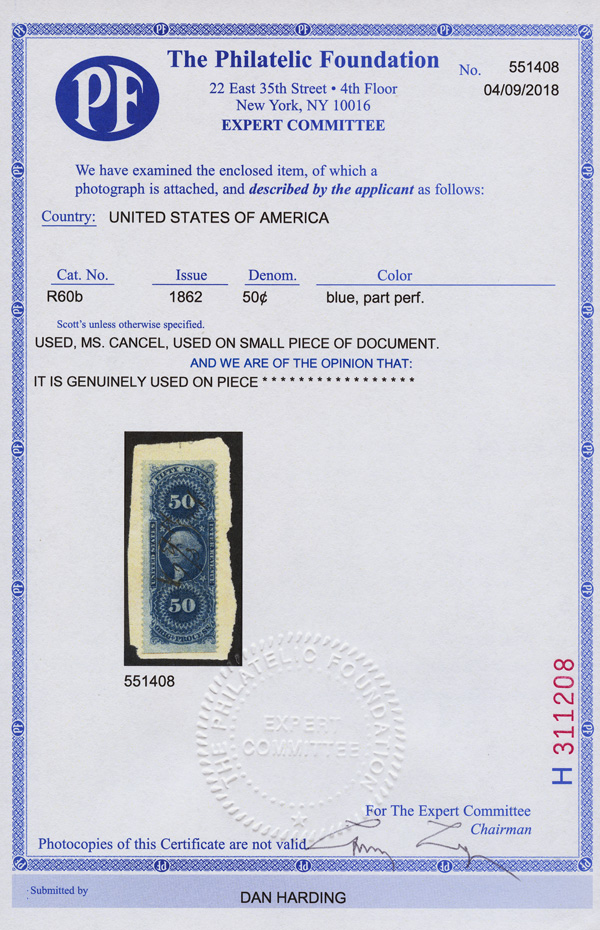
Lastly, one that I was hopeful for, but with part perfs one never knows...
In the 2018 Scott U.S. Specialized Catalogue, #R60b (50-cent Original Process part perforate) took a leap from $650 to $4,000, an almost unprecedented increase.
Well, there have been 3 recent auction results of very high grade examples, all with PF certs:
1. Dec. 16, 2014. Lot 298 in the Curtis Collection auction held by Siegel. Also a gorgeous stamp, brought $7,080 including BP.
2. Oct. 5, 2016. Lot 1261 in the Grant Inman Collection auction held by Siegel. Gorgeous stamp, brought $7,965 including BP.
3. Nov. 11, 2016. Lot 1340 in Siegel auction #1140. PF graded XF90 brought $7,080 including BP.
All of these results were when the catalogue value was $650.
All 3 examples are very well centered, so is this a condition rarity or an actual rarity? (The term "condition rarity" in numismatics refers to the case where the piece in and of itself is not scarce or rare, but in high grade it becomes rare).
Would examples with centering not as nice still have value?
That's when I started researching known examples... and was shocked at just how few examples there are of R60b.
I came up with only 9 examples of R60b including the 3 examples above:
1964. Siegel sale 277, lot 365. No cert. Hammer: $16.
1983. Siegel sale 624, lot 229. No cert. Hammer: $55.
2010. Rumsey sale 40, lot 2193. 2008 PF Cert. Hammer: $700.
2014. Siegel sale 1089 (Curtis Collection), lot 298. 1996 PF Cert #525843. Hammer: $6,000.
2016. Siegel sale 1137 (Grant Inman Collection), lot 1261. 1997 PF Cert #311540. Hammer: $6,750.
2016. Siegel sale 1140, lot 1340. 2016 PF Cert #536551 (XF90). Hammer: $6,000.
PF Cert #469239
PF Cert #243377
PF Cert #243376
That's far fewer than the R15e population I came up with when researching that stamp.
I asked both Eric and Richard how many they have handled... neither one has ever had an example of R60b.
So with that information in hand, I decided to send in my example, more typical of left-to-right centering normally found on part perforations, so not quite as nice as the 3 examples above. I picked it up back in 2012 from a small dealer at INDYPEX; I felt it had a good shot at being legit... and so it is.
So this is now the 10th reported example of R60. It may not be worth the $7-8K the most recent 3 brought, but it's certainly worth a bit.





 Posted 05/19/2018 9:03 pm