Link to a site about these neat stamps (Adminware is a site by the editor of the Canada Unitrade Specialized Stamp Catalogue.),
The 50c era of flowers:
http://www.adminware.ca/checklist/c...-series1.htmA special little page about the plating possibilities:
http://www.adminware.ca/checklist/f...-plating.htmSince 2004/5 year end the flower definitives have been am eye pleasing stamp (albeit kind of small) to put on an envelope.
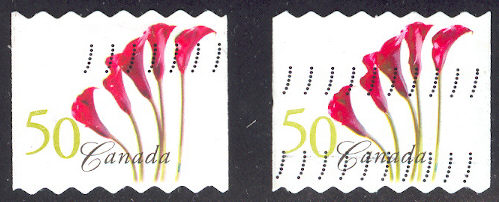
Nice lookin' stamp(s).
But wait, look at the perforations, or to make it easier, the 'peaks' and 'valleys'.
There are 7-1/2 peaks on the first stamp and 8-1/2 on the second (roughly). Hmmm. And what about those little 'nibs'?
Those little pieces of paper that attached each stamp to the next stamp in the coil roll?
(Very hard to see on a used stamp, sorry)
Top of left hand stamp:

The stamps are printed 10 rolls across and 10 stamps between gutters, or a plate of 10 x 10, 100 stamps.
The perfs vary between one roll and the next and between the top and bottom of each stamp. Include the information about where the 'nibs' appear on a stamp (which varies somewhat also) and you have enough information to 'plate' a single stamp. Or, in other words, to tell the position within the 100 stamps on a plate exactly where the stamp was printed.
I really like the idea of 'placing' a stamp and of hunting for that 'missing' stamp. And, right now anyway, it's cheaper than plating the Great Britain Penny Blacks!
The difficulties are two that I can see (or can't actually, my eyesight not being top notch). One is the perforations. There is a special perf gauge made for perfs between 5.3 to 10.
Link to information on getting one through the Canada Elizabethan II Study Group (ESG):
http://www.adminware.ca/esg/perfgauge.htmSo, problem one kind of taken care of. But I wish there was a computer program that could perf a stamp exactly while it was zoomed up on the screen. Slide the perf gauge up and down over a scanned stamp (or photographed with a microscope or camera).
Two is actually seeing the 'nibs' on a used stamp. Very difficult even with a scanner / camera that can zoom in. It is actually easier to see the nibs with the naked eye I find.
So, although Mr Harris, editor of Unitrade and of the site mentioned above, is working away on producing a database of all the variations of these stamps (50c era,51c,52c,54c,<P> and Olympic coils too I assume but am not sure) what can one do in the meantime?
According to his web site there are 9 variations on the nibs. Is there a clear 'nib' gauge like a perf gauge that one can tell which 'nib' variety the top and bottom of a stamp has? Then one could classify a stamp beyond just the perfs. Such as A-I or B-C or or H-F or something along those lines. Then one could (with poor eyesight) (or failing eyesight if you look for these little nibbers for too long!) actually hold the gauge up to the stamp and make a studied guess at what the nibs are. Or aren't. Or can't be because that one doesn't exist, it's a phantom, a figment, a dust static storm across the plastic page!
This is exciting stuff!
I am just starting on a (seemingly) long journey.
The longest journey starts with a single step, the old Chinese saying.
At least the stamps are pretty to look at and nice orchids and lilys etc.
Does anyone have any other pictures or information?





 Posted 10/22/2009 03:35 am


