| Author |
 Replies: 13 / Views: 2,540 Replies: 13 / Views: 2,540 |
|
|
Valued Member
Japan
36 Posts |
|
|
|
Hi all. I'm about to try soaking stamps for the first time in about 40 years. (It's still called "soaking", isn't it?) I just wanted to check with everyone that I'm doing it right. As I recall, this is how I did it as a kid:
1. Place stamps in a tray of lukewarm water.
2. Wait for 10 to 15 minutes until stamps fall off paper.
3. With tongs, remove from water and place face down on newspaper to dry.
4. When dry, place between pages of a heavy book to flatten.
How does that sound so far? Anything you would do differently?
I've just purchased a stamp-drying book from Lighthouse so I guess that will replace the newspaper. For step #4, I guess I just put heavy stuff directly on top of the drying book.
Am I doing this right? Anything I else should watch out for? (I already know to do colored envelopes separately.)
All advice appreciated. Thanks!
|
|
Send note to Staff
|
|
|
|
|
Pillar Of The Community
United Kingdom
8624 Posts |
|
|
JPR - Enjoy! Quick glance at a catalogue beforehand to check that the stamps (usually late-19th century-early-20th century) weren't printed with fugitive ink. GB Jubilee series is an example. |
Send note to Staff 
|
|
|
Pillar Of The Community
United States
507 Posts |
|
|
1. Place stamps in a tray of lukewarm water.
2. Wait for 10 to 15 minutes until stamps fall off paper.
3. With tongs, remove from water and put then into another tray of water to rinse any glue residue of the stamps.
4. With tongs, remove from water and place face down on newspaper to dry.
5. When dry, place between pages of a heavy book to flatten.
Also, I use paper towels rather than newspaper. And I let the stamps dry until damp (not completely dry) and press them in a stamp drying book. |
|
Send note to Staff
|
|
|
Bedrock Of The Community
Australia
38679 Posts |
|
|
TIP: Using the "Search" option here, Type in "soaking" Click the option search in : "Subject only" A feast for the grey matter.......... Hope this helps.  |
|
Send note to Staff
|
|
|
Pillar Of The Community
United States
1817 Posts |
|
|
JPR, with the stamp-drying book your method is almost exactly what I have been doing for years. One thing I'd add is to keep a second tray of water nearby, and when the stamps fall off paper remove them to the second tray and while in water there use your thumb and fingers to rub any gum residue off the stamps before placing on newspaper or towel to dry. Then place them in the drying book when they are still slightly damp. |
|
Send note to Staff
|
|
|
Valued Member
United States
271 Posts |
|
|
Pillar Of The Community
United States
713 Posts |
|
|
A drop of dishwashing liquid in the bowl of water will help. Then use a second bowl of clear water to rinse as dudley says. |
|
Send note to Staff
|
|
|
Pillar Of The Community
United States
571 Posts |
|
|
I agree with dkabq8, adding the step to rinse the stamp in a second tub of water to remove residue. I do that and the water does get dirty so I know this is necessary. I also agree with rwoodennickel, not mixing in colored paper. When I soak stamps off, I separate colors and soak them together in like batches I find that a little salt added to the water helps keep the colors from running although that depends largely on the paper and ink and some will still run no matter what you do. I use a warming tray on the lowest setting to keep the water warm (NOT HOT) when doing marathon soaking sessions. I get cheap paper towels at Walmart with no pattern on them for blotter paper and use tongs or chopsticks from a local buffet for handling them. After the "wash" I slide both sides on the edge on the tub to remove excess water before putting it on the "blotter" paper towel. Then sandwich them between paper towels and metal plates I salvaged from datacomm equipment. Each weighs about a pound (see photo lower left corner) Note the circular tub to the left for a wash (rinse) and a old margarine tub for the paper. As I remove the stamp from the wash 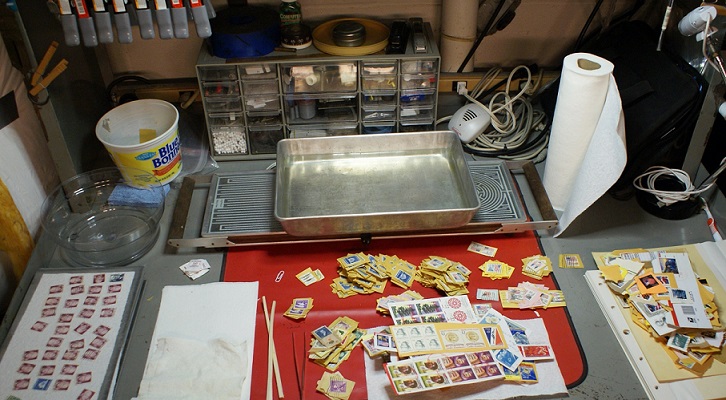 Just a note about tongs. When stamps are wet they are even more susceptible to damage so I preferer to use 904 tongs with a wide flat jaw. It's just easier to handle them... wkusau, I never tried dish soap, I'll have to give that a go. Just my two cents for what it's worth. Jeff |
|
Send note to Staff
|
|
|
Pillar Of The Community
United States
571 Posts |
|
|
Just to add a note of explanation in the photo above... When putting wet stamps down you place them on the blotter paper printed side down...
After they are dry, I flip the stack then separate each layer for a hour to let them air out. Then restack with the printed side up so as I take layers off I can see what the stamp is for stocking.
The stamps on the blotter paper to the left are already dry, I was removing them to clear out the stack of plates for the next run. I usually let them sit in the stack for a few days to a week, more dependent on my schedule than drying time requirements. What you don't see are the stock pages that I was putting them into as I remove them.
Jeff |
|
Send note to Staff
|
|
|
Valued Member
Japan
36 Posts |
|
|
Thanks for all the good advice, everyone.
Rod, I'll be sure to do some searching before posting next time.
Great photo, Jeff. Looks like you're all set up. I hadn't thought of using chopsticks.
I realize there is greater risk to the stamps from tongs when they are wet, but is there any risk to the tongs from the water or the wet gum? |
|
Send note to Staff
|
|
|
Moderator

United States
12330 Posts |
|
|
Quote:
...I find that a little salt added to the water helps keep the colors from running... Yikes, using salt to fix the color should not be recommend. The salt solution will penetrate the paper and as it dries it will cause the paper to curl and warp. Additionally, there will be microscopic salt crystals left behind on the stamp surface. Salt is abrasive and can scratch the surface of your stamps. Do not use salt around stamps. I also recommend using only clear, cool water. While cool water takes a bit longer to float some stamps, it is safer. Warm/hot water is much more likely to cause some inks to become fugitive (either the stamp ink, ink on paper, or the paper dye). Don |
|
Send note to Staff
|
|
|
Pillar Of The Community
United States
571 Posts |
|
|
51studebaker: I should clarify the salt... This is not a briny solution, just a pinch will do in the warm water. I only use salt on stamps that are on colored paper which bleed badly, like some reds and greens. I also rinse the newly lifted stamp in a separate cool water wash. I have not noticed any excessive curling but maybe the wash and my pressing method is enough to counter that effect. Been doing this for over 25 years without a problem.
Agreed on the cool vs warm but if doing a lot of stamps the time required is the decisionmaker. I usually wind up doing marathon sessions with a huge number of stamps. Time is a commodity. Again, I warm the water, you don't want it more than lukewarm. The wash I use is cool water. I also change the water in both frequently.
JPR as far as damage to tongs... I've never had a problem with water damage like rust or something like that. I've been using the same pair of 904s for close to 20 or 30 years and they are showing a good bit of wear. I keep them clean. I've thought about replacing them but it's like that old comb you've been carrying for a while or those old almost completely worn out shoes that feel so comfortable. I do have a couple others that I use for other tasks but the 904 is a favorite for sorting a through huge piles and soaking.
Jeff
After thought added: As mentioned by others, extra care should be taken for stamps with fugitive ink, various older paper types also have issues requiring different methods, if removed at all. |
|
Send note to Staff
|
| Edited by jconey - 07/05/2018 8:34 pm |
|
|
Moderator
United States
12330 Posts |
|
|
Hi Jeff,
Paper preservation experts say that salt water is bad. In fact trying to preserve paper that has been immersed in salty water requires all kinds of additional steps and challenges. There is plenty of info online on this topic.
Please keep in mind that there are thousand of other folks who read these posts. So what worked for you, including the 'pinch' amount, might not be what others end up doing. Being a guy, I often follow the manly rule of 'if a little works then a lot will be better'!
Bottom-line, we should be not recommending that folks add salt to their stamp soaking bath.
Don
|
|
Send note to Staff
|
|
|
Valued Member
Canada
29 Posts |
|
|
Quick question. What can be done when the stamp stay on the paper on only a fine layer of paper stay on the stamp? I soaked a couple of stamps today and some just fidn't want to get off and they didn't seem to be self adhesive either. |
|
Send note to Staff
|
|
| |
Replies: 13 / Views: 2,540 |
|



 Posted 06/25/2018 06:20 am


