| Author |
 Replies: 7 / Views: 1,606 Replies: 7 / Views: 1,606 |
|
|
New Member
Sweden
3 Posts |
|
|
I need help from you! I know that an air mail letter from Sweden to Brooklyn costed 25+10 öre. But what was the SCHLEUDERFLUG fee? Does the letter look genuine? Why was the German stamp crossed over instead of stamped? Did the letter leave Sweden with the German stamp affixed or was this done onboard the ship? I'm sorry, I hope it isn't too many questions. Regards from Sunny Sweden 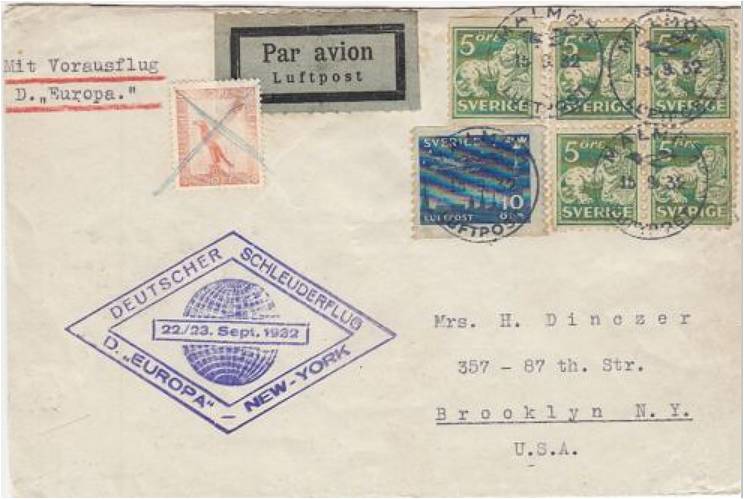 |
|
Send note to Staff
|
|
|
|
|
Pillar Of The Community
United Kingdom
1255 Posts |
|
|
The cover was probably cancelled in Malmo, and taken to the ship where it had the fancy cancel and airmail stamp affixed. The ship may not have had a cancelled, hence the manuscript cancel. Is there a receiving mark from New York? |
Send note to Staff 
|
|
|
Pillar Of The Community
1213 Posts |
|
|
There were over 200 different catapult flights flown across the North Atlantic on the regular catapult service using either the SS Bremen and SS Europa between 1929 and 1935. A detailed listing of them is found in a catalog entitled "Katapultpost-Katalog" by E. Haberer. There were even more flown involving other ships on the South Atlantic route. Most of the North Atlantic route covers have unique special cachets such as yours has. Yours is listed in the American Air Mail Catalog as flight number 109. The Haberer catalog is the better one to use since it includes information on covers from countries other than Germany and the US, such as yours. It is a more extensive listing. Collecting catapult flown covers would be a long term effort since there are so many different ones. Also, they are a bit more expensive than many other kinds of first flights - often going for around the $15 to $30 each range - so it can be a financial challenge to collect as well. |
|
Send note to Staff
|
|
|
New Member
Sweden
3 Posts |
|
|
Thank you, I will try to locate and purchase Haberer's book on the internet. In the meanwhile do you know any answers to my specific questioms:
1. what was the SCHLEUDERFLUG fee?
2. does the letter look genuine to you?
3. why was the German stamp crossed over instead of stamped?
4. do you think the letter left Sweden with the German stamp affixed or was this done onboard the ship?
Again thank you very much, all help is appreciated.
|
|
Send note to Staff
|
|
|
Pillar Of The Community
France, Metropolitan
3753 Posts |
|
|
Hi: The SCHLEUDERFLUG fee was +50pf for each 20 grams.
Your letter has 35 ore in stamps + the 50pf german stamp.
I dont't know the Swedish standard airmail fee for New York at that time.....Were the German stamp came in the picture; have no idea.
|
|
Send note to Staff
|
|
|
Pillar Of The Community
1213 Posts |
|
|
I am not an expert on catapult flights but I have collected first flights including international ones for several decades. But in response to your questions 2, 3, and 4 my impression of this cover is that it seems to be a bit dodgy and I were I to begin collecting catapult flight covers this is not one I would seek to add to a collection. It may very well be good, but my concern is that German stamp and the rough hand scrawled X marking someone scratched over it. Every German first flight or other flight cover I have seen has been rather carefully cancelled with the proper German post office cancels - their postal clerks seem to have taken a great deal of pride in applying proper cancels. Also, that German stamp itself seems to be worn and faded where the Swedish stamps are not. Such a degree of disparate wear and fading of this German stamp compared to the Swedish ones suggests to my thinking on this that it could have been added at a later date. Another concern is that other Swedish catapult covers I have seen have not had mixed franking. They were properly franked the full amount in Sweden. Below is an example of a Swedish catapult mail cover that shows all Swedish postage stamps. The addressee on this on, Bill Schneider, was a famous stamp collector and dealer who made exceptionally nice first flight covers - especially ones to and from other countries - for many years in the 1920s and 1930s. His name on a cover adds a good amount of trust that a cover is correct.  |
|
Send note to Staff
|
|
|
New Member
Sweden
3 Posts |
|
|
I can't say that anything you say is wrong!
But if I read it right, one of the imprint reads "Kein Katapultflug von D. (dampship i.e. steamship) Europa nach New York" i.e. No Catapult mail from the steamship Europa to New York.
The letter rate from Sweden abroad was at the time 25 öre for 20 grams, 40 öre for 40 grams, 55 öre for 60 grams and the air mail fee for 60 grams was 30 öre. So the Swedish stamps could be for a air mail letter 40 < 60 gram overpaid with 5 öre.
I know for sure that you couldn't pay the catapult fee with Swedish stamps.
Since there where NO air mail over the Atlantic at the time. The Swedish air mail fee was for airmail transport of the letter to the nearest Harbour with ship-lines to the USA: Hamburg, Bremen, Cherbourg or for instance Southhampton. |
|
Send note to Staff
|
|
|
Pillar Of The Community
1213 Posts |
|
|
Perhaps, but another equally possible explanation for the "Kine Katapult . . " line might be that it was intended for the catapult flight and was put on the Europa receiving the proper large circular seepost cancel that is on the left side of this cover, but when it came time to launch the catapult aircraft with the mail there was bad weather or a problem with the aircraft so it did not get the catapult service at the last minute.
I did not know that you could not pay the catapult fee with stamps other than German ones. Other kinds of mail among other countries were such that the stamps used in the originating country were used and that country's post office coordinated with the German post office by keeping track of how many such pieces of mail were sent and there was a transfer of those fees from the originating country post office to the German post office. Most sea mail also worked this way. |
|
Send note to Staff
|
|
| |
Replies: 7 / Views: 1,606 |
|



 Posted 08/12/2018 09:46 am


