Stamp Community Family of Web Sites
Thousands of stamps, consistently graded, competitively priced and hundreds of in-depth blog posts to read


Stamp Community Forum
 
Username:
Password:
Save Password
Forgot your Password?

This page may contain links that result in small commissions to keep this free site up and running.

Welcome Guest! Registering and/or logging in will remove the anchor (bottom) ads. It's Free!

Glazed Paper Vs Unglazed

 
To participate in the forum you must log in or register.
Author Previous TopicReplies: 6 / Views: 3,558Next Topic  
Valued Member
United States
100 Posts
Posted 08/12/2018   2:03 pm  Show Profile Bookmark this topic Add GrandpaJohn to your friends list Get a Link to this Message
Are these two paper types easily identifiable one from the other, in this case as cut squares, like the U420-U428's? I'm darned if I can tell one from the other, but then I may well only have one type. I know the name implies a glossy surface but as we all know, things are quite often not as apparent as they may seem. Having surfed several sites for images, I see no differences.
Send note to Staff
Edited by GrandpaJohn - 08/12/2018 4:34 pm

Pillar Of The Community
621 Posts
Posted 08/13/2018   4:37 pm  Show Profile Bookmark this reply Add ThomasGalloway to your friends list  Get a Link to this Reply
"Having surfed several sites for images, I see no differences."

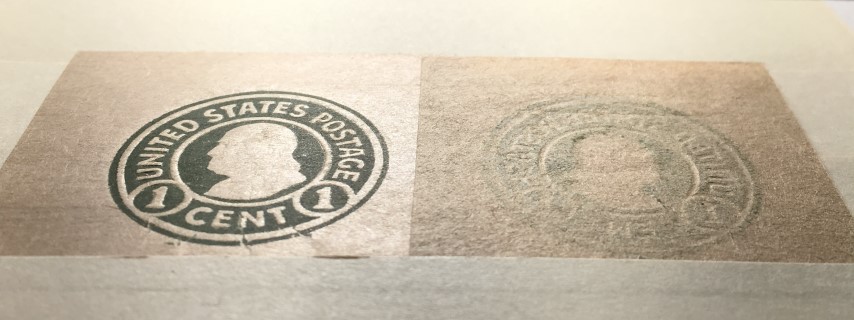
Images on websites are typically made from a straight-on perspective (scanner, camera, etc.). Glazed paper is best identified while viewing the surface at an acute angle, and with a somewhat bright light behind the indicium in question.
Send note to Staff  Go to Top of Page
Valued Member
United States
100 Posts
Posted 08/13/2018   8:04 pm  Show Profile Bookmark this reply Add GrandpaJohn to your friends list  Get a Link to this Reply
So is it a coated paper that one can easily tell from unglazed paper, like it jumps out at you or is it a lot more subtle? Since I'm new to CS's & have maybe a hundred of the U420's-U428 to look at I'd like to understand those 2 paper differences and don't want to miss one if I have one. Some of these cut squares are really a bear to ID and so far no literature or write-ups or documents I've read/seen give a clear answer, hence my asking here.
Send note to Staff  Go to Top of Page
Pillar Of The Community
621 Posts
Posted 08/14/2018   08:17 am  Show Profile Bookmark this reply Add ThomasGalloway to your friends list  Get a Link to this Reply
You seem to have two threads you're working on. 1. Glazed v unglased and 2. unsatisfactory die descriptions for early 20th century envelopes and wrappers.

re #1: The following probably won't help much, but anyway. . .
First row: Manila, brown
Second row: Manila glazed side, manila unglazed side
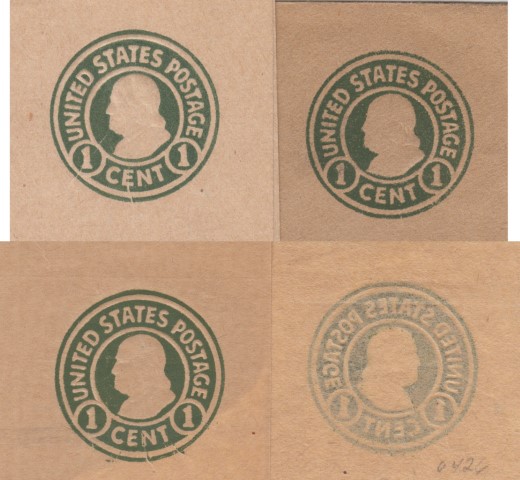


The manila on the first row is unglazed both sides and is of typical envelope/wrapper thickness. The bottom row showing glazed and unglazed examples is a very thin paper. One wonders how it (the wrapper) made it through the mails.

Btw: I believe the "brown" paper is really just a dark shade of manila. I don't believe the USPOD ordered brown paper (in addition to manila) envelopes from the envelope contractor.
Send note to Staff  Go to Top of Page
Pillar Of The Community
621 Posts
Posted 08/14/2018   08:46 am  Show Profile Bookmark this reply Add ThomasGalloway to your friends list  Get a Link to this Reply
re #2: "Some of these cut squares are really a bear to ID and so far no literature or write-ups or documents I've read/seen give a clear answer"
I agree totally. My solution is to build an identification flowchart for these early 20th century envelopes with multiple die varieties.

For U420-U428A I start by eliminating Die 131 (Scott die 5) as it is a total no-brainer with those oval letters (C, G, & O).
Next I check for Die 127 (Scott die 1) by comparing the relationship of UNITED to the two ribbon lines.
Die 127 is clearly closer to the inner ribbon line. Next I check for UNITED being closer to the outer ribbon line, which signals Die 130 (Scott die 4).
That leaves Dies 128 (Scott die 2) and 129 (Scott die 3). For these two, look at the distance between C of CENT and the circle around the left 1.
With Die 129 they are very close, whereas Die 128 exhibits a good gap.
There are a lot of other attributes called out in the descriptions. They don't really help.

Try building one of these flowcharts and post it here.
Send note to Staff  Go to Top of Page
Valued Member
United States
100 Posts
Posted 08/14/2018   11:01 am  Show Profile Bookmark this reply Add GrandpaJohn to your friends list  Get a Link to this Reply
Hi ThomasGalloway, nope, just one thread. I referenced the U420-U428A as an example of the paper types (glazed vs unglazed) that Scott mentions for clarity in any responses. Unknown if such paper types exist for other cut squares as I'm not that far into them yet. I see no difference in the example you posted, as in none seem to show a glaze, they all look the same to me in that respect. I'll just keep plugging along and perhaps one of the group of them I have will jump out at me. Thx sir.
Send note to Staff  Go to Top of Page
Pillar Of The Community
621 Posts
Posted 08/14/2018   11:43 am  Show Profile Bookmark this reply Add ThomasGalloway to your friends list  Get a Link to this Reply
"Having surfed several sites for images, I see no differences."

Right. Because the people who create images for these sites do so from a straight-on perspective (as with my block of 4 above). To really see the differences between glazed and unglazed, you need to look at them like this:

Send note to Staff  Go to Top of Page
Edited by ThomasGalloway - 08/14/2018 11:47 am
  Previous TopicReplies: 6 / Views: 3,558Next Topic  
 
To participate in the forum you must log in or register.

Go to Top of Page

Disclaimer: While a tremendous amount of effort goes into ensuring the accuracy of the information contained in this site, Stamp Community assumes no liability for errors. Copyright 2005 - 2026 Stamp Community Family - All rights reserved worldwide. Use of any images or content on this website without prior written permission of Stamp Community or the original lender is strictly prohibited.
Privacy Policy / Terms of Use    Advertise Here
Stamp Community Forum © 2007 - 2026 Stamp Community Forums
It took 0.15 seconds to lick this stamp. Powered By: Snitz Forums 2000 Version 3.4.05