|
This page may contain links that result in small commissions to keep this free site up and running.

Welcome Guest! Registering and/or logging in will remove the anchor (bottom) ads. It's Free!
To participate in the forum you must log in or register.
| Author |
 Replies: 9 / Views: 1,888 Replies: 9 / Views: 1,888 |
|
|
Pillar Of The Community
United States
3532 Posts |
|
|
This is a Hybrid Trial Color Large Die Proof of the 1c stamp in Black. Forgive my scanner's rendition of the color. Its darker black than it appears here. It appears to be printed on India Paper from the reprint plate, and cut to shape. It is mounted on the typical salesman's-sample-book type of showcase card. If this were in Blue, it would be Scott #40P1. These aren't common even in blue, but this is literally the only one I've personally seen in Black. I have not found any Scott listing for this item (yet). I've heard rumors that the Black is quite rare - with the implication that there are others - I've just never seen any. What is a Hybrid Large Die Proof ? Well, first off, its a contradiction in terms. Its not a die proof at all. Additionally, usually, the paper its printed on is cut to shape, so, the part of it that matters, aka the stamp part, isn't even 'large' either. Nevertheless, that's what its called. The 1851 stamp design issue comes exclusively in Hybrids, but the later stamp issues, actually I think probably do qualify as the name states. These Hybrid Large Die Proofs are usually India paper plate proofs from the reprint plate, cut to shape, and mounted on the (rather nice) display card. So, if this were blue, it would be a Scott #40P3, cut to shape, and mounted as such, now to become, voila, a Hybrid Large Die Proof. I've seen card proofs 40P4 also mounted as such, as well. What really grabbed me about this item, is that nothing was printed that matches this. None of the traditional 1c stamps printed from the reprint plate are in Black, except for the Atlanta printings. These, however, are on card and cannot be mistaken for this. So this item, I claim, has to be a special trial color printing made from the 1c reprint plate in Black. My point is, even if this weren't mounted as it is, a 1c stamp on India paper in Black from the reprint plate -- I've never seen another, and although a few others likely do exist, there is no question in my mind but that this is really legitimately rare. I know that there are some talented essay-proof guys out there - I'd be quite interested to hear from you on this. Also, another time a long time ago in private when I decided to show a 'rare' variety of a 1c stamp that I had, everyone else in the room also had one. So, lets see..... 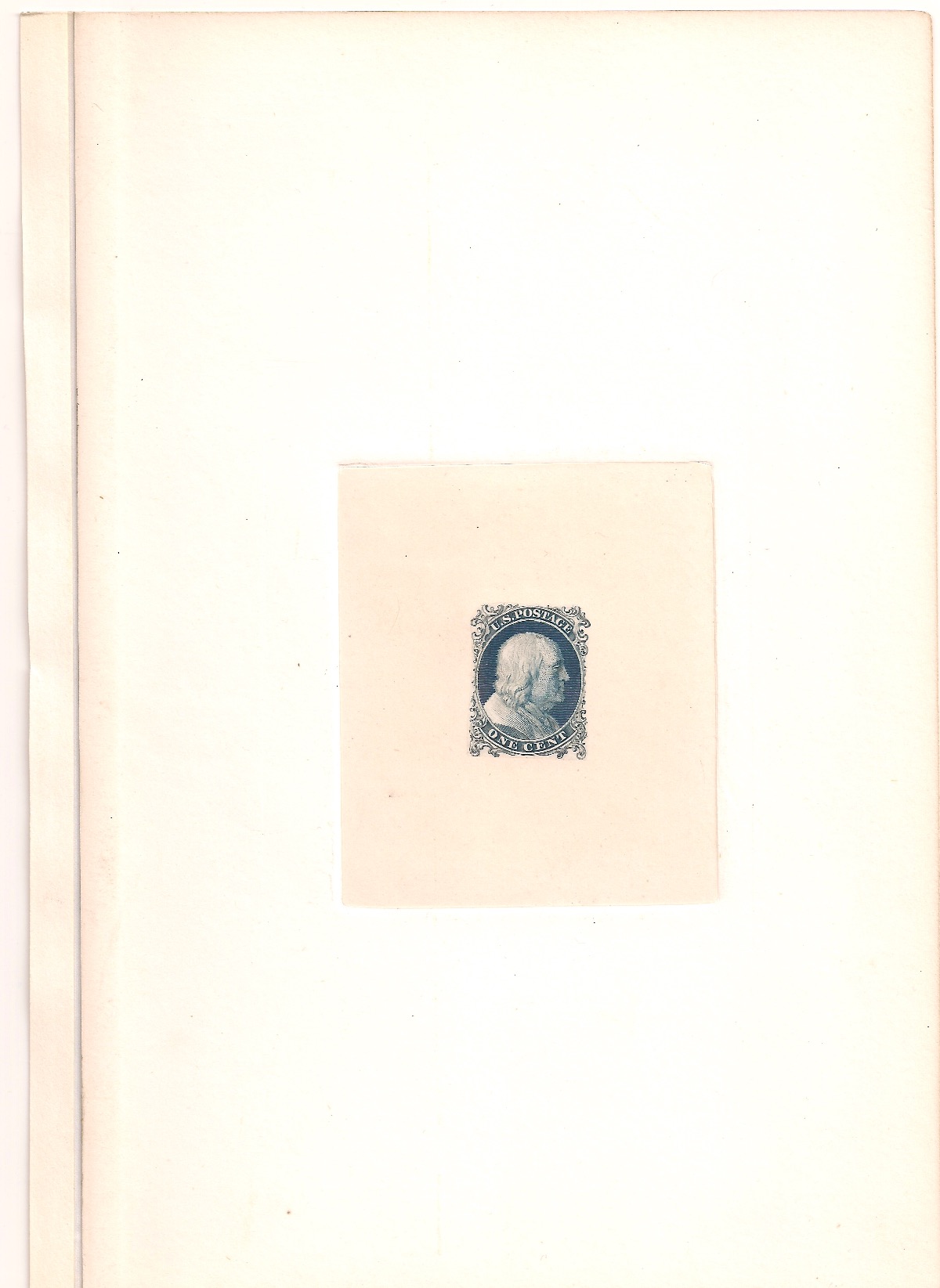 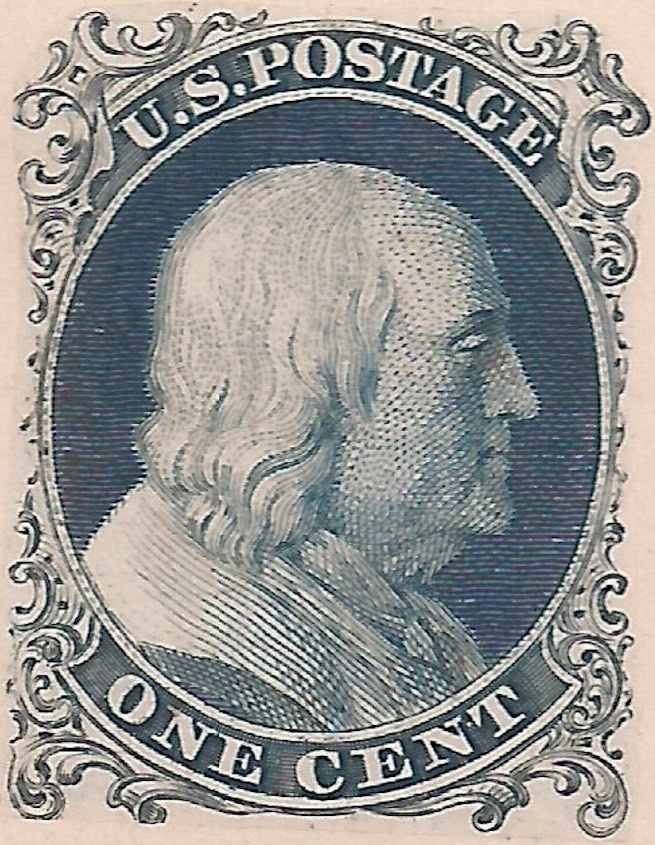 |
|
Send note to Staff
|
|
|
|
|
Pillar Of The Community
6366 Posts |
|
|
Pillar Of The Community
United States
3532 Posts |
|
|
Thank you John.
I asked Jim over the weekend, and he had no memory of the item.
I'm mostly unable to get a better picture/scan of this due to the faux 'die-sinkage'. It messes with the scanner, and my iPhone wont even focus properly on the right place to get a good shot of it that way either.
With my inability to produce a better picture of this, I'm going to a long-term plan, which will be to get a couple 40P3's over time - the 1c India proof reprints.
I want to carefully compare a stamp printed the same way (allegedly) on the same paper to this. I studied the black one a bit this weekend under my stamp-microscope, and looking at it on an angle, and I can't convince myself one way or the other yet if its line-engraved. Usually that's easy -- intaglio printing is raised, and it usually stands out when viewed with a glass at an angle.
That's certainly a red-flag to a possible fake, but I'm not at all sure of that yet. Face-on, this is a high-quality detailed proof-like printing. India paper is very fine, and thin - it produces quality printings.
What I'm wondering, however, is if, over time, the ink has flattened out a bit and is not as raised. It appears slightly raised, but not as much as I'd expect from a normal stamp. It could just be environmental issues over time -- I'm kind of leaning that way, or it could be a flat out fake. Eventually I'll get some comparison copies, form my own opinion, and if I think its legit, I'll send it to the PF someday. |
Send note to Staff 
|
|
|
Pillar Of The Community
United States
3532 Posts |
|
|
Reviving my old thread, I haven't done anything further on this subject, other than watch for another copy. I'm in no hurry. I noticed last week, that in today's Siegel sale, that they had what appeared to be a 1c black hybrid large die proof. Sale 1320, Lot 1027. Naturally, I was curious, so I emailed them and asked if, in fact, the 1c Franklin (40P1) was in fact, black as it appeared in the scan, and if so, was it in fact, a real stamp? The answer was that the stamp in fact, is "blue", and they made a new scan to prove it. I took a screenshot of just the 1c proof and posted it below. Doesn't look blue to me, and there are other blue proofs in that lot, that are clearly blue. So I don't know what to say, but I'll just log this one here to continue the saga that I already outlined. If anyone here bought that lot, kindly let me know if its really blue  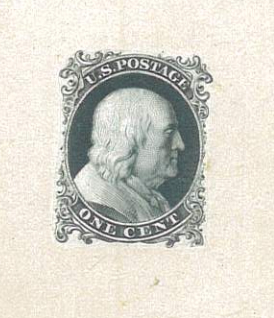 |
|
Send note to Staff
|
|
|
Pillar Of The Community
United States
3532 Posts |
|
|
A board member offline has, I believe, correctly set me straight on this item finally.
This proof, and the Siegel one, are pretty clearly just oxidized/sulfuretted and are/were blue but have turned black over time. I thought of this years ago, of course, as its an obvious consideration, but I dismissed it too quickly, since I've seen probably 10s of thousands of 1c stamps from the 1850s, and they mostly just don't turn black. I don't recall ever seeing a fully black 1c stamp from the 1850s. I've seen tons of 3c (blackish) stamps from that era, in fact many which I've treated myself with hydrogen peroxide and restored their color. So I'm very familiar with the issue(s), but it just isn't a typical issue for 1850s 1c stamps.
The minute I read the email to me about this, it hit me, that this is not an 1850s 1c stamp. It is a proof, from 20+ years later, with the following variables, which I failed to consider :
- different ink, from a different era
- proof/india paper, not stamp paper, and just different paper, period
- the card stock it is mounted on is probably very acidic
- clearly it was not well cared for (environmentally) as most proofs are well cared for
Anyway, at some point, I'll drop H2O2 on this and look for a blue proof to emerge, which I fully expect it will.
This was actually useful for me to help me think about overall conservation of proofs, vs the issued stamps. They are in fact, different critters somewhat. Overall, proofs tend to have great color, impression, etc, and a further fact, is that they tend to be better cared for over time. They are not issued stamps, so they don't go through the mail on an envelope and suffer environmental damage from that. They basically just get put in some album - probably acidic cardboard for mine. So I think all of that helps to contribute to the overall better preservation of most proofs over time. Clearly mine and the Siegel one, have suffered environmental damage over time.
This was actually a fun and useful exercise for me. At some point, I'll post when I give this a peroxide treatment.
[to the casual reader: don't put peroxide on your stamps unless you know what you are doing. Enough said]
edit: Thanks to the board member who let me know about this. Much appreciated. |
|
Send note to Staff
|
| Edited by txstamp - 04/24/2024 12:51 pm |
|
|
Valued Member
United States
81 Posts |
|
|
Hello txstamp, I read your thread with interest and thought you might be interested to see this... The blackish tinge of your proof reminded me of a 40P4 in my collection that's undergone a partial transition from blue to black, lending the appearance of a bi-color printing. The blackish tinge of your proof seems to be the same as in the example I've posted. I've had this proof since the mid-1990s and it used to live with two decidedly blue card proof companions on the same approval card for color comparison purposes. (Those companion P4s are long gone.) As for "hybrid" or "hybrid large die proof," IMO it's a questionable if not misleading term, though certainly a term of convenience. The Specialized Essay/Proof catalog explains what hybrids are, but doesn't include prices for many (if any) of them. It only says that they generally sell for less than original die proofs. In your photo of the isolated stamp above, I can see what appears to be the edges of the paper on which the stamp was printed, cut extremely close to the design. There's also what looks like a slight intrusion of the scissors on the lower scroll on the upper LH corner ornament. But from the larger view, it gives the appearance of a proper large die print. 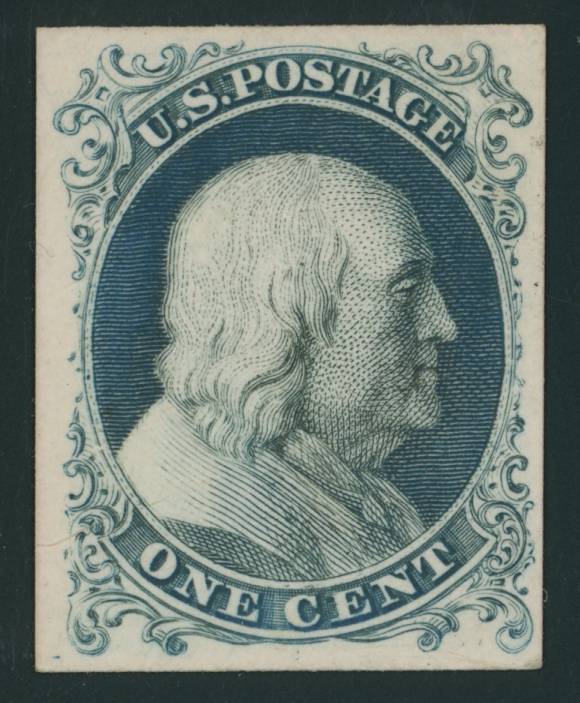 |
|
Send note to Staff
|
|
|
Pillar Of The Community
United States
3532 Posts |
|
|
Hi, welcome to the board, and thanks for the reply. Very interesting.
I agree that the use of Large Die Proof with the term Hybrid can give one pause as to what they really are. 40-47P1's are all Hybrids, and typically seem to be essentially P3's (India plate proofs) mounted on the salesman's sample cards. Occasionally I've seen P4's (card), but I've often wondered if those were real or manufactured later by people passing them off as these.
Regardless, these P1's in effect, are really not die proofs, but, instead are plate proofs from the reprint plates.
It is interesting, and in hindsight, not entirely surprising that they would have different aging effects due to differing inks, papers, not to mention the card stock that they are mounted on. It all makes sense to me now - I was just so focused in thinking one way that I couldn't see the forest for the trees, so to speak. Thanks, and welcome. |
|
Send note to Staff
|
|
|
Valued Member
United States
81 Posts |
|
|
Thanks for your reply and the welcome! Quote:
Occasionally I've seen P4's (card), but I've often wondered if those were real or manufactured later by people passing them off as these. Same here. |
|
Send note to Staff
|
|
|
Pillar Of The Community
United States
1946 Posts |
|
|
Thanks for showing this. I was not aware that blue/ultramarine would sulfite to black. I think you may have just cleared up a mystery that has bedeviled me on and off for most of a decade by now. 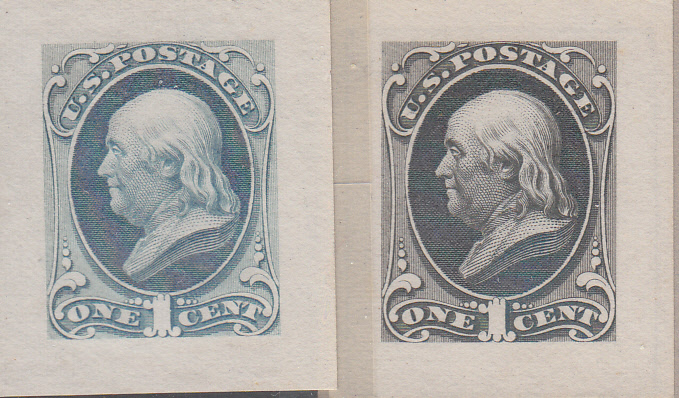 Both the items in this pic are Roosevelt small die proofs (145P2) The one on left has been removed from the card backing, the one on the right is still mounted to a reduced piece of the heavy stock gray page (cum backing). On close examination the layoutlines characteristic of the Roosevelt albums can be seen through the stamp paper for the item still on the gray backing.(on r). The horiz line visible on the left side of that item is from the mount surrounding the stamp on the left. The color change is so uniform that I have debated about whether this is an unlisted variety or some kind of changeling. Seeing your discussion of sulfiting of blue has put me in mind of that as an explanation for this changeling. I have seen the phenomenon on other colors, usually in an incomplete form. But the uniformity of the change on a color I did not associate with that prevented me from spotting it here. I'm glad I stopped by. |
|
Send note to Staff
|
|
|
Pillar Of The Community
United States
3532 Posts |
|
|
Very interesting. There is a good chance you are experiencing the same issue I did. My 1c proof is really black. It is "very" deceptive.  |
|
Send note to Staff
|
|
| |
Replies: 9 / Views: 1,888 |
|
|
To participate in the forum you must log in or register. | |
Disclaimer: While a tremendous amount of effort goes into ensuring the accuracy of the information contained in this site, Stamp Community assumes no liability for errors. Copyright 2005 - 2026 Stamp Community Family - All rights reserved worldwide. Use of any images or content on this website without prior written permission of Stamp Community or the original lender is strictly prohibited.
Privacy Policy / Terms of Use Advertise Here |
| Stamp Community Forum |
© 2007 - 2026 Stamp Community Forums |
| It took 0.32 seconds to lick this stamp. |
 |
|
|
|


 Posted 08/24/2018 9:09 pm


