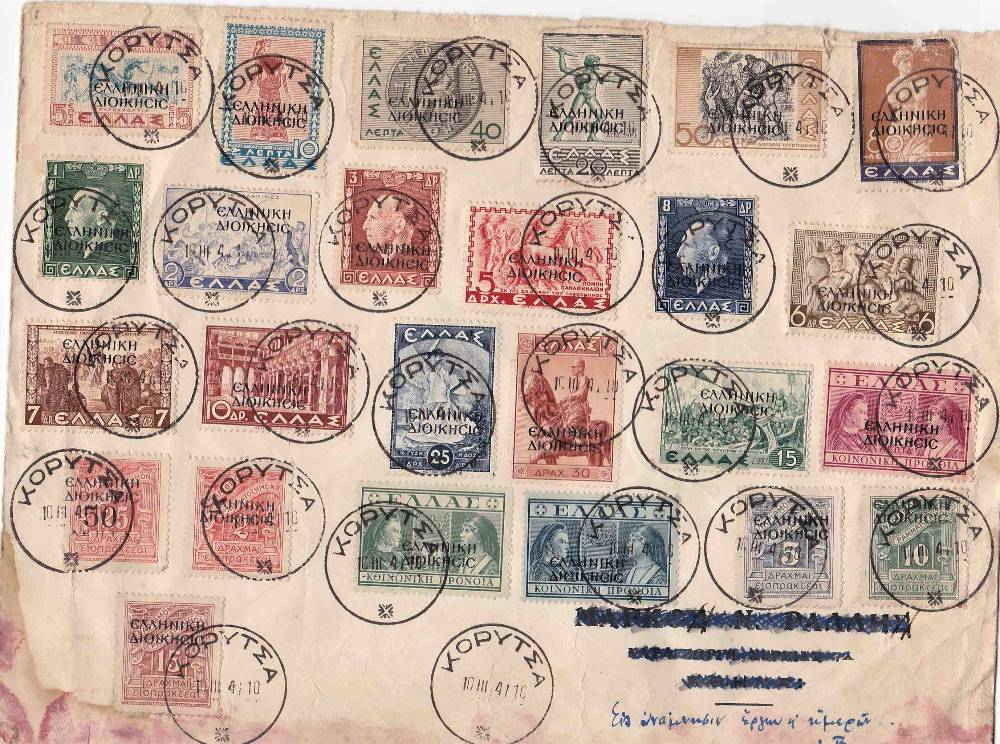
And, a quick internet search provides a quick history lesson and a possible explanation for the cover...
In the Spring of 1941 there was an Italian Offensive to take the areas along the Albanian/Greek border (including Korytsa). I found this passage describing the part of the offensive that took place on the date the cover was cancelled:
"The Italian attack, watched by Mussolini, began on 9 March, with a heavy artillery barrage and air bombardment; on the main sector, held by the Greek 1st Division, over 100,000 shells were dropped on a 6 km (3.7 mi) front. Despite repeated assaults and heavy shelling, the positions of 1st Division held during 9–10 March. A flanking manoeuvre on 11 March ended in Italian defeat. The exhausted Puglie Division was withdrawn and replaced with the Bari Division during the subsequent night, but all attacks until 15 March failed.[162] The Italian offensive halted on 16–18 March, allowing the Greeks to bring reserves forward and begin a gradual reshuffle their line, relieving the 1st Division with the 17th." Source:
https://wikivisually.com/wiki/Greco..._April_1941)It may be that whoever created the cover thought that with the ongoing attacks that area might fall to the Italians. Perhaps they created this philatelic cover on what might end up being the last day of Greek rule in Korytsa?
This is why I love stamp collecting - so much history packed into little pieces of paper...
Joe





 Posted 10/09/2018 12:53 pm