| Author |
 Replies: 16 / Views: 1,902 Replies: 16 / Views: 1,902 |
|
Rest in Peace
7742 Posts |
|
|
Hi guys So far I have gone through about 35,000 of the 77,000 O.H.M.S. stamps in my possession...Boring or not, here a few of the oddities I have came across..After I finish the pile, I will try to do a write up on what I have found and have it available in a PDF format for stamp collectors on this forum to download. Robert Regular Scott 0233F O.H.M.S. stamp 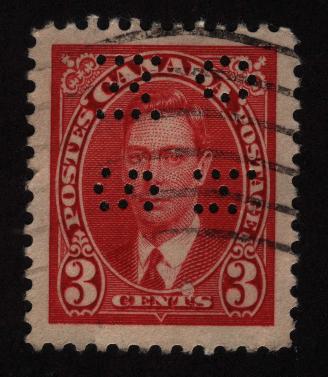 Broken pins and position as per BNAPS O.H.M.S. pin numbering. 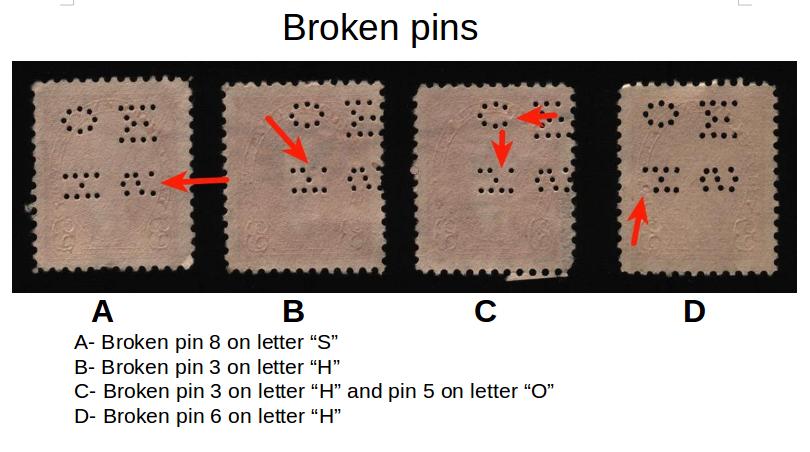 Extra pins in the O.H.M.S. procedure 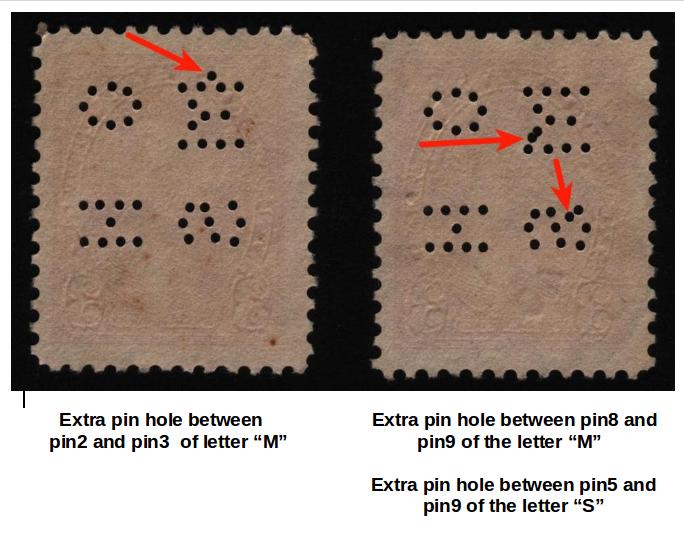 Odd way of separating stamps for use. 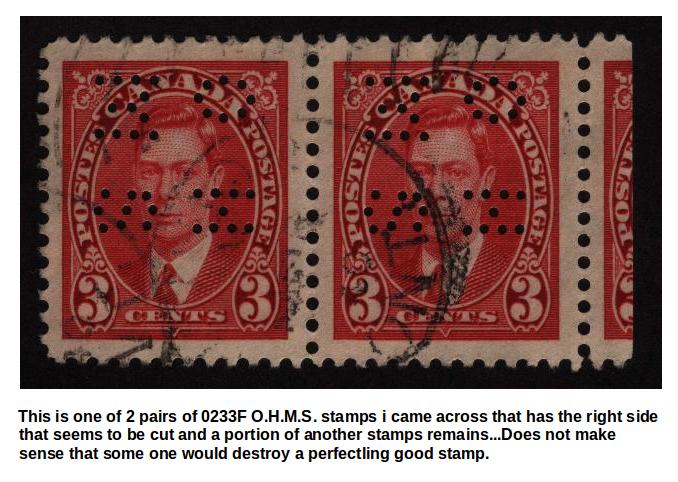 Here is a investigation into pin wheel placement and the lack of accuracy when doing so. 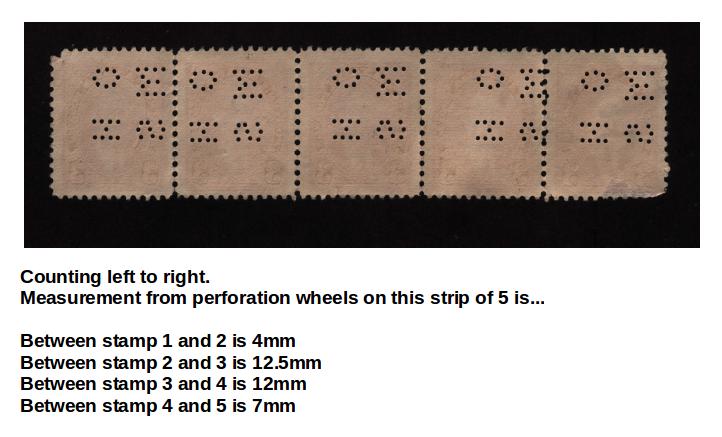 |
|
Send note to Staff
|
|
|
|
|
Pillar Of The Community
Canada
1647 Posts |
|
|
Robert, interesting stuff. Have often heard of missing pin punches, and 1,3,4,5 look pretty normal. But then it looks like the setting of the 2nd punch moved (to the left) causing a narrow space setting. Small variety?
Mike |
Send note to Staff 
|
| Edited by No1philatelist - 11/29/2018 9:01 pm |
|
|
Rest in Peace
7742 Posts |
|
|
No1philatelist...no, not considered a variety as such..Just interesting to collect.
Probably get anywhere from 2 to 7 broken pins every 1000 I look at.
Robert
|
|
Send note to Staff
|
| Edited by wert - 11/29/2018 9:37 pm |
|
|
Pillar Of The Community
Canada
1647 Posts |
|
|
Funny isn't it. Put an overprint on an early 1898 issue where it is close like this example and they call it narrow spacing. Find it on an ohms perfin and it is only an interest. To me it is still a variety, no matter what Scott or Unitrade says.
Then you get some constant shifted print (black lines) on the fisshing vessels issues and they call them varieties and put a higher price on them. To me they are not varieties and should be eliminated from the Unitrade catalogue. Just plain stupid attempt to overvalue stamps with nothing more than a mm print shift.
Mike |
|
Send note to Staff
|
|
|
Pillar Of The Community
Canada
1462 Posts |
|
|
Any measurable variation or deviation from the norm in a stamp is by definition a variety. That's what variety means, after all.
It's just that stamp authorities/publishers/experts have "uplifted" certain more significant variations to status of a variety. Of course choices, preference, bias, etc play a huge role in that, since we're all human. Which then brings official recognition from an "authoritative" source, and perhaps financial significance to that variation.
But there's nothing stopping anyone from calling any kind of variation a variety, of course. And collecting those. Or on the other hand, ignoring all varieties as inconsequential and collecting just 1 of each stamp. Whatever makes a collector happy... |
|
Send note to Staff
|
|
|
Moderator

United States
12330 Posts |
|
|
Quote:
Any measurable variation or deviation from the norm... And what is the 'norm'? How is that defined? Rather than defining a 'variety' the real exercise is to define the 'norm'. As technology increases, collectors are finding more 'varieties'; at what point is something no longer a variety but rather just a normal production run? Is a .000005 color shift special? Or is it .00005? Or .05? Where is the variation line drawn that makes a stamp 'unusual' or no longer representative of the overall production population? In my opinion, what makes a stamp 'special' would be something that typically would have been rejected during the production run/inspection as falling outside the normal production run tolerances (making them less common). If a company typically would reject a sheet with that variation but it slips through the inspections, then it becomes in my mind, something of note. Any decent production company (in any industry) has documented tolerances which they use to determine if the customer is going to accept/reject the product. What kind of supplier would leave this undefined? What kind of supplier would allow production floor people to simply make subjective decisions? Surely the approach would never have been, 'ship everything no matter how bad it is screwed up'. This begs the question 'how bad is bad' before a sheet of stamps would be rejected? Is a little ink smear ok to ship? Can you ship a sheet with a big fold-over? Yet over the last 4-5 decades I have yet to ever see inspection drawings or other documented evidence that stamp printers had tolerances noted. Has anyone ever seen or heard of such a thing? Don |
|
Send note to Staff
|
|
|
Bedrock Of The Community
12701 Posts |
|
|
It would be interesting to see the Government contracts technical specifications for the printing. If they are like other Government contracts they will be quite detailed. |
|
Send note to Staff
|
|
|
Rest in Peace
7742 Posts |
|
|
Quote:
Yet over the last 4-5 decades I have yet to ever see inspection drawings or other documented evidence that stamp printers had tolerances noted. When I used to do printing runs, I was the printer and also the proof reader at the same time...I believe it was left up to the printer at the time to say (what I hated hearing)..Its GOOD ENOUGH. Robert |
|
Send note to Staff
|
|
|
Pillar Of The Community
Canada
1462 Posts |
|
|
You've hit the nail on the head - defining the norm (normative standards) for a stamp, or any product, is the key.
Re printing, I used to do press approvals for an architecture/building product directory with many high-quality images. Obviously colour correctness/image sharpness were key for this printed product. We didn't have recorded tolerance levels, but closely "eye-balled" initial sheets for each page - against proof sheets and our own knowledge - before approving the run. And the press person would do an initial approval before even having us folks from the publisher look at the sheets. Time-consuming (many overnights on the printing floor) but crucial for quality. All this was a lot of effort but still much cheaper than having to do a recall, or having angry customers pull their business because we screwed up their images!
Nowadays, I imagine a large printer (such as government stamp printer) would have very sophisticated measurement tools (computer/optical laser) with programmed in tolerance levels. And would make sense for those to be contractually set. I would imagine visual checking is still done, but perhaps much less need for it now. |
|
Send note to Staff
|
|
|
Rest in Peace
7742 Posts |
|
|
Quote:
closely "eye-balled" initial sheets for each page Correct gmot...When I was a printer, colour, even print colour were high on the proofreaders list, but also centering..Must LOOK PLEASING and lots of other lessor important items when printing. Robert |
|
Send note to Staff
|
|
|
Moderator
United States
12330 Posts |
|
|
Quote:
...Nowadays, I imagine a large printer (such as government stamp printer) would have very sophisticated measurement tools (computer/optical laser) with programmed in tolerance levels. And would make sense for those to be contractually set. gmot, Agreed. Any quality business wants to avoid subjective decisions, inconsistent shipped product, and certainly any customer disputes. Where is the first place a dispute with a customer would go? 'Hey, this is not what we ordered'. Sending an approval proof over the fence before the first production run is obviously common, but inspection documents/drawing typically exist on both sides of the fence (suppler and customer) so that people can inspect outgoing and incoming shipments throughout the production run. This is any QA department works and certainly is required documentation for any company which tries to compile with an ISO certification. As a person who generated hundreds of these kinds of inspection documents and drawings, I can attest to their importance. And as you said, companies have sought to automate the inspection processes with technology. At my company, the electronic products we developed often also used our own custom injected molded enclosures. Having a inspector sit there with calipers, drawings, and a large sample on the incoming loading dock was an expensive process. The ROI on a 3D laser part comparator was easy to calculate. Simply place the part under the laser, it scans the part, compares it to the drawing dimensions, and automatically accepts or rejects the part. For a supplier delivering stamps, I would imagine that a number of inspection points would exist. One thing that really sticks out in my mind (as an engineer) is an adhesion specification. The customer (postal system) would never want to have stamps falling off in the field so somewhere there are specs for this criteria. This would be tested on any alpha/beta runs before cutting the final purchase order and then occasionally tested during the production run. I would think that the dimensions also have specified tolerances as well as perforations and colors. All of these things would need to be known and understood to be able to define the 'norm'. Don |
|
Send note to Staff
|
|
|
Rest in Peace
7742 Posts |
|
|
Here is your answer Don With all the misperfed stamps, colour variations, major re-entries, printed on gum side, wrong perfs or changed perfs on a stamp run, etc. I dought very much if there was any document related to stamp normalization...No consistently shipped product...I really DO NOT believe earlier stamps were payed attention to all that much.. Remember, bottom line..They were NOT printed for stamp collectors, they were printed by Canada Post to make MONEY..Bottom line. Robert |
|
Send note to Staff
|
|
|
Moderator
United States
12330 Posts |
|
|
Hi Robert,
A quick look at one of the current printers for the US postal system (Ashton Potter) shows they ISO 9001:2015 certified. The BEP (Bureau of Engraving and Printing) which has been US printing stamps since 1866, is also a ISO 9001:2015 company. You cannot be ISO certified without having the things I described in place. From the BEP website; "We understand that consistently high-quality products can only come from high-quality processes. High-quality products come from organizations that foster a culture in which systems and process refinement are valued. BEP has demonstrated its commitment to this culture by meeting the regulatory requirements and applying the system effectively."
The BEP did not decide to pay attention to quality and QA only in the few decades. It was renowned for its inspection criteria and services. (After all, they also printed the money.) Security was paramount, print quality was high, and inspection played a huge role in their processes. Postal systems did not seek out choose companies like American Bank Note because they were the cheapest or quickest printing solution. Remember, these are government agencies handing out very large government contracts. Stamps were indeed printing money.
We also know that quality requirements were lower for certain types of stamps. Postage Due are good example of an 'internally used' stamp which did not need to have higher quality standards like those being sold to the public. We also know that the First issue revenue stamps were pushed out the door due to overwhelming demand with 'less than ideal ' quality. Stamps which were supposed to be perforated were shipped without perforations or partly perforated yet as soon as they could they reinstituted the correct quality specifications. If quality did not matter to them they would have just shipped the out-of-specification stamps and saved time and money. So I think that they were quite aware of quality, quality assurance practices, and had inspection services.
Don
|
|
Send note to Staff
|
|
|
Rest in Peace
7742 Posts |
|
|
Hey Don ISO 9001..is a very critical process..I was involved bringing into a Major telecommunication company in Canada, ISO processes and what we told the people was if a phone rings and you turn around in your chair twice, make sure you turn twice..That is how critical ISO documentation was. I am not (could be wrong) aware that Canada Post had any type of process early (especially ISO9000-9001) in those years...Since I was trained by Rumbler-Braches out of the states in the 90's..So I wonder WHAT type of process was in place to ensure quality except just give us a quality product.Getting back to what I was posting about..Here is two Scott 0233E stamps..One with normal O.H.M.S. perforation and the one on the right with an inverted O.H.M.S. perforation 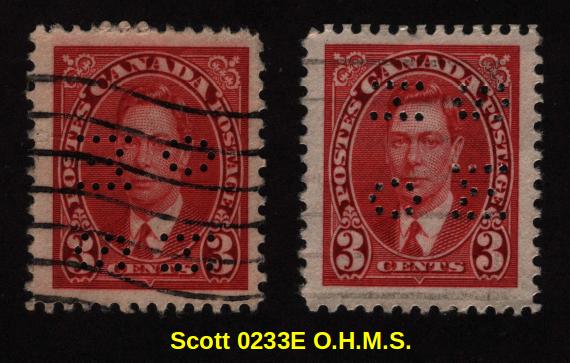 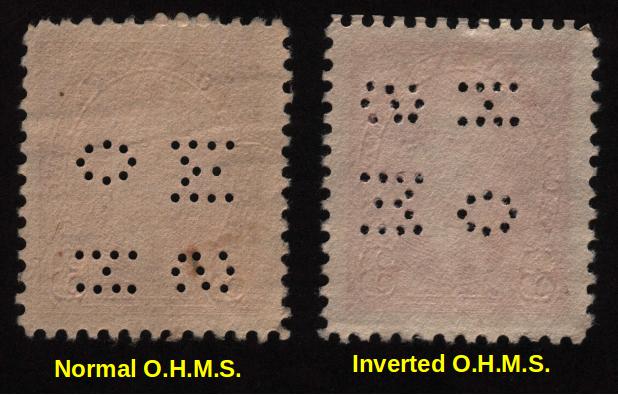 I have gone through 2000 E and F's and only found ONE inverted O.H.M.S. stamp..That is to say only 0.0005% of these stamps have inverted O.H.M.S....cool eh..? Robert |
|
Send note to Staff
|
| Edited by wert - 12/01/2018 5:45 pm |
|
|
Moderator
United States
12330 Posts |
|
|
Quote:
Hey Don
ISO 9001..is a very critical process..I was involved bringing into a Major telecommunication company in Canada, ISO processes and what we told the people was if a phone rings and you turn around in your chair twice, make sure you turn twice..That is how critical ISO documentation was. Put another way... 'Hey Don, I don't care about your experience with QA and ISO, it is all a bunch of crap'. |
|
Send note to Staff
|
|
|
Pillar Of The Community
Canada
1647 Posts |
|
|
Robert, Wow! I should have started a new thread titled printing varieties, or specifications! It kind of blew away the o.h.m.s. subject.
Anyway, since this thread is about O.H.M.S. perfins you mentioned the inverted perforation. I like to think outside the box and from a different perspective. To me the only difference was that the sheet was fed in 180° around. Still print side up.
Yea, now I see it, but I keep thinking reversed perforation where it is punched from the gum side up. Find any like that?
Mike |
|
Send note to Staff
|
| Edited by No1philatelist - 12/01/2018 10:32 pm |
|
|
Replies: 16 / Views: 1,902 |
|




 Posted 11/29/2018 5:01 pm


