| Author |
 Replies: 5 / Views: 1,010 Replies: 5 / Views: 1,010 |
|
|
Valued Member
United States
42 Posts |
|
|
Hi all, I wanted to send this out to the congregation, as I haven't seen this before yet, but am still new to this whole thing. This common 1 cent Franklin with plate number has an interesting back of the stamp: I think. It appears that the design for the previous plate block left an impression on this stamp, as you can see the plate block number on the back of this stamp and it doesn't appear to match what is was on the front exactly. Is this a rarity? I'm not sure how common sheet ink rubs off on another with older stamps like this one during printing, or what happened here exactly.. 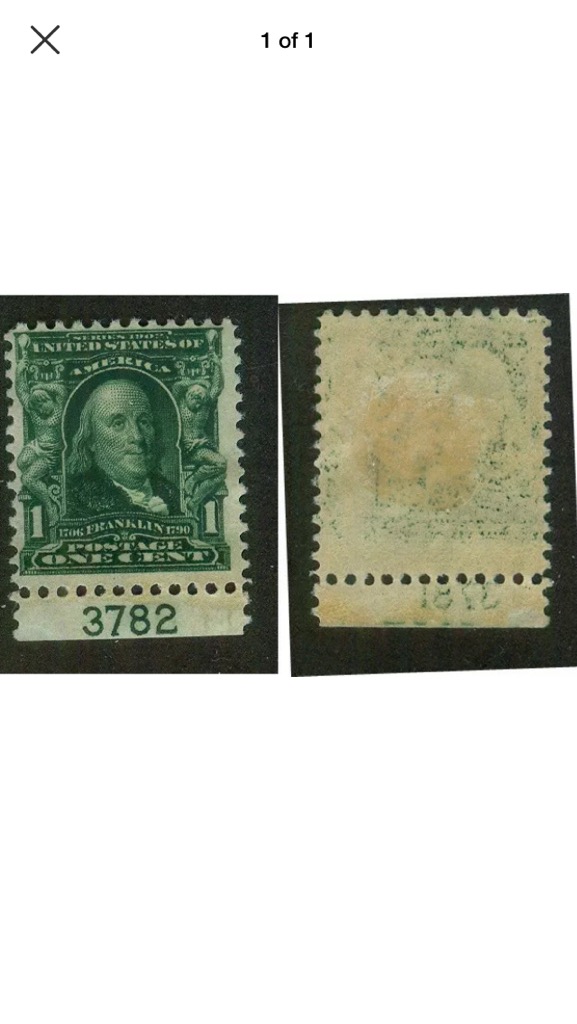 |
|
Send note to Staff
|
|
|
|
|
Bedrock Of The Community
Australia
38679 Posts |
|
|
Search this forum, type ....set off
Search in.....Subject only
Lots of juicy information.
|
Send note to Staff 
|
|
|
Pillar Of The Community
673 Posts |
|
|
Finn,
This is a "set-off". What you have is wet ink on a sheet, as another sheet lands on top of it. This is why your image is a "reverse image" from the front. What I love about this one is it's a plate # single, and the plate # of the sheet below it (3781) is visible! Just awesome.
But as you can imagine, this happens a lot when you print millions of sheets, and they all have to dry, so wet ink just gets applied to the sheet above it.
Nice #300. |
|
Send note to Staff
|
|
|
Pillar Of The Community
6363 Posts |
|
|
If I may interpret, the OP is specifically noting the DIFFERENCE in the two plate numbers. 3782 on the front, 3781 offset on the back. Beyond defining "setoff", he is seeking the technical details of how multiple plates were set up and arranged for cleaning, inking, wiping, and printing issues in this era. I seem to recall seeing this explained and illustrated for the Washington/Franklins in the Specialist some time ago. Fini32, does this capture your question? |
|
Send note to Staff
|
|
|
Valued Member
United States
42 Posts |
|
|
I think you guys all got to the heart of my question. Rod, thank you for the tip on searching for setoff:: I found a nice short article on stampsmarter about it. Thanks a lot ClassicPhil for explaining it: so does this mean that in flat plate printing when an indicator is often "flecks of ink on the back", does this then mean that ink came from another sheet that was stacked? I had always thought it was simply a bleedthrough. And yep John, I was noting both the difference in the design and the plate, so I think the next step from here is to investigate further into the technicalities of this process. Thanks for catching that! |
|
Send note to Staff
|
|
|
Pillar Of The Community
673 Posts |
|
|
Finn,
The setoff is caused by one sheet landing on top of another sheet during printing and with the flat plate, the ink is raised due to the engraving. So you can get anywhere from just a few dots to a near full-image (that almost always appears a bit washed-out). But your setoff of the 300 is one of the boldest I've seen, and particularly interesting with the plate # single below it from a different plate.
But, you can imagine, it's not 100% fool proof, because some sheets have to be "the first on the stack", which means they will not have ink from the sheet below them. (Either first sheet of the day, or perhaps the hopper gets full, and the sheets are pulled out, and a new "first sheet" hits the stack.
It is 100% most certainly NOT bleed through.
|
|
Send note to Staff
|
|
| |
Replies: 5 / Views: 1,010 |
|




 Posted 01/22/2019 9:32 pm


