| Author |
 Replies: 13 / Views: 1,383 Replies: 13 / Views: 1,383 |
|
|
Pillar Of The Community
673 Posts |
|
|
Hi All, The description of paper type for the Scott #1 and #2 is "Thin bluish wove paper". I was examining some under high magnification today, and discovered that there is a large amount of "blue dots" scatter throughout the paper, almost a bright Lapis color. Does anyone know what the blue dots are? (What material are they?) I've attached a 150x magnification of the surface from a #1, but I see the presence of the same blue dots in the #2 as well, which makes sense from the "bluish paper" comment, but I had not noticed just how intensely blue the small dots are before. 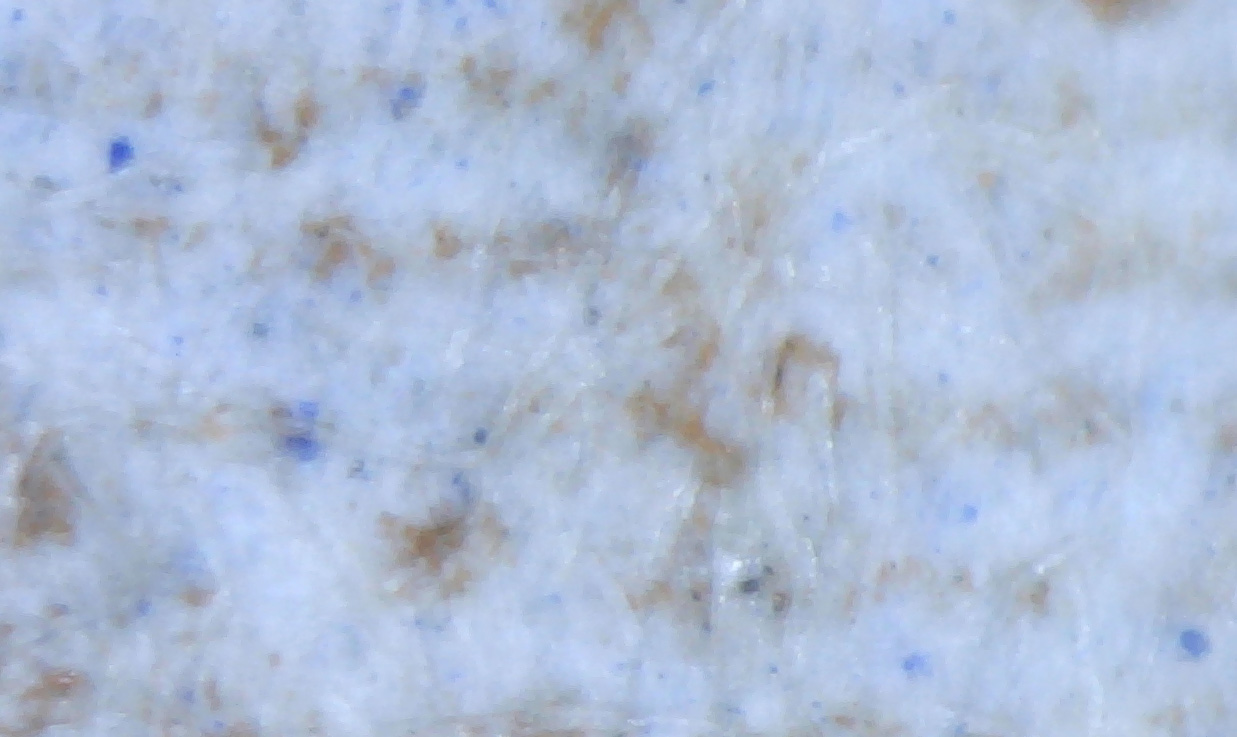 |
|
Send note to Staff
|
|
|
|
|
Valued Member
United States
283 Posts |
|
|
From the American Philatelist:
"(1847 issues)...were printed on thin wove, machine made, bluish paper. Similar paper was in general use at the time for letter sheets on which almost all correspondence was written. The paper was intentionally tinted by the use of ultramarine pigment in the manufacture, the ultramarine at the time being made from lapis lazuli. |
Send note to Staff 
|
|
|
Pillar Of The Community
673 Posts |
|
|
So that is why it holds its color so well, and looks like Lapis! (Because it is!)
I was really surprised when these stood out so boldly under magnification.
I wonder what the purpose of the pigment was... simply to give the paper a blue look? |
|
Send note to Staff
|
|
|
Valued Member
213 Posts |
|
|
There are two kinds of paper, gray and gray-blue. A weak, or diluted blue textile die was used. I have numerious letters to and from paper mills on the subject of textile die. Since the paper was hand-made, the die was not always evenly mixed in the vat. Thus, some papers had a darker appearing blue color, while many others have very little or no bluish color at all.
This kind of paper used linen rags from London, and these were poor-grade die-colored variety (i.e. colored rags) since Parliament decreed they were the only variety permitted for export. Even after chemical washing, these rags retained a tell-tale gray color. Manufacturers as Willcox used blue or rose-colored textile die to mask the appearance. Then, in 1845 the Italian States opened up the port of Liverno (aka Leghorn) for exports. Soon thereafter the New York rag market offered the imported linen (Leghorn) rags of beautiful white color.
It's an interesting fact that the 1847 issue was printed on obsolete papers. The Government had asked for a paper of distinguishing characteristics (e.g. watermarked), but had not provided any detailed specifications. The printer thus decided the old stock of grey paper would fit the bill nicely. Thereafter, U.S. stamps did not begin the use of paper made from Leghorn rags until the 1851 issue. |
|
Send note to Staff
|
| Edited by AJ Valente - 01/28/2019 08:32 am |
|
|
Pillar Of The Community
United States
1125 Posts |
|
|
Pillar Of The Community
1375 Posts |
|
|
Was there a similar approach when testing the so called "bluish paper" (with grayish cast which was due to the bluing, less to the rag content) in the Washington-Franklins? I search for years now for an good image of such a bluish paper stamp under microscope and didn't find one. So I find this thread interesting at least from the perspective to see the bluing (ultramarine pigment from lapis lazuli), although it's from another stamp. But my guess is that in the Washington-Franklins the bluing pigment elements are much smaller and not good to catch on an image file. |
|
Send note to Staff
|
|
|
Valued Member
United States
283 Posts |
|
|
An interesting side note for the tinting of the 1860's issues (from above USPCS article, subject 'Papers of the 1860's Stamps') -
"In 1860, domestic cotton rags made up 70% of the raw material used for paper, largely from cotton mills. There was apparently a rodent problem in the paper mill supplying the 1861 paper in the Spring or Summer of 1863, as the mill used arsenic as a rodenticide, which got into the water and resulted in arsenic getting into the stamp paper and causing the ultramarine shades to darken, creating the dark blue and indigo shades known immediately after." |
|
Send note to Staff
|
| Edited by craigk - 01/28/2019 09:48 am |
|
|
Valued Member
213 Posts |
|
|
Sorry to say, but Hahn's article is obsolete and the "Papers of the 1860's Stamps" article is a gross misrepresentation of the facts. Arsenic was not commercially available until the 1890s. Paper mills of the 1860s did not have a rodent problem, at least there are no contemporary accounts of such. See https://en.wikipedia.org/wiki/ArsenicStamperix; Your talking apples and oranges. If you want to see examples of early to mid-19th century gray paper, check with your favorite numismatic dealer and ask to see some gray or gray blue currency notes of the early 1840s. If you want to find examples of early 19th century blue tablet or writing paper, see your favorite postal history dealer. Most of the kind you are looking for will have a watermark saying "40 percent rag" or some such thing. |
|
Send note to Staff
|
|
|
Pillar Of The Community
United States
1873 Posts |
|
|
Quote:
in 1845 the Italian States opened up the port of Liverno (aka Leghorn) for exports The correct spelling is Livorno ... I mention this just to ensure that future keyword-based searches will find this thread. |
|
Send note to Staff
|
|
|
Valued Member
United States
283 Posts |
|
|
Traced the Am Phila excerpt to an old issue of 'The Philatelic Gazette' from 1916. The paper/lapis connection is found on page 204. Great magazine. Chase talks of his attempts to plate the 5 cent 1847 issue, p 202. Also, Chase's extensive grill research of the 1869 issues - page 6 https://books.google.com/books?id=h...ge&q&f=false |
|
Send note to Staff
|
|
|
Valued Member
213 Posts |
|
|
CH, my apologies.
Craig, thanks for that.
Dr. Chase was one of the very few philatelists who took a technical view of paper. Unfortunately, very little was known about paper at that time. Here (p.204) he writes "Similar paper was in very general use at this time for letter sheets on which almost all letters were written, . . ." So, Chase anticipates that stamp and stationery paper were one in the same, yet nothing could be further from the truth. The colored stationery paper of the period Chase refers to is a solid blue, not blueish. The reason for this is the color compounds used with machine-made stationery paper were used sufficient in quantity to turn the pulp a solid blue (or other color of choice).
The 1847 issue stamps were printed on print paper, not stationery paper. The qualities of the two vary widely, but would take too long to explain here. The papers of the 1847 issue were hand-made, and the reason for rather faint and irregular color pattern goes back to the early part of the century when hand mills gradually introduced color into paper. As Dr. Hunter explains in his book "Papermaking," if you visit the tavern nearest the paper mill the man with the reddish arms up to his elbows is instantly recognized as the vat man. The vat man was the most senior and highest paid employee of the mill, and had his hands and arms almost continuously immersed in the vat (a very bad case of dishpan hands). Naturally, this was a sensitive subject, and so when die color was introduced the vat man made sure that it was used sparingly so as not to turn his arms blue (or red, green, etc.). Thus, the colors of hand-made paper are notably feint, not at all as strong and solid as in machine-made paper.
|
|
Send note to Staff
|
|
|
Valued Member
213 Posts |
|
|
I wanted to amend my remarks with some illustrations for those of you who are interested. Below is a rare type of handmade paper called "double dipped." Owen & Hurlbut were among the top ten paper-makers of this era, and this was their top-of-the line stationery paper. To produce this type the mill used two vats, one with blueish pulp and the other with white pulp. The mold is dipped into one, and then the other. This creates a two-sided paper where one side is blueish and the other white. It should also be noted that this was the only kind of blueish handmade paper produced by the South Lee Mill. (continued) 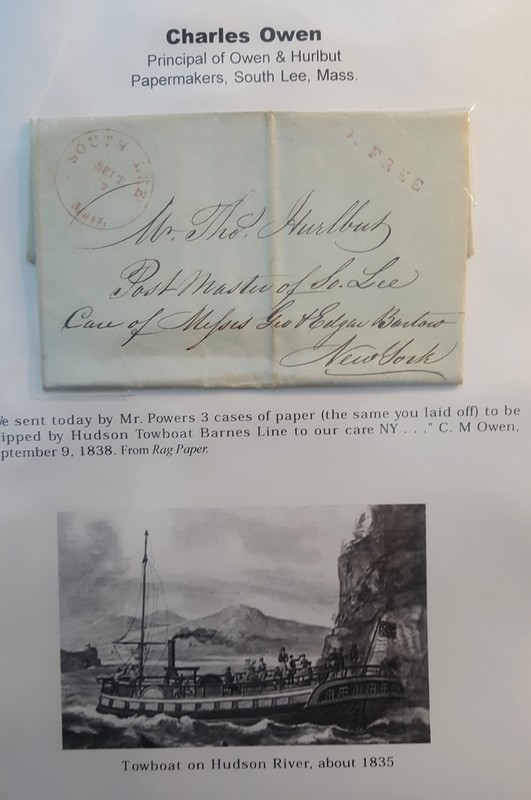 |
|
Send note to Staff
|
|
|
Valued Member
213 Posts |
|
|
Now, fast-forward a few years. Owen & Hurlbut closed their hand mill in 1840 since it couldn't compete on price with the flood of machine-made paper appearing on the market. Owen & Hurlbut had set-up a new paper machine and proceeded to reclaim their market share. Some rare strips of this machine-made paper from salesman sample book survive, and the one shown here (at top) is described a blue cap (short for foolscap) dated 11/44 (red underline mine). Note the pale blueish color. Owen & Hurlbut's engineer evidently continued to use the same blue compound as previously found on their hand-made paper (see prior post). Directly below the sample strip is a letter-sheet posted in Baltimore in 1846. The same is identified by Owen & Hurlbut's embossed stamp at top left. Note the difference is color and color depth. This implies that sometime during 1845-46 Owen & Hurlbut changed suppliers and went in for the latest color treatment. 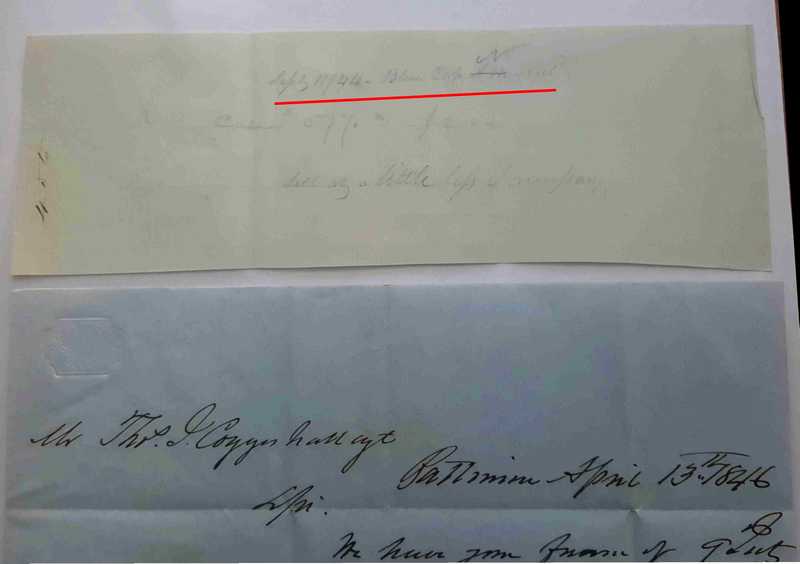 |
|
Send note to Staff
|
|
|
Valued Member
213 Posts |
|
|
I won't say much more other than every paper mill was different in how and when they embraced technological advances. Most of the color compounds used by paper mills in the 1840s and later came from Europe, specifically Germany where the chemical industry was most advanced.
If one looks at postal history from the 1830s it becomes obvious that the colors are much paler than those from the mid-1840s. |
|
Send note to Staff
|
|
| |
Replies: 13 / Views: 1,383 |
|




 Posted 01/27/2019 1:57 pm


