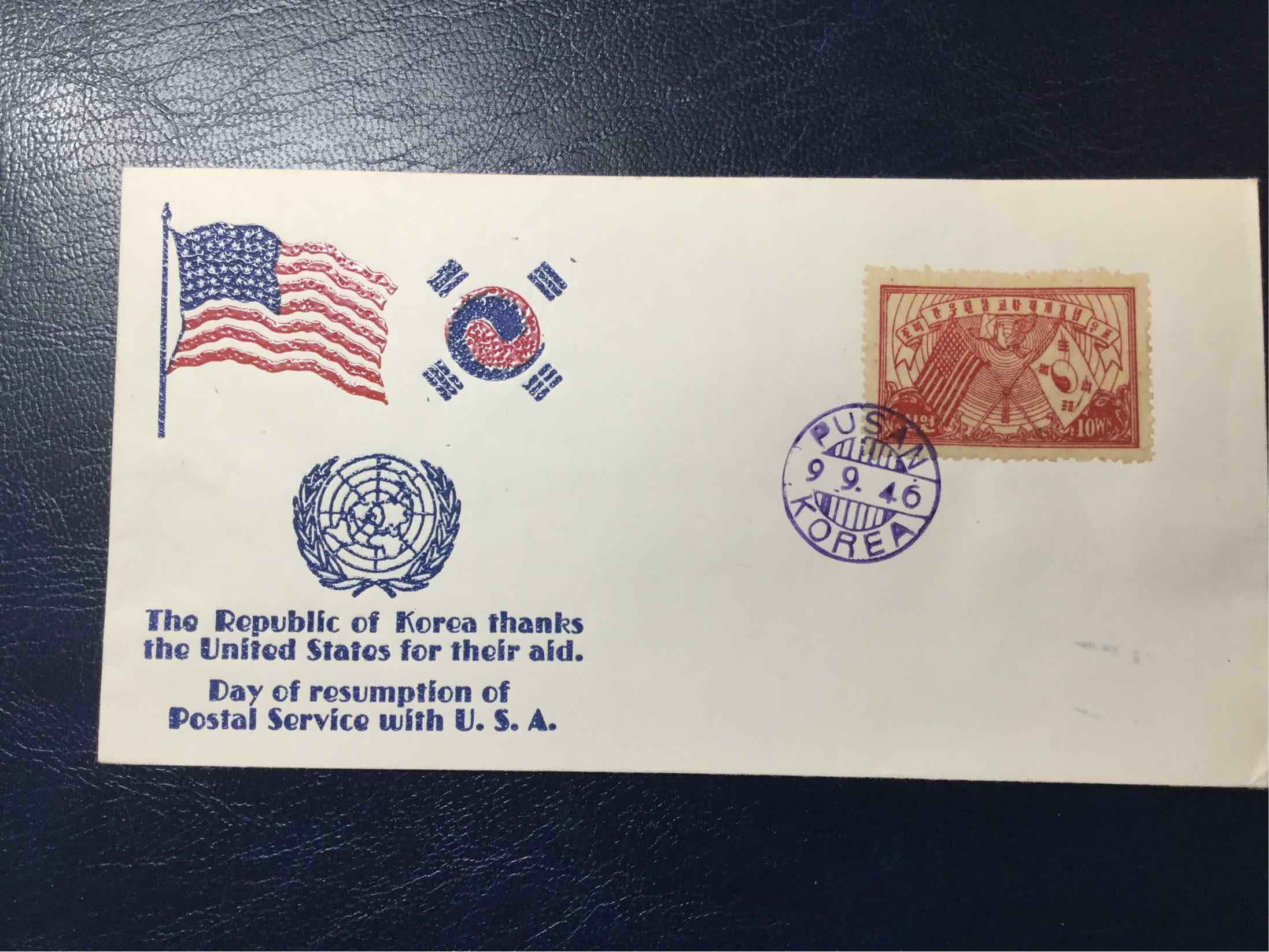
There were 300,000 stamps issued (sheets of 100) by the ROK on 9 September 1946 under the U.S. Military Government administration of the Korean Post Office. This is the second commemorative issue of the ROK after the forty-year occupation of Korea from 1905 thru 1945, when only Japanese stamps and postal stationary were available for purchase and use.
The first issue by the U.S. Military Government (surcharged Japanese stamps) was 1 February 1946. Records of First Day Covers were not kept, however quantities were quite small. The thermography on this cover was applied after the FDC was applied. The thermography was done in the U.S., sometime after the FDC was issued. There were several hand stamp black-ink cachets created by American G.I.s for early ROK issues, between 1946-1952, but I don't remember if there is one for this issue. A genuine FDC would would have no cachet. I would estimate less than 5,000 first day covers exist, probably less and here's why.
First, the division of Korea began at the end of WWII (August 15, 1945.) As the country was being divided, families were fleeing in both directions across the 48th parallel. By the end of WWII, Korea was the second most industrialized nation in Asia, while Japan was the first. Korea was Japan's colonial state – more like slave state to Japan, for the forty years of occupation. The majority of the Korean population, at that time, was extremely poor.
With the division of the country between Russia and the United States, the Communists wanted the North, where the gold, uranium, tungsten, graphite (over 200 mineral types) mines were located; the Americans wanted the South, where the Japanese-industries and "agri-rich" rice-belt was located.
Few of the locals could afford to collect stamps post WWII. The stamp collectors in South Korea were the in the American troops and that collecting group would expand to collectors among the U.N. Forces and contractors in Korea during and after the Korean conflict. Your Pusan FDC was probably created and produced by an American soldier in Pusan after he returned home. I have an idea the creator of your cover was an ex-GI/US Korea dealer named Howard Maxcy - but I may be wrong. However, there was no official FDC cachet.
Postal records, prior to 1953, are extremely scarce due to the ravages of the Korean War. The Republic of Korea, Ministry of Communications, located in Seoul, was overrun, looted and virtually destroyed when North Korean forces invaded the South on June 25, 1950. General Macarthur, leader of the American liberation forces, recaptured Seoul in about two weeks, but by then the damage was done.
When the DPRK Army retreated from Seoul, they left little of value behind. DPRK forces "liberated" any currency they found in banks plus every stamp and postal card from the Ministry of Communications and from every Postal/Telegraph Office. This resulted in the ROK issuing new stamps and currency. The new stamps were the Overprinted Third Definitive Issue in the new currency.
The ROK stamps & postal stationary "liberated" were overprinted and postally used by the DPRK; these are truly modern postal history rarities – if you can find one!
Best,
Hal
Past Director, Korea Stamp Society, Inc.
Past Member, Korea Stamp Society Expert Committee
Past Publisher, "KOREAN PHILATELY" |





 Posted 02/19/2019 8:25 pm