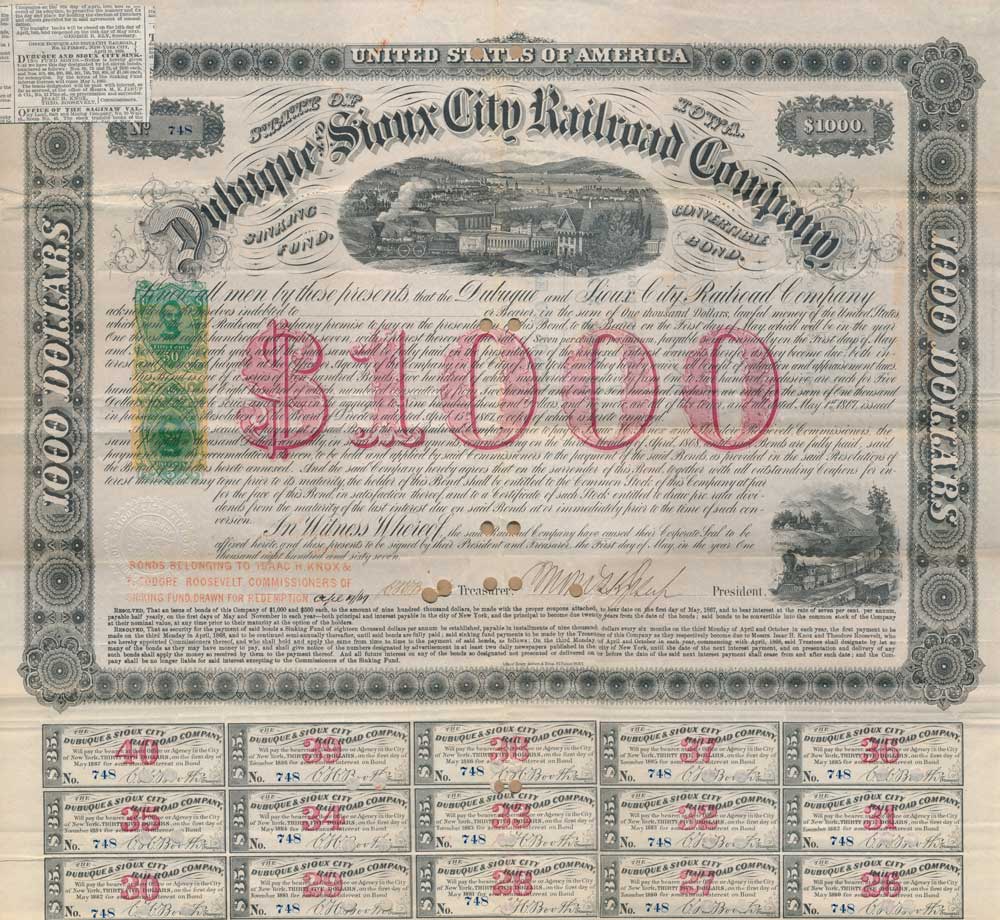
Last night I promised to post a revenue item I found in a "junk" box lot I purchased at auction last October. Interestingly this is on Ron Lesher's list of The Greatest Revenues", at least the $500 bond is. I'll let him explain the story from his column in the March 2008 issue of The American Stamp Dealer and Collector":
Quote:
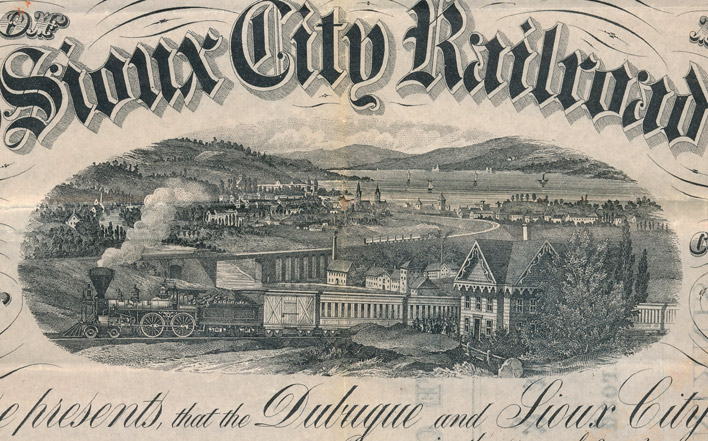
The story of the Dubuque & Sioux City Rail Road bonds is also quite fascinating from a philatelic point of view. Two denominations of bonds, $500 and $1000, were printed by Henry Seibert & Brothers in 1867. They were then forwarded to the American Phototype Company for imprinting. They were initially imprinted with 50¢ and $1.00 stamps, the rate that one would expect if these were mortgage bonds. But that was not the case. These were almost a simple promise to pay with no pledge of the property and rolling stock of the company pledged as collateral for the bonds.
These were what we would today call junk bonds, or nearly so. The Dubuque & Sioux City Rail Road pledged to set aside $18,000 per year in two installments to be placed in a sinking fund. These were also convertible into stock of the same rai I road. The advantage for the investor was that if the company was financially successful and the stock of the company appreciated in value, these bonds could be used to purchase an ownership share of the company.
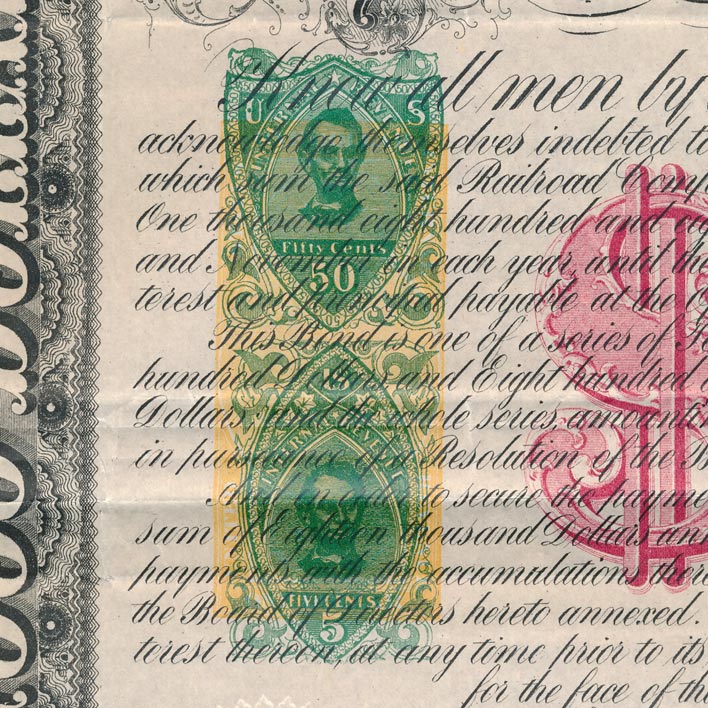
At what point it was discovered that these bonds were improperly stamped is not known. The fact that they are dated May I, 1867 suggests that they may have been imprinted by the American Phototype Company before it was required that all new imprinting work had to be approved by the Bureau of Internal Revenue in Washington (April 15, 1867). Unsecured debt was to be taxed as a promissory note, i.e., at the rate of 5¢ per $100 of face value. Thus they should have been taxed at 25¢ and 50¢ respectively.
The agreement that they could be converted at any time into stock of the company required an additional tax of 5¢. The $500 bond was imprinted with a 25¢ stamp and a 5¢ stamp in green, obliterating the original 50¢ orange imprinted stamp. Similarly, the $1000 bond was imprinted with 50¢ and 5¢ stamps in green obliterating the underlying $1.00 imprint. The Dubuque & Sioux City Rail Road bonds are the only ones known to the author that show evidence that an error in imprinting had been caught and subsequently corrected. They are the only examples of the higher denominations that were printed in green. The $500 bonds are quite scarce, only six examples having been recorded in collections.
The provenance of the Dubuque & Sioux City Rail Road bonds is also quite interesting. Two of the bonds were in the estate sale of the collection of the late Samuel Smith (Ivy & Mader, December 11-12, 2001 ), who certainly deserves the credit for resurrecting the collecting and study of revenue stamped paper for his series of articles on stamped paper that appeared in The Bureau Specialist and later in The American Revenuer in the early and mid-1970's.
Smith personally related to me the origin of the find, a box of revenue stamped paper in the legendary Weill brothers stock. This certainly contained the collection of Hiram Deats, who teamed with E. B. Sterling, a Trenton, N. J. stamp dealer,to produce the first listing of revenue stamped paper in the 1880s. It seems likely that all six of the currently known examples originated in the Deats collection that was at one point in the stock of the Philadelphia dealer Phillip Ward, before passing to the Weill brothers.
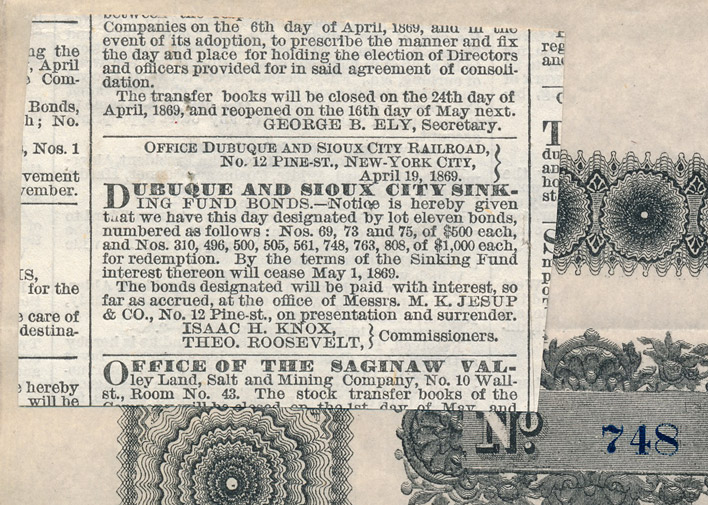
I have no idea where this item came from, but the presence of the newspaper clipping that came with the bond may be a clue that it didn't originate with the source mentioned above. I have no idea of it's current value as the only other $1000 bond of this type I could find was from a 2009 Spink Sale 111 where one sold for $900.
Anyway, it's happily joined my half-dozen other RN stamped RR bonds.





 Posted 03/10/2019 10:25 pm




