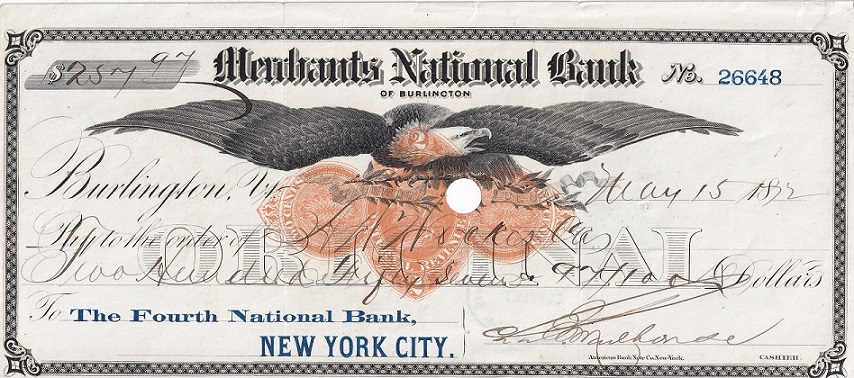
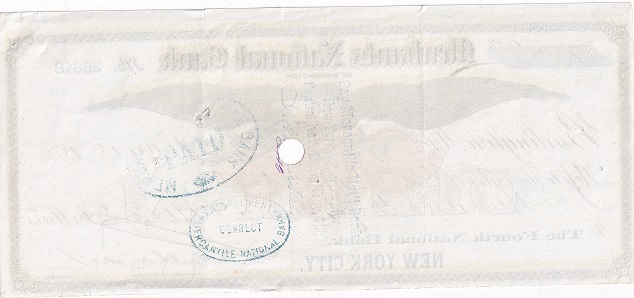
Haven't seen this before. Anyone know why the word Original would be pre-printed on this check? Have other old checks but none have the word Original on them.
The check was marked original because there was a second check marked duplicate (and in some cases even a triplicate). The issuer would send the checks by different routes and the first to be presented at the bank would be paid. Thus the check was marked original so the clerk would know to look and make sure the copy marked "duplicate" had not already been paid. Duplicate checks were more common in long-distance transactions where there could be mail disruptions. For example someone in San Francisco in the 1850s might issue duplicate checks and send one check by ship via Panama and one check by overland mail.
This is a cashier's check and not a bill of exchange. Yes, bills of exchange were issued in sets of 2, 3, or 4. I have never seen a cashier's check issued in sets and I have never seen a duplicate of this check from Vt. On bills of exchange the original has the added phrase Duplicate Unpaid, often in parentheses. The Duplicates have the added phrase Original Unpaid, again often in parentheses. It seems unlikely that two cashier's checks going from Vermont for payment in New York City would have sent. Possibly Original added because they kept a duplicate in the bank, but I have not seen such a practice. Each would have been subject to the 2¢ federal tax on checks, seemingly an unnecessary practice for a bank, which would have been conscious of superfluous costs.
The check does appear distinctly different than other checks I've seen. It has a quality to it that sets it apart from others in my small collection. I suspect it may be a bank issued Cashier's Check but have no basis for that opinion other than your post.
I found the suggestion that this check may have been issued in duplicate a challenge. I was under the mistaken belief that carbon copies were a 20th Century innovation. Again, no basis for that opinion. Decided to research that topic online and found information suggesting it was an Italian invention dating back to 1806 and became common use among business around 1870:
"It became common practice for businesses to compose every outgoing form in triplicate, using two sheets of carbon paper to create three copies. Soon, retailers found it convenient to create instant copies of receipts, invoices, money orders, checks, and other financial records. For more than 80 years, carbon paper was the cheapest and most essential tool for making copies."
In this hobby knowledge is cumulative. I don't know if a single lifetime is long enough to learn all that is relative to this hobby. Thank you all for your help.
Disclaimer: While a tremendous amount of effort goes into ensuring the accuracy of the information contained in this site, Stamp Community assumes no liability for errors. Copyright 2005 - 2026 Stamp Community Family - All rights reserved worldwide. Use of any images or content on this website without prior written permission of Stamp Community or the original lender is strictly prohibited. Privacy Policy / Terms of UseAdvertise Here





 Posted 03/17/2019 12:34 pm