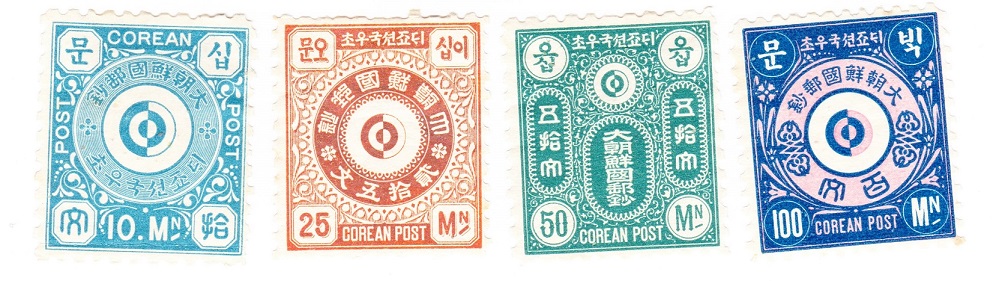
I was going to put these very attractive Korean stamps in Big Blue, which has spaces for them even though some were never issued. Scott notes that reprints and counterfeits exist. But how can I tell if they are real or reprints? Thanks! - Troy
Detail on the reprints: Originals are on slightly grayish/off-white paper. The reprints are easiy told because they have a wavy line watermark. In addition, they are on bright white paper with clear semi-matte gum. Note the difference between the margins of yours (which look genuine from here) and the large margins of the ones shown in the presentation album in the link.
Your items are genuine and not counterfeits. And here is some additional information. The 5 Mon & 10 Mon issues comes in the following perforations: 8-1/2; 8-1/2 x 9; 9 x 8-1/2; 9 x 8-3/4; 9 x 9; 9 x 9-1/2; 9-1/2; 9-1/2 x 10; 10x9-1/2; 10; & 11. The 25 Mon, 50 Mon & 100 Mon comes in the following perforations: 8-1/2; 8-1/2 x 9; 9 x 8-1/2; 9 x 8-3/4; 9 x 9; 9 x 9-1/2 & 9-1/2 & 9 (25M only) ; 9-1/2; 9-1/2 x 10; 10x9-1/2; 10; 11 (25m & 50m only)
Perf 11 of the 5 Mon and 10 Mon are reprints issued in 1905 to fill the Gray cloth with ribbon and 1910 Navy cloth with ribbon Official Government Souvenir Ministry of Communications' Books. The 1905 gray cloth was a limited edition "presentation book" that included the 1905 Japanese/Korea Amalgamation Issue page. The Books were numbered and were an edition of 500. The 1910 Issue was Navy cloth. These stamps were printed by the Stamp Bureau, Japanese Finance Dept., Tokyo, Japan and perforated in Japan. Dies for the issues were completed in Tokyo on August 9, 1884 and printing commenced 8 December 1884.
Only the First two stamps were issued and saw a usage for a period of less under two days when the first Post Office of Korea was destroyed by the Japanese during a coup d'état (Gapsin coup), was attempted on December 4, 1884, seeing the first Postmaster of Korea murdered, in the prolonged power struggle by the Japanese to rest influence of the Chinese and gain a foothold in Korea.
The three unissued values (25M, 50M & 100M) were reported held in Yokohama by the German "contractor" P. von Mollendorf, prominent in Korean affairs, who sold this stock after the Japanese annexation of Korea in 1905.
PLEASE NOTE: 1. The Value of the stamp is "Mon" not "Mun". 2. Forgeries of the Korean First Issues, and others. Please do not assume all forgeries were done by Kamagata. Other forgers of Korea Empire stamps, cancellations and overprints include: Wada, Kuriowa, and a few others.
Disclaimer: While a tremendous amount of effort goes into ensuring the accuracy of the information contained in this site, Stamp Community assumes no liability for errors. Copyright 2005 - 2026 Stamp Community Family - All rights reserved worldwide. Use of any images or content on this website without prior written permission of Stamp Community or the original lender is strictly prohibited. Privacy Policy / Terms of UseAdvertise Here





 Posted 03/22/2019 10:50 am